


Wydawcy
Katalog tematyczny
- Archeologia (109)
- Ekonomia, finanse, business (13704)
- Filozofia (1445)
- Historia (3040)
- Języki i językoznawstwo (2356)
- Lifestyle, hobby i rozrywka (475)
- Medycyna (9704)
- Nauki humanistyczne (4)
- Nauki o Ziemi i środowisku (2638)
- Nauki ścisłe (20412)
- Nauki społeczne (8486)
- Nauki techniczne (13450)
- Budownictwo lądowe (1045)
- Chemia przemysłowa (2258)
- Elektronika i telekomunikacja (3287)
- Energetyka (1122)
- Inne nauki stosowane (363)
- Inżynieria biochemiczna (507)
- Inżynieria transportu (232)
- Mechanika i materiały (3316)
- Nauka o środowisku (321)
- Rolnictwo (507)
- Technika, ogólnie (475)
- Prawo (1696)
- Publikacje informacyjne i interdyscyplinarne (1288)
- Religia i wierzenia (917)
- Technika komputerowa (4067)
- Zdrowie, relacje międzyludzkie i rozwój osobisty (657)





Informacje szczegółowe o książce
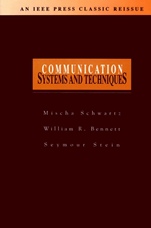
Communication Systems and Techniques
ISBN 9780780347151
Autor: Mischa Schwartz, William R. Bennett, Seymour Stein
Wydawca: Wiley
Dostępność: 3-6 tygodni
Cena: 811,65 zł
Przed złożeniem zamówienia prosimy o kontakt mailowy celem potwierdzenia ceny.
ISBN13: |
9780780347151 |
ISBN10: |
0780347153 |
Autor: |
Mischa Schwartz, William R. Bennett, Seymour Stein |
Oprawa: |
Paperback |
Rok Wydania: |
1995-11-08 |
Ilość stron: |
636 |
Wymiary: |
227x162 |
Tematy: |
TJ |
The recent strong interest in wireless technology has put this classic in even more demand than when it was first published. Many engineers are rediscovering territory originally covered in Communication Systems and Techniques. Engineers and engineering students with an interest in mobile communications, wireless technology, and statistical communication theory will find this book to be an excellent reference … It is a testimony to the foresight and skill of its authors."
—Thomas G. Robertazzi, State University of New York at Stony Brook
This seminal presentation of the applications of communication theory to signal and receiver design brings you valuable insights into the fundamental concepts underlying today’s communications systems, especially wireless communications. Heretofore unmatched in its treatment of the subject, Communication Systems and Techniques covers topics such as:Basic notions on design for fading radio channelsFundamentals of modulation theoryMethods for probabilities calculations of error ratesOutage probabilities
Carefully organized and free of academic jargon, this industry classic is a must–have for radio systems developers (satellites, wireless cellular, microwave relay), engineers involved in interpreting propagation influences, and advanced–level students.
Related Seminal Works Now Available From IEEE Press
Introduction to Nonparametric Detection with Applications An IEEE Press Classic Reissue Jerry D. Gibson, Texas A & M University, and James L. Melsa, Tellabs, Inc. 1996 Hardcover 256pp IEEE Order No. PC5634 ISBN 0–7803–1161–2
Microwave Mobile Communications An IEEE Press Classic Reissue William C. Jakes, formerly with AT&T Bell Labs 1994 Hardcover 656pp IEEE Order No. PC4234 ISBN 0–7803–1069–1
Introduction to the Theory of Random Signals and Noise Wilbur B. Dave
nport, Jr., and William L. Root 1987 Hardcover 408pp IEEE Order No. PC2253 ISBN 0–87942–2351
Spis treści:
Foreword to the IEEE Press Reissue.
Preface.
PART I Mischa Schwartz.
Chapter 1. GENERAL TUTORIAL MATERIAL.
1–1. Summary of Statistical Properties of Noise.
1–2. Orthogonal Series Representations of Noise.
1–3. A Simple Application to Binary Transmission.
1–4. Narrowband Noise and Envelope Detection.
1–5. Application to Binary Transmission.
1–6. Hilbert–transform Representation of Signals.
1–7. Preenvelope and Envelope of Signals; Application to Noise.
1–8. Low–pass Equivalents of Bandpass Signals.
Chapter 2. STATISttCAL COMMUNICATION THEORY AS APPLIED TO DIGITAt COMMUNICATIONS.
2–1. Statistical Decision Theory.
2–2. Decision Theory in the Case of Binary–signal Repetition.
2–3. Neyman–Pearson Theory of Testing Hypotheses with Application to Radar.
2–4. Signal Shape and Matched Filters.
2–5. Transmission of Two Known Messages of Arbitrary Shape.
2–6. Sampling of Band–limited Signals.
2–7. Decision–theory Approach to Af–ary Signal Transmission.
Chapter 3. CW COMMUNICATIONS: COMPARISON OF AM AND FM.
3–1. S/N ratios in AM.
3–2. Spectral Analysis of Envelope Detectors.
3–3. Correlation–function Method of Determining Power Spectrum.
3–4. Frequency–modulation Noise Analysis.
3–5. FM Noise Output, Carrier Absent.
3–6. Second Threshold in FM: Decrease in Output Signal.
3–7. Zero–crossing Analysis.
3–8. A Heuristic Approach to FM Threshold Analysis—Rice′s "Clicks" Analysis.
3–9. Threshold Extension in FM: FMFB Demodulators and Phase–locked Loops.
3–10. FM Spectrum Analysis, Noiselike Modulati
ng Signal.
PART II William R. Bennett.
Chapter 4. AMPLITUDE MODULATION AND RELATED CW SYSTEMS.
4–1. Structure of an AM Wave.
4–2. Amplitude Modulators.
4–3. Amplitude Detectors.
4–4. Systems Derived from AM.
4–5. Analysis of Modulating and Demodulating Circuits.
4–6. Effect of Distortion in Transmitting Medium.
4–7. Multiplexing of AM Channels.
Chapter 6. ANGLE MODULATION IN CW SYSTEMS.
5–1. Phase Modulation.
5–2. Frequency Modulation.
5–3. Spectral Resolution for Sinusoidal Angle Modulation.
5–4. Transmission through Linear Networks.
5–5. The FM Interference Problem.
5–6. Compound CW Modulation Systems.
Chapter 6. PULSE MODULATION.
6–1. Pulse Amplitude Modulation (PAM).
6–2. Pulse Time Modulation.
6–3. Pulse Code Modulation (PCM).
6–4. Compound Pulse–modulation Systems.
PART III Seymour Stein.
Chapter 7. BASIC BINARY COMMUNICATIONS TECHNIQUES.
7–1. Carrier Telegraphy.
7–2. Relation of Character or Code Performance to Binary Error Rate.
7–3. Representations of Bandpass Signals, Noise, and Filtering.
7–4. On–off Keying.
7–5. Frequency–shift Keying (FSK).
7–6. Phase–shift Keying (PSK).
7–7. Suboptimum versus Matched Filters.
Chapter 8. GENERAL ANALYSIS OF SINGLE–CHANNEL BINARY SYSTEMS IN ADDITIVE NOISE.
8–1. Generalized Models.
8–2. A Unified Formulation and Its Solution.
8–3. Specializations, Including Previous Results.
8–4. Distribution of Instantaneous Frequency For Signal Plus Noise.
8–5. Binary FSK with Frequency Detection.
Chapter 9. FADING COMMUNICATION MEDIA.
9–1. Role of Fading Channels within the Radio Spectrum.
9–2. Phenomenological Descriptions of Multipath an
d Fading.
9–3. High–frequency Ionospheric–skywave Propagation.
9–4. Tropospheric–scatter Propagation.
9–5. Single Binary Channels in Slow, Nonselective Rayleigh Fading.
9–6. Signal Behavior in Channels with Arbitrary Selectivity and Rapidity.
Chapter 10. LINE ARDIVERSITY COMBINING TECHNIQUES.
10–1. Methods for Achieving Diversity Branches.
10–2. General Principles of Linear Combining.
10–3. Diversity Improvement and Relation to System Design.
10–4. Selection Combining.
10–5. Maximal–ratio Combining.
10–6. Equal–gain Combining.
10–7. Further Comments on Comparative Combiner Statistics.
10–8. Digital Data Performance of Ideal Linear Combining Systems.
10–9. Postdetection versus Predetection Combining in FM Systems; Digital Data Transmission in FDM–FM.
10–10. Effect of Correlation in Fading among Diversity Branches.
10–11. Effect of Diversity on Distributions of Lengths of Fades.
10–12. Effect of External Noise or Interference.
Chapter 11. DECISION–ORIENTED DIVERSITY FOR DIGITAL TRANSMISSION.
11–1. Optimum Combining for Digital Signaling in Slow, Nonselective Fading.
11–2. Performance of Quadratic Combiner Systems in Slow, Multiplicative Fading.
11–3. Performance of Suboptimal Systems.
11–4. Diversity Operation Involving Energy Sharing and Energy Detection.
11–5. Wideband Antimultipath Systems (Rake).
APPENDIX A. The Q Function and Related Integrals.
APPENDIX B. Distribution of Hermitian Quadratic Form in Complex Gaussian Variates.
Bibliography.
Index.
Okładka tylna:
"The recent strong interest in wireless technology has put this classic in even more demand than when it was first published. Many engineers are rediscovering territory originally covered in Communication Systems an
Koszyk
Książek w koszyku: 0 szt.
Wartość zakupów: 0,00 zł
Informacje


Kontakt
Gambit
Centrum Oprogramowania
i Szkoleń Sp. z o.o.
Al. Pokoju 29b/22-24
31-564 Kraków
Siedziba Księgarni
ul. Kordylewskiego 1
31-542 Kraków
+48 12 410 5991
+48 12 410 5987
+48 12 410 5989
Subskrypcje
Administratorem danych osobowych jest firma Gambit COiS Sp. z o.o. Na podany adres będzie wysyłany wyłącznie biuletyn informacyjny.
Autoryzacja płatności

Informacje na temat autoryzacji płatności poprzez PayU.

© Copyright 2012: GAMBIT COiS Sp. z o.o. Wszelkie prawa zastrzeżone.
Projekt i wykonanie: Alchemia Studio Reklamy