


Wydawcy
Katalog tematyczny
- Archeologia (109)
- Ekonomia, finanse, business (13704)
- Filozofia (1445)
- Historia (3040)
- Języki i językoznawstwo (2356)
- Lifestyle, hobby i rozrywka (475)
- Medycyna (9704)
- Nauki humanistyczne (4)
- Nauki o Ziemi i środowisku (2638)
- Nauki ścisłe (20412)
- Nauki społeczne (8486)
- Nauki techniczne (13450)
- Budownictwo lądowe (1045)
- Chemia przemysłowa (2258)
- Elektronika i telekomunikacja (3287)
- Energetyka (1122)
- Inne nauki stosowane (363)
- Inżynieria biochemiczna (507)
- Inżynieria transportu (232)
- Mechanika i materiały (3316)
- Nauka o środowisku (321)
- Rolnictwo (507)
- Technika, ogólnie (475)
- Prawo (1696)
- Publikacje informacyjne i interdyscyplinarne (1288)
- Religia i wierzenia (917)
- Technika komputerowa (4067)
- Zdrowie, relacje międzyludzkie i rozwój osobisty (657)





Informacje szczegółowe o książce
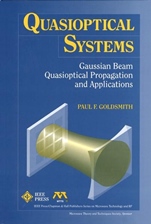
Quasioptical Systems: Gaussian Beam Quasioptical Propogation and Applications
ISBN 9780780334397
Autor: Paul F. Goldsmith
Wydawca: Wiley
Dostępność: 3-6 tygodni
Cena: 1 080,45 zł
Przed złożeniem zamówienia prosimy o kontakt mailowy celem potwierdzenia ceny.
ISBN13: |
9780780334397 |
ISBN10: |
0780334396 |
Autor: |
Paul F. Goldsmith |
Oprawa: |
Hardback |
Rok Wydania: |
1997-12-19 |
Ilość stron: |
432 |
Wymiary: |
260x182 |
Tematy: |
TJ |
Electrical Engineering Quasioptical Systems Gaussian Beam Quasioptical Propagation and Applications The increasing commercial use of millimeter wavelengths for remote sensing, communications, and radar systems has driven the need for new low–cost, high–performance systems, and with it, the need for quasioptical systems. Advantages of quasioptical propagation include broader bandwidth, lower insertion loss, better polarization purity, and higher power–handling capability. As this book illustrates, quasioptical system design using Gaussian beam propagation is relatively straightforward, yielding valuable insights without requiring extensive computations. Combining a general introduction to Gaussian beams and quasioptical propagation with practical applications, Quasioptical Systems provides a state–of–the–art treatment of the design of low–loss, broadband systems at microwave to submillimeter wavelengths. The approach presented involves utilizing a beam with a Gaussian distribution of field strength perpendicular to its axis, which in turn propagates in a simple, predictable fashion. Features include:A convenient summary of Gaussian beam propagation formulasExtensive coverage of present–day quasioptical components and their performanceIn–depth coverage of dielectric materials uses at millimeter and submillimeter wavelengthsAn analysis of lenses and mirrors used as beam focusing elementsAn integrated approach to quasioptical system designThis book will be of key interest to systems designers, antenna engineers, communications and radar systems engineers, and researchers.
Spis treści:
PREFACE.
ACKNOWLEDGMENTS.
Chapter 1: Introduction and Historical Overview.
1.1 What Is Quasioptics?
1.2 Why Quasioptics Is of Interest.
1.3 Historical Overview.
1.4 Organization of This Book.
1.5 Bibliographic Notes.
Chapter 2: Gaussian Beam Propagatio
n.
2.1 Derivation of Basic Gaussian Beam Propagation.
2.2 Description of Gaussian Beam Propagation.
2.3 Geometrical Optics Limits of Gaussian Beam Propagation.
2.4 Higher Order Gaussian Beam Mode Solutions of the Paraxial Wave Equation.
2.5 The Size of Gaussian Beam Modes.
2.6 Gaussian Beam Measurement.
2.7 Inverse Formulas for Gaussian Beam Propagation.
2.8 The Paraxial Limit and Improved Solutions to the Wave Equation.
2.9 Alternative Derivation of the Gaussian Beam Propagation Formula.
2.10 Bibliographic Notes.
Chapter 3: Gaussian Beam Transformation.
3.1 Introduction.
3.2 Ray Matrices and the Complex Beam Parameter.
3.3 Gaussian Beam Transformation by Focusing Elements.
3.4 Mode Matching.
3.5 Complex Beam Parameter and Smith Chart Representation.
3.6 Transformation of Higher Order Gaussian Beam Modes.
3.7 Bibliographic Notes.
Chapter 4: Gaussian Beam Coupling.
4.1 Introduction.
4.2 Axially Aligned Beams.
4.3 Tilted Beams.
4.4 Offset Beams.
4.5 Bibliographic Notes.
Chapter 5: Practical Aspects of Quasioptical Focusing Elements.
5.1 Introduction.
5.2 Single–Pixel and Imaging Systems.
5.3 The Eikonal Equation.
5.4 Refractive Focusing Elements.
5.5 Zoned Lenses.
5.6 Zone Plate Lenses.
5.7 Metallic Lenses.
5.8 Reflective Focusing Elements.
5.9 Bibliographic Notes.
Chapter 6: Gaussian Beams and Antenna Feed Systems.
6.1 Introduction.
6.2 Antenna Efficiency and Aperture Illumination.
6.3 Aperture Efficiency.
6.4 Radiation Patterns.
6.5 Extended Sources.
6.6 Defocusing Due to Secondary Motion in Cassegrain Systems.
6.7 Requirements on the Beam Waist.
6.8 Reflection Due to Central Blockage in Cassegrain Systems.
6.9 Bibliographic Notes.
Chapter 7: Gaussian Beam Coupling to Radiating Elements.
7.1 Introduction.
7.2 Expansion in Gaussian Beam Modes: General Considerations.
7.3 Radius of
Curvature.
7.4 Beam Radius.
7.5 Beam Waist Location and Complex Amplitudes.
7.6 Gaussian Beam Modes for Feed Elements of Various Types.
7.7 Summary of Fundamental Mode Coupling Coefficients.
7.8 Bibliographic Notes.
Chapter 8: Frequency–Independent Quasioptical Components.
8.1 Introduction.
8.2 Path Length Modulators/Delay Lines.
8.3 Polarization Processing Components.
8.4 Polarization Transducers and Wave Plates.
8.5 Quasioptical Hybrids.
8.6 Quasioptical Attenuators and Power Dividers.
8.7 Quasioptical Ferrite Devices.
8.8 Quasioptical Absorbers and Calibration Loads.
8.9 Bibliographic Notes.
Chapter 9: Quasioptical Frequency–Selective Components.
9.1 Introduction.
9.2 Planar Structures.
9.3 Thick Structure: Perforated Plates.
9.4 Interferometers.
9.5 Interferometers of Other Types.
9.6 Layered Dielectrics.
9.7 Multiple–Grid Filters.
9.8 Diffraction Gratings.
9.9 Resonators.
9.10 Bibliographic Notes.
Chapter 10: Quasioptical Active Devices.
10.1 Introduction.
10.2 Bulk Coupled Quasioptical Devices.
10.3 Quasioptical Planar Arrays.
10.4 Cavity–Coupled Quasioptical Devices.
10.5 Spatial Power Combining.
10.6 Bibliographic Notes.
Chapter 11: Quasioptical System Design: Principles and Examples.
11.1 Introduction.
11.2 Design Methodology and General Guidelines.
11.3 System Design Examples.
11.4 Conclusions.
11.5 Bibliographic Notes.
BIBLIOGRAPHY.
INDEX.
ABOUT THE AUTHOR.
Nota biograficzna:
Paul F. Goldsmith was appointed Director of the National Astronomy and Ionosphere Center and professor of astronomy at Cornell University in 1993. He is a coinvestigator on the Submillimeter Wave Astronomy Satellite (SWAS), currently scheduled for launch in 1998. Dr. Goldsmith was a founder of Millitech Corporation and was MTT Distinguished Lecturer 1992–1993. He
is a Fellow of IEEE.
Okładka tylna:
Electrical Engineering Quasioptical Systems Gaussian Beam Quasioptical Propagation and Applications The increasing commercial use of millimeter wavelengths for remote sensing, communications, and radar systems has driven the need for new low–cost, high–performance systems, and with it, the need for quasioptical systems. Advantages of quasioptical propagation include broader bandwidth, lower insertion loss, better polarization purity, and higher power–handling capability. As this book illustrates, quasioptical system design using Gaussian beam propagation is relatively straightforward, yielding valuable insights without requiring extensive computations. Combining a general introduction to Gaussian beams and quasioptical propagation with practical applications, Quasioptical Systems provides a state–of–the–art treatment of the design of low–loss, broadband systems at microwave to submillimeter wavelengths. The approach presented involves utilizing a beam with a Gaussian distribution of field strength perpendicular to its axis, which in turn propagates in a simple, predictable fashion. Features include:A convenient summary of Gaussian beam propagation formulasExtensive coverage of present–day quasioptical components and their performanceIn–depth coverage of dielectric materials uses at millimeter and submillimeter wavelengthsAn analysis of lenses and mirrors used as beam focusing elementsAn integrated approach to quasioptical system designThis book will be of key interest to systems designers, antenna engineers, communications and radar systems engineers, and researchers.
Koszyk
Książek w koszyku: 0 szt.
Wartość zakupów: 0,00 zł
Informacje


Kontakt
Gambit
Centrum Oprogramowania
i Szkoleń Sp. z o.o.
Al. Pokoju 29b/22-24
31-564 Kraków
Siedziba Księgarni
ul. Kordylewskiego 1
31-542 Kraków
+48 12 410 5991
+48 12 410 5987
+48 12 410 5989
Subskrypcje
Administratorem danych osobowych jest firma Gambit COiS Sp. z o.o. Na podany adres będzie wysyłany wyłącznie biuletyn informacyjny.
Autoryzacja płatności

Informacje na temat autoryzacji płatności poprzez PayU.

© Copyright 2012: GAMBIT COiS Sp. z o.o. Wszelkie prawa zastrzeżone.
Projekt i wykonanie: Alchemia Studio Reklamy