


Wydawcy
Katalog tematyczny
- Archeologia (109)
- Ekonomia, finanse, business (13704)
- Filozofia (1445)
- Historia (3040)
- Języki i językoznawstwo (2356)
- Lifestyle, hobby i rozrywka (475)
- Medycyna (9704)
- Chirurgia (272)
- Inne gałęzie medycyny (1871)
- Medycyna kliniczna (4187)
- Choroby wewnętrzne (514)
- Dermatologia (51)
- Diagnostyka medyczna (3)
- Endokrynologia (144)
- Gastroenterologia (27)
- Geriatria (50)
- Ginekologia i położnictwo (134)
- Hematologia (46)
- Hepatologia (10)
- Kardiologia (71)
- Laryngologia (12)
- Nefrologia (10)
- Neurologia (500)
- Oftalmologia (50)
- Pediatria (33)
- Pulmunologia (32)
- Reumatologia (14)
- Terapia genowa (1)
- Układ mięśniowo-szkieletowy (1)
- Urologia (14)
- Medycyna niekonwencjonalna (14)
- Medycyna przedkliniczna (269)
- Medycyna, ogólnie (1740)
- Medyczne służby pomocnicze (745)
- Studia medyczne (16)
- Weterynaria (548)
- Nauki humanistyczne (4)
- Nauki o Ziemi i środowisku (2638)
- Nauki ścisłe (20412)
- Nauki społeczne (8486)
- Nauki techniczne (13450)
- Prawo (1696)
- Publikacje informacyjne i interdyscyplinarne (1288)
- Religia i wierzenia (917)
- Technika komputerowa (4067)
- Zdrowie, relacje międzyludzkie i rozwój osobisty (657)





Informacje szczegółowe o książce
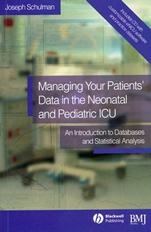
Managing your Patients Data in the Neonatal and Pediatric ICU: An Introduction to Databases and Statistical Analysis
ISBN 9780727918703
Autor: Joseph Schulman
Wydawca: Wiley
Dostępność: 3-6 tygodni
Cena: 465,15 zł
Przed złożeniem zamówienia prosimy o kontakt mailowy celem potwierdzenia ceny.
ISBN13: |
9780727918703 |
ISBN10: |
0727918702 |
Autor: |
Joseph Schulman |
Oprawa: |
Paperback |
Rok Wydania: |
2006-08-02 |
Ilość stron: |
376 |
Wymiary: |
233x157 |
Tematy: |
MJ |
With accompanying software!
Clinicians manage a lot of data – on assorted bits of paper and in their heads. This book is about better ways to manage and understand large amounts of clinical data. Following on from his ground breaking book, Evaluating the Processes of Neonatal Intensive Care, Joseph Schulman has produced this eminently readable guide to patient data analysis. He demystifies the technical methodology to make this crucial aspect of good clinical practice understandable and usable for all health care workers.
Computer technology has been relatively slow to transform the daily work of health care, the way it has transformed other professions that work with large amounts of data. Each day, we do our work as we did it the day before, even though current technology offers much better ways.
Here are much better ways to document and learn from the daily work of clinical care. Here are the principles of data management and analysis and detailed examples of how to implement them using computer technology.
To show you that the knowledge is scalable and useful, and to get you off to a running start, the book includes a complete point of care database software application tailored to the neonatal intensive care unit (NICU).
With examples from the NICU and the pediatric ward, this book is aimed specifically at the neonatal and pediatric teams. The accompanying software can be downloaded on to your system or PDA, so that continual record assessment becomes second nature – a skill that will immeasurably improve practice and outcomes for all your patients.
Spis treści:
1 Introduction.
Part I Managing data and routine reporting.
Section 1 The process of managing clinical data.
2 Paper–based patient records.
3 Computer–based patient records.
4 Aims of a patient data management process.
Section 2 Modeling data: Accurately representing our work and sto
ring the data so we may reliably retrieve them.
5 Data, information, and knowledge.
6 Single tables and their limitations.
7 Multiple tables: where to put the data, relationships among tables, and creating a database.
8 Relational database management systems: normalization (Codd’s rules).
Section 3 Database software.
9 From data model to database software.
10 Integrity: anticipating and preventing data accuracy problems.
11 Queries, forms, and reports.
12 Programming for greater software control.
13 Turning ideas into a useful tool: eNICU, point of care database software for the NICU.
14 Making eNICU serve your own needs.
Section 4 Database administration.
15 Single versus multiple users.
16 Backup and recovery: assuring your data persists.
17 Security: controlling access and protecting patient confidentiality.
Conclusion – Part I: Maintaining focus on a moving target.
Part II Learning from aggregate experience: exploring and analyzing data sets.
Section 5 Interrogating data.
18 Asking questions of a data set: crafting a conceptual framework.
and testable hypothesis.
19 Stata: a software tool to analyze data and produce graphical.
displays.
20 Preparing to analyze data.
Section 6 Analytical concepts and methods.
21 Variable types.
22 Measurement values vary: describing their distribution and summarizing them quantitatively.
23 Data from all versus some: populations and samples.
24 Estimating population parameters: confidence intervals.
25 Comparing two sample means and testing a hypothesis.
26 Type I and type II error in a hypothesis test, power, and sample size.
27 Comparing proportions: introduction to rates and odds.
28 Stratifying the analysis of dichotomous outcomes: confounders and effect modifiers; the Mantel–Haenszel method.
29 Ways to measure and compare the frequency of outcomes, and standardization to
compare rates.
30 Comparing the means of more than two samples.
31 Assuming little about the data: nonparametric methods of hypothesis testing.
32 Correlation: measuring the relationship between two continuous variables.
33 Predicting continuous outcomes: univariate and multivariate linear regression.
34 Predicting dichotomous outcomes: logistic regression, and receiver operating characteristic.
35 Predicting outcomes over time: survival analysis.
36 Choosing variables and hypotheses: practical considerations.
Conclusion The challenge of transforming data and information to shared knowledge: tools that make us smart.
References.
Index.
CD ROM: eNICU files; practice data sets back cover.
“Microsoft, Access, SQL Server, andWindows are either registered trademarks or trademarks of Microsoft Corporation in the United States and/or other countries.”
Nota biograficzna:
Joseph Schulman,MD, MS Division of Newborn Medicine, Weill Medical College of Cornell University, New York–Presbyterian Hospital, New York, USA
Okładka tylna:
With accompanying software!
Clinicians manage a lot of data – on assorted bits of paper and in their heads. This book is about better ways to manage and understand large amounts of clinical data. Following on from his ground breaking book, Evaluating the Processes of Neonatal Intensive Care, Joseph Schulman has produced this eminently readable guide to patient data analysis. He demystifies the technical methodology to make this crucial aspect of good clinical practice understandable and usable for all health care workers.
Computer technology has been relatively slow to transform the daily work of health care, the way it has transformed other professions that work with large amounts of data. Each day, we do our work as we did it the day before, even though current technology offers much better ways.
Here are much better w
ays to document and learn from the daily work of clinical care. Here are the principles of data management and analysis and detailed examples of how to implement them using computer technology.
To show you that the knowledge is scalable and useful, and to get you off to a running start, the book includes a complete point of care database software application tailored to the neonatal intensive care unit (NICU).
With examples from the NICU and the pediatric ward, this book is aimed specifically at the neonatal and pediatric teams. The accompanying software can be downloaded on to your system or PDA, so that continual record assessment becomes second nature – a skill that will immeasurably improve practice and outcomes for all your patients.
Koszyk
Książek w koszyku: 0 szt.
Wartość zakupów: 0,00 zł
Informacje


Kontakt
Gambit
Centrum Oprogramowania
i Szkoleń Sp. z o.o.
Al. Pokoju 29b/22-24
31-564 Kraków
Siedziba Księgarni
ul. Kordylewskiego 1
31-542 Kraków
+48 12 410 5991
+48 12 410 5987
+48 12 410 5989
Subskrypcje
Administratorem danych osobowych jest firma Gambit COiS Sp. z o.o. Na podany adres będzie wysyłany wyłącznie biuletyn informacyjny.
Autoryzacja płatności

Informacje na temat autoryzacji płatności poprzez PayU.

© Copyright 2012: GAMBIT COiS Sp. z o.o. Wszelkie prawa zastrzeżone.
Projekt i wykonanie: Alchemia Studio Reklamy