


Wydawcy
Katalog tematyczny
- Archeologia (109)
- Ekonomia, finanse, business (13704)
- Filozofia (1445)
- Historia (3040)
- Języki i językoznawstwo (2356)
- Lifestyle, hobby i rozrywka (475)
- Medycyna (9704)
- Nauki humanistyczne (4)
- Nauki o Ziemi i środowisku (2638)
- Geografia (299)
- Nauki o Ziemi (1661)
- Geologia (414)
- Hydrologia (237)
- Meteorologia i klimatologia (114)
- Paleontologia (33)
- Wulkanologia i sejsmologia (44)
- Planowanie przestrzenne (53)
- Środowisko (607)
- Nauki ścisłe (20412)
- Nauki społeczne (8486)
- Nauki techniczne (13450)
- Prawo (1696)
- Publikacje informacyjne i interdyscyplinarne (1288)
- Religia i wierzenia (917)
- Technika komputerowa (4067)
- Zdrowie, relacje międzyludzkie i rozwój osobisty (657)





Informacje szczegółowe o książce
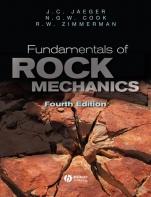
Fundamentals of Rock Mechanics
ISBN 9780632057597
Autor: John Conrad Jaeger, Neville G. W. Cook, Robert Zimmerman
Wydawca: Wiley
Dostępność: 3-6 tygodni
Cena: 382,20 zł
Przed złożeniem zamówienia prosimy o kontakt mailowy celem potwierdzenia ceny.
ISBN13: |
9780632057597 |
ISBN10: |
0632057599 |
Autor: |
John Conrad Jaeger, Neville G. W. Cook, Robert Zimmerman |
Oprawa: |
Hardback |
Rok Wydania: |
2007-04-03 |
Numer Wydania: |
4th Edition |
Ilość stron: |
488 |
Wymiary: |
246x189 |
Tematy: |
RB |
Since the publication of the first edition in 1969, Fundamentals of Rock Mechanics has been widely regarded as the most authoritative and comprehensive book in its field. This classic book, unavailable for many years, is now back by popular demand. Extensively revised for this fourth edition, it now contains substantially expanded chapters on poroelasticity, wave propagation, and subsurface stresses, as well as entirely new chapters on rock fractures and micromechanical models of rock behavior.
Beginning with a detailed discussion of fundamental concepts such as stress and strain, this classic text offers a thorough introduction to the subject of rock mechanics, before expertly delving into a fundamental, self–contained discussion of specific topics. Unmatched in the breadth of its treatment, the new edition of this highly praised text is an invaluable resource for all geologists, geophysicists, and geotechnical engineers working in the field today.
Spis treści:
1. Rock as a Material.
1.1 Introduction.
1.2 Joints and faults.
1.3 Rock–forming minerals.
1.4 The fabric of rocks.
1.5 The mechanical nature of rock.
2. Analysis of Stress and Strain.
2.1 Introduction.
2.2 Definition of traction and stress.
2.3 Analysis of stress in two dimensions.
2.4 Graphical representations of stress in two dimensions.
2.5 Stresses in three dimensions.
2.6 Stress transformations in three dimensions.
2.7 Mohr’s representation of stress in three dimensions.
2.8 Stress invariants and stress deviation.
2.9 Displacement and strain.
2.10 Infinitesimal strain in two dimensions.
2.11 Infinitesimal strain in three dimensions.
2.12 Determination of principle stresses or strains from measurements.
2.13 Compatibility equations.
2.14 Stress and strain in polar and cylindrical coordinates.
2.15 Finite strain.
3. Friction on Rock Surfaces.
3.1 Introduction.
3
.2 Amonton’s law.
3.3 Friction on rock surfaces.
3.4 Stick–slip oscillations.
3.5 Sliding on a plane of weakness.
3.6 Effects of time and velocity.
4. Deformation and Failure of Rock.
4.1 Introduction.
4.2 The stress–strain curve.
4.3 Effects of confining stress and temperature.
4.4 Types of fracture.
4.5 Coulomb failure criterion.
4.6 Mohr’s hypothesis.
4.7 Effects of pore fluids.
4.8 Failure under true–triaxial conditions.
4.9 The effect of anisotropy on strength.
5. Linear Elasticity.
5.1 Introduction.
5.2 Stress–strain relations for an isotropic linear elastic solid.
5.3 Special cases.
5.4 Hooke’s law in terms of deviatoric stresses and strains.
5.5 Equations of stress equilibrium.
5.6 Equations of stress equilibrium in cylindrical and spherical coordinates.
5.7 Airy stress functions.
5.8 Elastic strain energy and related principles.
5.9 Uniqueness theorem for elasticity problems.
5.10 Stress–strain relations for anisotropic materials.
6. Laboratory Testing of Rocks.
6.1 Introduction.
6.2 Hydrostatic tests.
6.3 Uniaxial compression.
6.4 Triaxial tests.
6.5 Stability and stiff testing machines.
6.6 True–triaxial tests.
6.7 Diametral compression of cylinders.
6.8 Torsion of circular cylinders.
6.9 Bending tests.
6.10 Hollow cylinders.
7. Poroelasticity and Thermoelasticity.
7.1 Introduction.
7.2 Hydrostatic poroelasticity.
7.3 Undrained compression.
7.4 Constitutive equations of poroelasticity.
7.5 Equations of stress equilibrium and fluid flow.
7.6 One–dimensional consolidation.
7.7 Applications of poroelasticity.
7.8 Thermoelasticity.
8. Stresses around Cavities and Excavations.
8.1 Introduction.
8.2 Complex variable method for two–dimensional elasticity problems.
8.3 Homogeneous state of stress.
8.4 Pressurised ho
llow cylinder.
8.5 Circular hole in a rock mass with given far–field principal stresses.
8.6 Stresses applied to a circular hole in an infinite rock mass.
8.7 Stresses applied to the surface of a solid cylinder.
8.8 Inclusions in an infinite region.
8.9 Elliptical hole in an infinite rock mass.
8.10 Stresses near a crack tip.
8.11 Nearly rectangular hole.
8.12 Spherical cavities.
8.13 Penny–shaped cracks.
8.14 Interactions between nearby cavities.
9. Inelastic Behavior.
9.1 Introduction.
9.2 Plasticity and yield.
9.3 Elastic–plastic hollow cylinder.
9.4 Circular hole in an elastic–brittle–plastic rock mass.
9.5 Perfectly plastic behavior.
9.6 Flow between flat surfaces.
9.7 Flow rules and hardening.
9.8 Creep.
9.9 Simple rheological models.
9.10 Theory of viscoelasticity.
9.11 Some simple viscoelastic problems.
10. Micromechanical Models.
10.1 Introduction.
10.2 Effective moduli of heterogeneous rocks.
10.3 Effect of pores on compressibility.
10.4 Crack closure and elastic nonlinearity.
10.5 Effective medium theories.
10.6 Sliding crack friction and hysteresis.
10.7 Griffith cracks and the Griffith locus.
10.8 Griffith theory of failure.
10.9 Linear elastic fracture mechanics.
11. Wave Propagation in Rocks.
11.1 Introduction.
11.2 One–dimensional elastic wave propagation.
11.3 Harmonic waves and group velocity.
11.4 Elastic waves in unbounded media.
11.5 Reflection and refraction of waves at an interface.
11.6 Surface and interface waves.
11.7 Transient waves.
11.8 Effects of fluid saturation.
11.9 Attenuation.
11.10 Inelastic waves.
12. Hydromechanical Behavior of Fractures.
12.1 Introduction.
12.2 Geometry of rock fractures.
12.3 Normal stiffness of rock fractures.
12.4 Behaviour of rock fractures under shear.
12.5 Hydraulic transmissivity of rock fracture
s.
12.6 Coupled hydro–mechanical behavior.
12.7 Seismic response of rock fractures.
12.8 Fractured rock masses.
13. State of Stress Underground.
13.1 Introduction.
13.2 Simple models for the state of stress in the subsurface.
13.3 Measured values of subsurface stresses.
13.4 Surface loads on a half–space: two–dimensional theory.
13.5 Surface loads on a half–space: three–dimensional theory.
13.6 Hydraulic fracturing.
13.7 Other stress measurement methods.
14. Geological Applications.
14.1 Introduction.
14.2 Stresses and faulting.
14.3 Overthrust faulting and sliding under gravity.
14.4 Stresses around faults.
14.5 Mechanics of intrusion.
14.6 Beam models for crustal folding.
14.7 Earthquake mechanics.
References
Nota biograficzna:
John Conrad Jaeger received a first–class honours degree in mathematics and physics from the University of Sydney, was Wrangler (class I) in the Mathematical Tripos at Cambridge, and received a DSc in applied mathematics from the University of Sydney. He was a professor at the University of Tasmania and the Australian National University. He was the author of several monographs in applied mathematics, including, with H. S. Carslaw, Conduction of Heat in Solids, and was a Fellow of the Australian Academy of Science and the Royal Society.
Neville G. W. Cook received a BS and PhD in geophysics from the University of Witwatersrand. He was the founder and first director of the Mining Research Laboratory of the South African Chamber of Mines, and in 1971 he received the Gold Medal of the Scientific and Technical Societies, the highest scientific award in South Africa. He was Donald H. McLaughlin Chair in Mineral Engineering at the University of California at Berkeley, and was a member of the U. S. National Academy of Engineering.
Robert Zimmerman received BS and MS degrees from Colum
Koszyk
Książek w koszyku: 0 szt.
Wartość zakupów: 0,00 zł
Informacje


Kontakt
Gambit
Centrum Oprogramowania
i Szkoleń Sp. z o.o.
Al. Pokoju 29b/22-24
31-564 Kraków
Siedziba Księgarni
ul. Kordylewskiego 1
31-542 Kraków
+48 12 410 5991
+48 12 410 5987
+48 12 410 5989
Subskrypcje
Administratorem danych osobowych jest firma Gambit COiS Sp. z o.o. Na podany adres będzie wysyłany wyłącznie biuletyn informacyjny.
Autoryzacja płatności

Informacje na temat autoryzacji płatności poprzez PayU.

© Copyright 2012: GAMBIT COiS Sp. z o.o. Wszelkie prawa zastrzeżone.
Projekt i wykonanie: Alchemia Studio Reklamy