


Wydawcy
Katalog tematyczny
- Archeologia (109)
- Ekonomia, finanse, business (13704)
- Filozofia (1445)
- Historia (3040)
- Języki i językoznawstwo (2356)
- Lifestyle, hobby i rozrywka (475)
- Medycyna (9704)
- Nauki humanistyczne (4)
- Nauki o Ziemi i środowisku (2638)
- Nauki ścisłe (20412)
- Nauki społeczne (8486)
- Nauki techniczne (13450)
- Prawo (1696)
- Publikacje informacyjne i interdyscyplinarne (1288)
- Religia i wierzenia (917)
- Technika komputerowa (4067)
- Zdrowie, relacje międzyludzkie i rozwój osobisty (657)





Informacje szczegółowe o książce
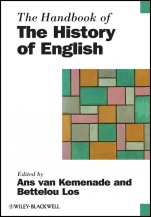
The Handbook of the History of English
ISBN 9780631233442
Autor: Ans van Kemenade, Bettelou Los
Wydawca: Wiley
Dostępność: 3-6 tygodni
Cena: 830,55 zł
Przed złożeniem zamówienia prosimy o kontakt mailowy celem potwierdzenia ceny.
ISBN13: |
9780631233442 |
ISBN10: |
063123344X |
Autor: |
Ans van Kemenade, Bettelou Los |
Oprawa: |
Hardback |
Rok Wydania: |
2006-05-05 |
Ilość stron: |
672 |
Wymiary: |
253x178 |
Tematy: |
CF |
The Handbook of the History of English is a collection of articles written by leading specialists in the field that focus on the theoretical issues behind the facts of the changing English language. The innovative organization of this volume applies recent insights to old problems and surveys the history of English from the perspective of structural developments in areas such as phonology, prosody, morphology, syntax, semantics, language variation, and dialectology. This unique handbook offers readers a comprehensive overview of the various theoretical perspectives available to the study of the history of English and sets new objectives for further research. Organizes the theoretical issues behind the facts of the changing English language innovatively and applies recent insights to old problems Surveys the history of English from the perspective of structural developments in areas such as phonology, prosody, morphology, syntax, semantics, language variation, and dialectology Offers readers a comprehensive overview of the various theoretical perspectives available to the study of the history of English and sets new objectives for further research
Editors′ Introduction. Notes on Contributors. Part I: Approaches and issues. 1. Change for the Better? Optimality Theory versus History: April McMahon (University of Sheffield). 2. Cueing a New Grammar: David Lightfoot (Georgetown University). 3. Variation and the Interpretation of Change in periphrastic DO: Anthony Warner (University of York). 4. Evolutionary Models and Functional–Typological Theories of Language Change: William Croft (University of New Mexico). Part II: Words: derivation and prosody. 5. Old and Middle English Prosody: Donka Minkova (UCLA). 6. Prosodic Preferences: From Old English to Early Modern English: Paula Fikkert (Radboud University Nijmegen, The Netherlands), Elan Dresher (University of Toronto, Canada) and Aditi Lahiri (University of Konstanz, Germany). 7. Typological Changes in Derivational Morphology: Dieter Kastovsky (University of Vienna). 8. Competition in English Word Formation: Laurie Bauer (Victoria University of Wellington). Part III: Inflectional morphology and syntax. 9. Case Syncretism and Word Order Change: Cynthia Allen (Australian National University). 10. Discourse Adverbs and Clausal Syntax in Old and Middle English: Ans van Kemenade (Radboud University Nijmegen) and Bettelou Los (Vrije Universiteit Amsterdam). 11. The loss of OV Order in the History of English: Susan Pintzuk and Ann Taylor (both University of York). 12. Category Change and Gradience in the Determiner System: David Denison (University of Manchester). Part IV: Pragmatics. 13. Pathways in the development of pragmatic markers in English: Laurel Brinton (University of British Columbia). 14. The Semantic Development of Scalar Focus Modifiers: Elizabeth Traugott (Stanford University). 15. Information Structure and Word Order Change: The Passive as an Information Rearranging Strategy in the History of English: Elena Seoane (University of Santiago de Compostela). Part V: Pre– and postcolonial varieties. 16. Old English Dialectology: Richard Hogg (University of Manchester). 17. Early Middle English Dialectology: Problems and Prospects: Margaret Laing (University of Edinburgh) and Roger Lass (University of Cape Town). 18. How English became African American English: Shana Poplack (University of Ottawa). 19. Historical Change in Synchronic Perspective: The Legacy of British Dialects: Sali Tagliamonte (University of Toronto). 20. The making of Hiberno–English and other ′Celtic Englishes′: Markku Filppula (University of Joensuu). Part VI: Standardisation and globalization. 21. Eighteenth–century Prescriptivism and the Norm of Correctness: Ingrid Tieken – Boon van Ostade (University of Leiden). 22. Historical Sociolinguistics and Language Change: Terttu Nevalainen (University of Helsinki). 23. Global English: From Island Tongue to World Language: Suzanne Romaine (University of Oxford). Appendix: Useful Corpora for Research in English Historical Linguistics. Index.
Ans van Kemenade is Professor in the Department of English at the Radboud University Nijmegen, and is author of Syntactic Case and Morphological Case in the History of English (1987), and The Syntax of Early English (2000; with O. Fischer, W. Koopman, and W. van der Wurff). Bettelou Los is a lecturer in the Department of English at the Radboud University Nijmegen. She is author of Infinitival Complementation in Old and Middle English (1999) and The Rise of the to–infinitive (2005).
“This ground–breaking book includes insightful and thorough analyses of a large number of features in the history of English, offering numerous new starting–points and theoretical considerations. Indispensable for all students and scholars of English historical linguistics and philology.” Matti Rissanen, University of Helsinki, Finland “A wonderful encapsulation of the field by cutting–edge scholars, inspired by the fin de siècle burst of research success in English historical linguistics. A must–read for all English language historians interested in how far we have come toward resolving the issues left open by Jespersen, Luick, Wyld, Sweet, and the other great philologists. It offers vastly deeper access to these problems, both through computer corpora and through new theoretical insights. Brilliant and often definitive.” Robert Stockwell, UCLA "As with The Handbook of English Linguistics, I enjoyed different insights and would also use it for state–of–the–art summaries and additional reading." Elly Van Gelderen, Arizona State University
Koszyk
Książek w koszyku: 0 szt.
Wartość zakupów: 0,00 zł
Informacje


Kontakt
Gambit
Centrum Oprogramowania
i Szkoleń Sp. z o.o.
Al. Pokoju 29b/22-24
31-564 Kraków
Siedziba Księgarni
ul. Kordylewskiego 1
31-542 Kraków
+48 12 410 5991
+48 12 410 5987
+48 12 410 5989
Subskrypcje
Administratorem danych osobowych jest firma Gambit COiS Sp. z o.o. Na podany adres będzie wysyłany wyłącznie biuletyn informacyjny.
Autoryzacja płatności

Informacje na temat autoryzacji płatności poprzez PayU.

© Copyright 2012: GAMBIT COiS Sp. z o.o. Wszelkie prawa zastrzeżone.
Projekt i wykonanie: Alchemia Studio Reklamy