


Wydawcy
Katalog tematyczny
- Archeologia (109)
- Ekonomia, finanse, business (13704)
- Filozofia (1445)
- Historia (3040)
- Języki i językoznawstwo (2356)
- Lifestyle, hobby i rozrywka (475)
- Medycyna (9704)
- Nauki humanistyczne (4)
- Nauki o Ziemi i środowisku (2638)
- Nauki ścisłe (20412)
- Nauki społeczne (8486)
- Nauki techniczne (13450)
- Prawo (1696)
- Publikacje informacyjne i interdyscyplinarne (1288)
- Religia i wierzenia (917)
- Technika komputerowa (4067)
- Zdrowie, relacje międzyludzkie i rozwój osobisty (657)





Informacje szczegółowe o książce
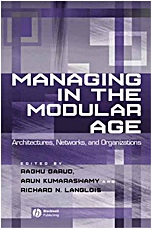
Managing in the Modular Age: Architectures, Networks, and Organizations
ISBN 9780631233152
Autor: Raghu Garud, Arun Kumaraswamy, Richard Langlois
Wydawca: Wiley
Dostępność: 3-6 tygodni
Cena: 492,45 zł
Przed złożeniem zamówienia prosimy o kontakt mailowy celem potwierdzenia ceny.
ISBN13: |
9780631233152 |
ISBN10: |
0631233156 |
Autor: |
Raghu Garud, Arun Kumaraswamy, Richard Langlois |
Oprawa: |
Hardback |
Rok Wydania: |
2002-09-13 |
Ilość stron: |
424 |
Wymiary: |
252x177 |
Tematy: |
KM |
There is increasing interest in modularity in the midst of our ongoing electronic revolution. To understand the implications of modularity across technological, organizational, and institutional contexts, the editors have brought together in one place seminal articles on architectures, networks, and organizations.
These articles address modularity from a variety of disciplinary perspectives and from multiple levels of analyses. The applicability of original insights to contemporary business environments as well as updates are summarized in fresh commentaries by each author.
The volume itself is designed to be modular. At the same time, it has been designed to highlight key interdependencies across the concepts of modularity, networks, architectures, and organizations. Readers are encouraged to make connections among different domains and to formulate new research questions and hypotheses.
The book includes a commentary co–authored by the late Nobel Laureate Herbert A. Simon, to whom the book is dedicated.
Spis treści:
Acknowledgments.
Introduction: Managing in The Modular Age: Architectures, Networks and Organizations. (R. Garud, A. Kumaraswamy, R. Langlois).
Part I: Overview.
1. The Architecture of Complexity. (H. A. Simon).
Commentary. (M. Augier and H. A. Simon).
2. Technological and Organizational Designs to Achieve Economies of Substitution. (R. Garud and A. Kumaraswamy).
Commentary.
3. Networks And Innovation In A Modular System: Lessons From The Microcomputer And Stereo Component Industries. (R. N. Langlois and P. L. Robertson).
Commentary.
Part II: Modularity And Architectures.
4. The Role of Product Architecture in the Manufacturing Firm. (K. Ulrich).
Commentary.
5. Managing in an Age of Modularity. (C. Y. Baldwin and K. B. Clark).
Commentary.
6. Towards a General Modular Systems Theory and Its Application to Interfirm Product Modularity. (M. A. Schilling).
Com
mentary.
Part III: Networks And Standards.
7. The Economics of Networks. (N. Economides).
Commentary.
8. The Art of Standards Wars. (C. Shapiro and H. R. Varian).
Commentary.
Part IV: Field–Level And Organizational Dynamics.
9. Dynamics of Organizational Communities and Technological Bandwagons: An Empirical Investigation of Community Evolution in the Microprocessor Market. (J. Wade).
Commentary.
10. Dominant Designs, Technological Cycles and Organizational Outcomes. (M. L. Tushman and J. P. Murmann).
Commentary. (G. Westerman and M. L. Tushman).
11. Modularity, Flexibility and Knowledge Management in Product and Organizational Design. (R. Sanchez and J. T. Mahoney).
Commentary. (R. Sanchez).
Index.
Nota biograficzna:
Raghu Garud is Associate Professor of Management and Organizational Behavior at Leonard N. Stern School of Business, New York University. Besides authoring many articles on modularity that have been published in leading management journals, Raghu has co–edited and co–authored several books, including Path Dependence and Creation (2001), The Innovation Journey (1999), and Technological Innovation: Oversights and Foresights (1997). He was Program Chair for the Technology and Innovation Management Division for the 2001 Academy of Management meetings.
Arun Kumaraswamy is Assistant Professor of Management at the School of Business – Camden, Rutgers University. He has published several papers on modularity and standards in journals such as the Academy of Management Journal and the Strategic Management Journal.
Richard N. Langlois is Professor of Economics at the University of Connecticut. He is the author of numerous articles and books, including Firms, Markets, and Economic Change: A Dynamic Theory of Business Institutions (1995). His history of the microcomputer industry won the Newcomen Award
as the best article in Business History Review in 1992.
Okładka tylna:
There is increasing interest in modularity in the midst of our ongoing electronic revolution. To understand the implications of modularity across technological, organizational, and institutional contexts, the editors have brought together in one place seminal articles on architectures, networks, and organizations.
These articles address modularity from a variety of disciplinary perspectives and from multiple levels of analyses. The applicability of original insights to contemporary business environments as well as updates are summarized in fresh commentaries by each author.
The volume itself is designed to be modular. At the same time, it has been designed to highlight key interdependencies across the concepts of modularity, networks, architectures, and organizations. Readers are encouraged to make connections among different domains and to formulate new research questions and hypotheses.
The book includes a commentary co–authored by the late Nobel Laureate Herbert A. Simon, to whom the book is dedicated.
Koszyk
Książek w koszyku: 0 szt.
Wartość zakupów: 0,00 zł
Informacje


Kontakt
Gambit
Centrum Oprogramowania
i Szkoleń Sp. z o.o.
Al. Pokoju 29b/22-24
31-564 Kraków
Siedziba Księgarni
ul. Kordylewskiego 1
31-542 Kraków
+48 12 410 5991
+48 12 410 5987
+48 12 410 5989
Subskrypcje
Administratorem danych osobowych jest firma Gambit COiS Sp. z o.o. Na podany adres będzie wysyłany wyłącznie biuletyn informacyjny.
Autoryzacja płatności

Informacje na temat autoryzacji płatności poprzez PayU.

© Copyright 2012: GAMBIT COiS Sp. z o.o. Wszelkie prawa zastrzeżone.
Projekt i wykonanie: Alchemia Studio Reklamy