


Wydawcy
Katalog tematyczny
- Archeologia (109)
- Ekonomia, finanse, business (13704)
- Filozofia (1445)
- Historia (3040)
- Języki i językoznawstwo (2356)
- Lifestyle, hobby i rozrywka (475)
- Medycyna (9704)
- Nauki humanistyczne (4)
- Nauki o Ziemi i środowisku (2638)
- Nauki ścisłe (20412)
- Nauki społeczne (8486)
- Edukacja (229)
- Kryminologia, opieka spełeczna (284)
- Obronność (10)
- Polityka (1389)
- Psychologia (777)
- Socjologia (410)
- Społeczeństwo i kultura (187)
- Nauki techniczne (13450)
- Prawo (1696)
- Publikacje informacyjne i interdyscyplinarne (1288)
- Religia i wierzenia (917)
- Technika komputerowa (4067)
- Zdrowie, relacje międzyludzkie i rozwój osobisty (657)





Informacje szczegółowe o książce
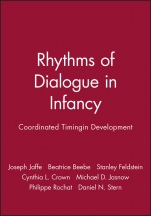
Rhythms of Dialogue in Infancy: Coordinated Timingin Development
ISBN 9780631232117
Autor: Joseph Jaffe, Beatrice Beebe, Stanley Feldstein, Cynthia L. Crown, Michael D. Jasnow, Philippe Rocha
Wydawca: Wiley
Dostępność: 3-6 tygodni
Cena: 265,65 zł
Przed złożeniem zamówienia prosimy o kontakt mailowy celem potwierdzenia ceny.
ISBN13: |
9780631232117 |
ISBN10: |
0631232117 |
Autor: |
Joseph Jaffe, Beatrice Beebe, Stanley Feldstein, Cynthia L. Crown, Michael D. Jasnow, Philippe Rocha |
Oprawa: |
Paperback |
Rok Wydania: |
2001-06-27 |
Ilość stron: |
164 |
Wymiary: |
228x151 |
Tematy: |
JC |
Coordination between infant and adult is thought to be essential to development. However, evidence on this topic is sparse. The research in this Monograph—grounded in a dyadic systems perspective and relational psychoanalysis—addresses the issue of vocal coordination. The research employs an automated apparatus to examine the micro–second vocal coordinations of 4–month old infants with their mothers and with strangers. These coordinations are then used to predict infant attachment and cognition at 12 months. The results demonstrate that coordination is related to the contexts of partner (mother/stranger), site (home/lab) and outcome (attachment/cognition). Although "more" is often assumed to be "better," a midrange of coordination was found to be optimal for attachment. However, for cognition a high degree of coordination between stranger and infant in the lab was optimal. There was more mutual coordination between infant and stranger than infant and mother. This suggests that mutual, or bi–directional, coordination assesses vigilance rather than "attunement." The coordination between infant and stranger predicted attachment status just as well as that between infant and mother. In addition, infant and stranger coordination was the most powerful cognitive predictor. This work further defines a fundamental dyadic timing matrix that guides infant development.
Spis treści:
Abstract.
Introduction.
Literature Review.
Method.
Results: The Timing of Sound and Silence.
Results: Coordinated Interpersonal Timing (CIT) at Age 4 Months.
Results: CIT Rhythms at Age 4 Months Predicts Outcomes at Age 12 Months.
Discussion.
References.
Acknowledgments.
Commentaries.
Dialogical Nature of Cognition (Philippe Rochat).
Face–to–Face Play: Its Temporal Structure as Predictor of Socioaffective Development (Daniel N. Stern).
Contributors.
Statement of Editorial Policy.
Nota biograficzna:
Contributors Include:
Joseph Jaffe M.D. Theoretical Biology and Neuroscience Department of Communication Sciences, N.Y.S. Psychiatric Institute, and Department of Psychiatry (in Neurosurgery), College of Physicians & Surgeons, Columbia
Beatrice Beebe Ph.D. Infancy and Psychoanalysis Department of Communication Sciences, N.Y.S. Psychiatric Institute, and Department of Psychiatry, College of Physicians & Surgeons, Columbia University N.Y.U. Postdoctoral Program in Psychotherapy and Psychoanalysis
Stanley Feldstein Ph.D. Statistics, Communication and Clinical Research Department of Psychology, University of Maryland, Baltimore County
Cynthia L. Crown Ph.D. Social Psychology Department of Psychology, Xavier University
Michael D. Jasnow Ph.D. Psychoanalysis, Child Psychology and Cognitive Science Center for Professional Psychology, George Washington University
Okładka tylna:
Coordination between infant and adult is thought to be essential to development. However, evidence on this topic is sparse. The research in this Monograph—grounded in a dyadic systems perspective and relational psychoanalysis—addresses the issue of vocal coordination. The research employs an automated apparatus to examine the micro–second vocal coordinations of 4–month old infants with their mothers and with strangers. These coordinations are then used to predict infant attachment and cognition at 12 months. The results demonstrate that coordination is related to the contexts of partner (mother/stranger), site (home/lab) and outcome (attachment/cognition). Although "more" is often assumed to be "better," a midrange of coordination was found to be optimal for attachment. However, for cognition a high degree of coordination between stranger and infant in the lab was optimal. There was more mutual coordination between infant and stranger than
infant and mother. This suggests that mutual, or bi–directional, coordination assesses vigilance rather than "attunement." The coordination between infant and stranger predicted attachment status just as well as that between infant and mother. In addition, infant and stranger coordination was the most powerful cognitive predictor. This work further defines a fundamental dyadic timing matrix that guides infant development.
Koszyk
Książek w koszyku: 0 szt.
Wartość zakupów: 0,00 zł
Informacje


Kontakt
Gambit
Centrum Oprogramowania
i Szkoleń Sp. z o.o.
Al. Pokoju 29b/22-24
31-564 Kraków
Siedziba Księgarni
ul. Kordylewskiego 1
31-542 Kraków
+48 12 410 5991
+48 12 410 5987
+48 12 410 5989
Subskrypcje
Administratorem danych osobowych jest firma Gambit COiS Sp. z o.o. Na podany adres będzie wysyłany wyłącznie biuletyn informacyjny.
Autoryzacja płatności

Informacje na temat autoryzacji płatności poprzez PayU.

© Copyright 2012: GAMBIT COiS Sp. z o.o. Wszelkie prawa zastrzeżone.
Projekt i wykonanie: Alchemia Studio Reklamy