


Wydawcy
Katalog tematyczny
- Archeologia (109)
- Ekonomia, finanse, business (13704)
- Filozofia (1445)
- Historia (3040)
- Języki i językoznawstwo (2356)
- Lifestyle, hobby i rozrywka (475)
- Medycyna (9704)
- Nauki humanistyczne (4)
- Nauki o Ziemi i środowisku (2638)
- Nauki ścisłe (20412)
- Nauki społeczne (8486)
- Nauki techniczne (13450)
- Prawo (1696)
- Publikacje informacyjne i interdyscyplinarne (1288)
- Religia i wierzenia (917)
- Technika komputerowa (4067)
- Zdrowie, relacje międzyludzkie i rozwój osobisty (657)





Informacje szczegółowe o książce
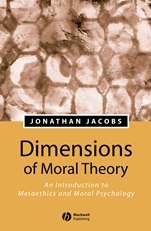
Dimensions of Moral Theory: An Introduction to Metaethics and Moral Psychology
ISBN 9780631229643
Autor: Jonathan Jacobs
Wydawca: Wiley
Dostępność: 3-6 tygodni
Cena: 200,55 zł
Przed złożeniem zamówienia prosimy o kontakt mailowy celem potwierdzenia ceny.
ISBN13: |
9780631229643 |
ISBN10: |
0631229647 |
Autor: |
Jonathan Jacobs |
Oprawa: |
Paperback |
Rok Wydania: |
2002-07-19 |
Ilość stron: |
192 |
Wymiary: |
229x152 |
Tematy: |
HPGM |
Dimensions of Moral Theory examines the key presuppositionsand philosophical commitments that support and shape moraltheories.
Many of the topics discussed belong to metaethics, the study of moral concepts, language, and thought rather than astudy of moral issues themselves. Other topics are under theheading of moral psychology and concern fundamentalissues about the nature of moral agents, moral motivation, and theroles of reason, desire, and pleasure in moral action andexperience. The book introduces metaethical and moral psychologicalpositions and arguments and shows how they are generated and whythey are important. It thereby brings to light some of the mostimportant philosophical problems raised by moral theorizing.
This volume formulates these issues of moral epistemology, themetaphysics of moral value, and moral motivation in a clear andrigorous but non–technical manner.
Preface.
Acknowledgments.
1. Objectivity and Subjectivity.
Interpretations of Objectivity.
Monism and Pluralism.
This Way to Subjectivism.
Subjectivity and Sentiment.
Subjectivism and Skepticism.
Relativism.
Where Now?.
Questions for Discussion and Reflection.
Thinkers and Their Works and Further Reading.
Notes.
2. Moral Theory and Moral Psychology.
Moral Motivation.
Virtue and Motivation.
Self–interest and Morality.
What about Luck?.
Are Moral Considerations Overriding?.
Where Now?.
Questions for Discussion and Reflection.
Thinkers and Their Works and Further Reading.
Notes.
3. Forms of Moral Theory.
Consequentialism.
Kantian Non–consequentialism.
Intuitionist Non–consequentialism.
The Virtue–centered Approach.
Contractarianism.
Theories, Duties, and Metaethics.
Where Now?.
Questions for Discussion and Reflection.
Thinkers and Their Works and Further Reading.
Notes.
4. Naturalism and Non–naturalism.
Naturalism.
The Modern Debate about Naturalism.
Reconstructed Naturalism.
Non–cognitivist Alternatives.
Hume and Naturalism.
Reconnecting Facts and Values.
Aristotle and Naturalism.
Moral Facts and Explanation.
What About God?.
Where Now?.
Questions for Discussion and Reflection.
Thinkers and Their Works and Further Reading.
Notes.
Conclusion.
Glossary.
Bibliography.
Index.
Jonathan Jacobs is Professor of Philosophy and Chair of the Department of Philosophy and Religion at Colgate University. He is author of Practical Realism and Moral Psychology (1995), A Philosopher's Compass (2001), and Choosing Character: Responsibility for Virtue and Vice (2001).
" Dimensions of Moral Theory is clear, concise, and in closetouch with major texts in the history of ethics. It is remarkablycomprehensive for a short book, and it is outstanding for itsintegration of the presentation of basic positions in ethicaltheory and the analysis of major issues in moral psychology." Robert Audi, University of Nebraska <!––end––>
"This book provides a lucid and engaging introduction to themajor issues of moral theory which gives a fine sense of thecomplexities of the subject while remaining thoroughly accessible.What particularly impressed me is the way that Jacobs shows therelevance of the thought of classical authors, such as Aristotle,Hume, and Kant, to contemporary debate. There is a real sense ofengaging in a continuing dialogue that spans the history of thesubject. The book also contains a helpful glossary and study aidsfor the student." David McNaughton, Keele University
Koszyk
Książek w koszyku: 0 szt.
Wartość zakupów: 0,00 zł
Informacje


Kontakt
Gambit
Centrum Oprogramowania
i Szkoleń Sp. z o.o.
Al. Pokoju 29b/22-24
31-564 Kraków
Siedziba Księgarni
ul. Kordylewskiego 1
31-542 Kraków
+48 12 410 5991
+48 12 410 5987
+48 12 410 5989
Subskrypcje
Administratorem danych osobowych jest firma Gambit COiS Sp. z o.o. Na podany adres będzie wysyłany wyłącznie biuletyn informacyjny.
Autoryzacja płatności

Informacje na temat autoryzacji płatności poprzez PayU.

© Copyright 2012: GAMBIT COiS Sp. z o.o. Wszelkie prawa zastrzeżone.
Projekt i wykonanie: Alchemia Studio Reklamy