


Wydawcy
Katalog tematyczny
- Archeologia (109)
- Ekonomia, finanse, business (13704)
- Filozofia (1445)
- Historia (3040)
- Języki i językoznawstwo (2356)
- Lifestyle, hobby i rozrywka (475)
- Medycyna (9704)
- Nauki humanistyczne (4)
- Nauki o Ziemi i środowisku (2638)
- Nauki ścisłe (20412)
- Nauki społeczne (8486)
- Nauki techniczne (13450)
- Prawo (1696)
- Publikacje informacyjne i interdyscyplinarne (1288)
- Religia i wierzenia (917)
- Technika komputerowa (4067)
- Zdrowie, relacje międzyludzkie i rozwój osobisty (657)





Informacje szczegółowe o książce
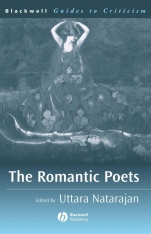
The Romantic Poets
ISBN 9780631229315
Autor: Uttara Natarajan
Wydawca: Wiley
Dostępność: 3-6 tygodni
Cena: 203,70 zł
Przed złożeniem zamówienia prosimy o kontakt mailowy celem potwierdzenia ceny.
ISBN13: |
9780631229315 |
ISBN10: |
0631229310 |
Autor: |
Uttara Natarajan |
Oprawa: |
Hardback |
Rok Wydania: |
2007-07-02 |
Ilość stron: |
360 |
Wymiary: |
236x161 |
Tematy: |
CS |
This welcome addition to the Blackwell Guides to Criticism series provides students with an invaluable survey of the critical reception of the Romantic poets. It steers readers through the plethora of critical material in the field, from contemporary responses through to modern–day readings, and directs them to the most influential work on particular poets. The editor presents key critical texts on each of the six major Romantic poets – Blake, Wordsworth, Coleridge, Byron, Shelley, and Keats – as well as on the changing canon.
Acknowledgements. Introduction. 1. William Blake (1757–1827) . Critical History: From First Responses to Northrop Frye. Extract from Northrop Frye, Fearful Symmetry: A Study of William Blake (1947). Further reading. Critical History: Historical and Political Readings. Extract from David Erdman, Blake: Prophet against Empire (1954). Further reading. Critical History: To the Present. Extract from V. A. De Luca, Words of Eternity: Blake and the Poetics of the. Sublime (1991). Further reading. Useful editions. Reference material. Chapter notes. 2. William Wordsworth (1770–1850). Critical History: The Contemporary Reception. Extract from William Hazlitt, ‘Mr. Wordsworth’, in The Spirit of the Age. (1825). Further reading. Critical History: Arnold to Hartman: From ‘Nature’ to ‘Vision’. Extract from Geoffrey Hartman, Wordsworth’s Poetry 1787–1814 (1964). Further reading. Critical History: Historicizing Wordsworth. Extract from Alan Liu, Wordsworth: The Sense of History (1989). Further reading. Critical History: To the Present. Extract from David Bromwich, Disowned by Memory: Wordsworth’s Poetry. of the 1790s (1998). Further reading. Useful editions. Reference material. Chapter notes. 3. Samuel Taylor Coleridge (1772–1834 ). Critical History: From the 1790s to the 1930s. Extract from J. L. Lowes, The Road to Xanadu (1927). Further reading. Critical History: Idealizing Coleridge. Extract from John Beer, Coleridge the Visionary (1959). Further reading. Critical History: Deconstructing Coleridge. Extract from J. J. McGann, ‘The Ancient Mariner: The Meaning of. Meanings’ in The Beauty of Inflections (1985). Further reading. Critical History: To the Present. Extract from Seamus Perry, Coleridge and the Uses of Division (1999). Further reading. Useful editions. Reference material. Chapter notes. 4. George Gordon, Lord Byron (1788–1824 ). Critical History: From Contemporary Responses to Victorian Readings. Extract from Joseph Mazzini, ‘On Byron and Goethe’ (1839). Further reading. Critical History: The Early Twentieth Century. Extract from T. S. Eliot, ‘Byron’ (1937). Further reading. Critical History: Canonical Byron: The 1960s and Onwards. Extract from J. J. McGann, Fiery Dust: Byron’s Poetic Development (1968). Further reading. Critical History: Byron and Politics. Extract from Jerome Christensen, Lord Byron’s Strength: Romantic. Writing and Commercial Society (1993). Further reading. Useful editions. Reference material. Chapter notes. 5. Percy Bysshe Shelley (1792–1822). Critical History: From Contemporary Responses to the Twentieth Century. Extract from C. E. Pulos, The Deep Truth: A Study of Shelley’s Scepticism. (1954). Further reading. Critical History: Shelley, Scepticism and Idealism. Extract from Earl Wasserman, Shelley: A Critical Reading (1971). Further reading. Critical History: Shelley and Socialism. Extract from Timothy Clark, Embodying Revolution: The Figure of the. Poet in Shelley (1989). Further reading. Useful editions. Reference material. Chapter notes. 6. John Keats (1795–1821). Critical History: The Contemporary Reception. Extract from J. G. Lockhart (‘Z’), ‘The Cockney School of Poetry’ (No. 4) in Blackwood’s Edinburgh Magazine (1818). Further reading. Critical History: Keats Canonized: The Victorian Period to the Twentieth Century. Extract from Walter Jackson Bate, John Keats (1963). Further reading. Critical History: Class, Gender and Politics: Keats’s Anxiety. Extract from Marjorie Levinson, Keats’s Life of Allegory: The Origins of a. Style (1988). Further reading. Critical History: History and Politics: Keats’s Radicalism. Extract from Nicholas Roe, John Keats and the Culture of Dissent (1997). Further reading. Useful editions. Reference material. Chapter notes. 7. An Expanding Canon . Critical History: John Clare (1793–1864). Extract from John Barrell, ‘Being is Perceiving: James Thomson and John. Clare’ in Poetry, Language, and Politics (1988). Further reading. Useful editions. Critical History: Romantic Women Poets. Extract from Stuart Curran, ‘Romantic Poetry: The I Altered’ in Romanticism and Feminism, ed. Anne Mellor (1988). Further reading. Useful editions. Reference material. Chapter notes. Index
Uttara Natarajan is Senior Lecturer in English at Goldsmiths College, University of London. Her previous publications include Hazlitt and the Reach of Sense (1998) and, with Tom Paulin and Duncan Wu, Metaphysical Hazlitt (2005).
“This anthology is not concerned with defining Romanticism, but rather is dedicated to producing a historical narrative that will guide students through the immense number of critical responses to the canonical Romantic poets.” ( Studies in English Literature , Fall 2008) "Authoritatively pithy, lucidly introduced and of great use to undergraduates." ( BARS Bulletin & Review , July 2008)
Koszyk
Książek w koszyku: 0 szt.
Wartość zakupów: 0,00 zł
Informacje


Kontakt
Gambit
Centrum Oprogramowania
i Szkoleń Sp. z o.o.
Al. Pokoju 29b/22-24
31-564 Kraków
Siedziba Księgarni
ul. Kordylewskiego 1
31-542 Kraków
+48 12 410 5991
+48 12 410 5987
+48 12 410 5989
Subskrypcje
Administratorem danych osobowych jest firma Gambit COiS Sp. z o.o. Na podany adres będzie wysyłany wyłącznie biuletyn informacyjny.
Autoryzacja płatności

Informacje na temat autoryzacji płatności poprzez PayU.

© Copyright 2012: GAMBIT COiS Sp. z o.o. Wszelkie prawa zastrzeżone.
Projekt i wykonanie: Alchemia Studio Reklamy