


Wydawcy
Katalog tematyczny
- Archeologia (109)
- Ekonomia, finanse, business (13704)
- Filozofia (1445)
- Historia (3040)
- Języki i językoznawstwo (2356)
- Lifestyle, hobby i rozrywka (475)
- Medycyna (9704)
- Nauki humanistyczne (4)
- Nauki o Ziemi i środowisku (2638)
- Nauki ścisłe (20412)
- Nauki społeczne (8486)
- Nauki techniczne (13450)
- Prawo (1696)
- Publikacje informacyjne i interdyscyplinarne (1288)
- Religia i wierzenia (917)
- Technika komputerowa (4067)
- Zdrowie, relacje międzyludzkie i rozwój osobisty (657)





Informacje szczegółowe o książce
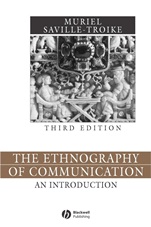
The Ethnography of Communication: An Introduction
ISBN 9780631228424
Autor: Muriel Saville–Troike
Wydawca: Wiley
Dostępność: 3-6 tygodni
Cena: 241,50 zł
Przed złożeniem zamówienia prosimy o kontakt mailowy celem potwierdzenia ceny.
ISBN13: |
9780631228424 |
ISBN10: |
063122842X |
Autor: |
Muriel Saville–Troike |
Oprawa: |
Paperback |
Rok Wydania: |
2002-11-29 |
Numer Wydania: |
3rd Edition |
Ilość stron: |
336 |
Wymiary: |
226x154 |
Tematy: |
CF |
The Ethnography of Communication explores how and why language is used, and how its use varies in different cultures. In this now standard introduction to the subject, Muriel Saville–Troike presents the essential terms and concepts introduced and developed by Dell Hymes and others, and surveys the most important findings and applications of their work. Drawing on insights from social anthropology and psycholinguistics and using examples from many languages and cultures, she builds a model that includes communication within the overall framework of cultural competence.
This third edition has been thoroughly revised to reflect the substantial contributions made in recent years to the development and application of the subject. It includes two completely new chapters on contrasts in patterns of communication and on politeness, power, and politics. The book now incorporates an even broader range of examples and illustrations for analyzing the patterns of communicative phenomena in the languages of the world.
Preface.
1. Introduction:.
Scope and Focus.
Method.
Historical Background.
Significance.
Organization of the Book.
2. Basic Terms, Concepts, and Issues:.
Patterns of Communication.
Communicative Functions.
Speech Community.
Communicative Competence.
The Competence of Incompetence.
Units of Analysis.
Categories of Talk.
Language and Culture.
Social Structure and Ideology.
Routines and Rituals.
Universals and Inequalities.
3. Varieties of Language:.
Language Choice.
Diglossia and Dinomia.
Code–Switching and Style–Shifting.
Code–Markers.
Varieties Associated with Setting.
Varieties Associated with Activity Domain.
Varieties Associated with Region.
Varieties Associated with Ethnicity.
Varieties Associated with Social Class, Status, and Role.
Varieties Associated with Role–Relationships.
Varieties Associated with Sex.
Varieties Associated with Age.
Varieties Associated with Personality States and Abnormal Speech.
Non–Native Varieties.
4. The Analysis of Communicative Events:.
Relationship of Ethnographer and Speech Community.
Types o f Data.
Survey of Data Collection and Analytic Procedures.
Identification of Communicative Events.
Components of Communication.
Relationship among Components.
Elicitation within a Frame.
Analysis of Interaction.
Sample Analyses of Communicative Events.
Further Illustrations of Ethnographic Analysis.
5. Contrasts in Patterns of Communication:.
Comparative Rhetoric.
Historical Development.
Ethnographic Perspective.
Establishing Validity.
Situated Event Analysis.
Other Data Collection and Analytic Procedures.
Cross–Cultural Communication.
Concepts of Face ;.
Constructing an Unseen Face.
6. Attitudes toward Communicative Performance:.
Methodology.
Attitudes Toward Language and Language Skills.
Attitudes Toward Languages and Varieties.
Stereotyping.
Appropriateness.
Language and Identity.
Language Maintenance, Shift, and Spread.
Taboos and Euphemisms.
7. Acquisition of Communicative Competence:.
Early Linguistic Development.
Social Interaction.
Language and Enculturation.
Definition of Stages and Roles.
Communicative Strategies.
Formulaic Expressions.
Nonverbal Communication.
Peer Influence and Extended Acquisition..
Speech Play.
Formal Education.
Multilingual Contexts..
Children s Beliefs about Language.
8. Politeness, Power, and Politics:.
Language and Politics.
Language and Social Theories.
Linguistic Signs of Power.
Linguistic Performances of Power.
Linguistic Resistance and Rebellion.
Language Planning.
Responsibilities and Limitations.
9. Conclusion:.
References.
Index of Languages.
General Index.
Muriel Saville–Troike is Professor in the Department of English at the University of Arizona. She is author of Bilingual Children (1975), Foundations for Teaching English as a Second Language (1976), A Guide to Culture in the Classroom (1978), and co–editor of Perspectives on Silence (with Deborah Tannen, 1985).
"This third edition of The Ethnography of Communication is a real treasure. For someone new to linguistic anthropology in general, or to the ethnography of communication in particular, it provides a thorough and accessible introduction to the basic contents and concepts, vocabulary, methodologies and theories of contemporary research in the intertwined topics of language and culture. For others, it is a refresher course and a briefing on the progress of the past couple of decades... a thoughtful and important work." Journal of Multilingual and Multicultural Development
"If you read one book on the ethnography of communication, read this one. Its coverage of what has been a major area of study for scholars in sociolinguistics, communication, and linguistic anthropology for the past three decades is comprehensive, insightful, and, in this third edition, completely brought up to currency with developments in the field." Ron Scollon, Georgetown University
"This is a fine introductory text and an excellent reference volume as well. In short, it is a first–rate work by a world–class scholar." TESOL Quarterly
"The Ethnography of Communication more than meets the pointed criteria for a good textbook. In addition, it is well written, interesting, and enlightening." Language and Social Psychology
Koszyk
Książek w koszyku: 0 szt.
Wartość zakupów: 0,00 zł
Informacje


Kontakt
Gambit
Centrum Oprogramowania
i Szkoleń Sp. z o.o.
Al. Pokoju 29b/22-24
31-564 Kraków
Siedziba Księgarni
ul. Kordylewskiego 1
31-542 Kraków
+48 12 410 5991
+48 12 410 5987
+48 12 410 5989
Subskrypcje
Administratorem danych osobowych jest firma Gambit COiS Sp. z o.o. Na podany adres będzie wysyłany wyłącznie biuletyn informacyjny.
Autoryzacja płatności

Informacje na temat autoryzacji płatności poprzez PayU.

© Copyright 2012: GAMBIT COiS Sp. z o.o. Wszelkie prawa zastrzeżone.
Projekt i wykonanie: Alchemia Studio Reklamy