


Wydawcy
Katalog tematyczny
- Archeologia (109)
- Ekonomia, finanse, business (13704)
- Filozofia (1445)
- Historia (3040)
- Języki i językoznawstwo (2356)
- Lifestyle, hobby i rozrywka (475)
- Medycyna (9704)
- Nauki humanistyczne (4)
- Nauki o Ziemi i środowisku (2638)
- Nauki ścisłe (20412)
- Nauki społeczne (8486)
- Nauki techniczne (13450)
- Prawo (1696)
- Publikacje informacyjne i interdyscyplinarne (1288)
- Religia i wierzenia (917)
- Technika komputerowa (4067)
- Zdrowie, relacje międzyludzkie i rozwój osobisty (657)





Informacje szczegółowe o książce
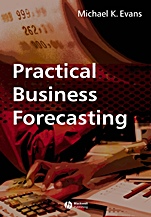
Practical Business Forecasting
ISBN 9780631220657
Autor: Michael K. Evans
Wydawca: Wiley
Dostępność: 3-6 tygodni
Cena: 502,95 zł
Przed złożeniem zamówienia prosimy o kontakt mailowy celem potwierdzenia ceny.
ISBN13: |
9780631220657 |
ISBN10: |
0631220658 |
Autor: |
Michael K. Evans |
Oprawa: |
Hardback |
Rok Wydania: |
2002-04-05 |
Ilość stron: |
528 |
Wymiary: |
264x185 |
Tematy: |
KC |
Stressing the concrete applications of economic forecasting, Practical Business Forecasting is accessible to a wide–range of readers, requiring only a familiarity with basic statistics. The text focuses on the use of models in forecasting, explaining how to build practical forecasting models that produce optimal results. In a clear and detailed format, the text covers estimating and forecasting with single and multi– equation models, univariate time–series modeling, and determining forecasting accuracy. Additionally, case studies throughout the book illustrate how the models are actually estimated and adjusted to generate accurate forecasts. After reading this text, students and readers should have a clearer idea of the reasoning and choices involved in building models, and a deeper foundation in estimating econometric models used in practical business forecasting.
Data and models are are available at: http://www.blackwellpublishing.com/evans/
Spis treści:
Part I: Choosing the Right Type of Forecasting Model:.
Introduction.
1. Statistics, Econometrics, and Forecasting.
2. Concept of Forecast Accuracy: Compared to What?.
Structural Shifts in Parameters.
Model Misspecification.
Missing, Smoothed, Preliminary, or Inaccurate Data.
Changing Expectations by Economic Agents.
Policy Shifts.
Unexpected Changes in Exogenous Variables.
Incorrect Assumptions about Exogenity.
Error Buildup in Multi–Period Forecasts.
3. Alternative Types of Forecasts:.
Point or Interval.
Absolute or Conditional.
Alternative Scenarios Weighed by Probabilities.
Asymmetric.
Single or Multi Period.
Short Run or Long Range.
Forecasting Single or Multiple Variables.
4. Some Common Pitfalls in Building Forecasting Equations:.
Part II: Useful Tools for Practical Business Forecasting:.
Introduction.
5. Types and Sources of Data:.
Time Series, Cross Section, and Pa
nel Data.
Basic Sources of U.S. Government Data.
Major Sources of International Government Data.
Principal Sources of Key Private Sector Data.
6. Collecting Data from the Internet:.
7. Forecasting Under Uncertainty.
8. Utilizing Graphs and Charts.
9. Mean and Variance.
10. Goodness of Fit Statistics:.
Covariance and Correlation Coefficients.
Standard Errors and t–ratios.
F–ratios and Adjusted R–squared.
11. Using the EViews Statistical Package.
12. Utilizing Graphs and Charts.
13. Checklist Before Analyzing Data.
Adjusting for Seasonal Factors.
Checking for Outlying Values.
14. Using Logarithms and Elasticities.
Part III: The General Linear Regression Model:.
Introduction.
15. The General Linear Model:.
The Bivariate Case.
Desirable Properties of Estimators.
Expanding to the Multivariate Case.
16. Uses and Misuses of R–Bar Squared:.
Differences Between R–Square and R–Bar Square.
Pitfalls in Trying to Maximize R–Bar Square.
An Example: the Simple Consumption Function.
17. Measuring And Understanding Partial Correlation:.
Covariance and the Correlation Matrix.
Partial Correlation Coefficients.
Pitfalls Of Stepwise Regression.
18. Testing and Adjusting for Autocorrelation:.
Why Autocorrelation Occurs and What it Means.
Durbin–Watson Statistic to Measure Autocorrelation.
Autocorrelation Adjustments: Cochrane–Orcutt and Hildreth–Lu.
Higher Order Autocorrelation.
Overstatement of t–ratios When Autocorrelation is Present.
Pitfalls of Using the Lagged Dependent Variable.
19. Testing and Adjusting for Heteroscedasticity:.
Causes of Heteroscedasticity in Cross–Section and Time–Series Data.
Measuring and Testing for Heteroscedasticity.
20. Getting Started: An Example in Eviews:.
Case Study #1: Predicting Retail Sales for Hardware Stores.
Case Study #2: German Sho
rt–Term Interest Rates.
Case Study #3: Lumber Prices.
Part IV: Additional Topics for Single–Equation Regression Models:.
Introduction.
21. Problems Caused by Multicollinearity.
22. Eliminating or Reducing Spurious Trends:.
Case Study #4. Demand for Airline Travel.
Log–Linear Transformation.
Percentage First Differences.
Ratios.
Deviations Around Trends.
Weighted Least Squares.
Summary and Comparison of Methods.
23. Distributed Lags:.
General Discussion of Distributed Lags.
Polynomial Distributed Lags.
General Guidelines for Using PDLs.
24. Treatment of Outliers and Issues of Data Adequacy.
Outliers.
Missing Observations.
General Comments of Data Adequacy.
25. Uses and Misuses of Dummy Variables:.
Single–Event Dummy Variables.
Changes in Dummy Variables for Institutional Structure.
Changes in Slope Coefficients.
26. Nonlinear Regressions:.
Log–Linear Regressions.
Quadratic and Other Powers, Including Inverse.
Ceilings, Floors, and Kronecker Deltas: Linearizing with Dummy Variables.
27. General Steps For Formulating A Multiple Regression Equation.
Case Study #5: The Consumption Function.
Case Study #6: Capital Spending.
Part V: Forecasting with a Single–Equation Regression Model:.
Introduction.
28. Checking for Normally Distributed Residuals:.
Higher Order Tests for Autocorrelation.
Tests For Heteroscedasticity.
29. Testing for Equation Stability and Robustness:.
Chow Test for Equation Stability.
Ramsey RESET Test to Detect Misspecification.
Recursive Least Squares – Testing Outside The Sample Period.
Additional Comments on Multicollinearity.
Case Study #7: Demand for Motor Vehicles.
30. Evaluating Forecast Accuracy.
31. The Effect of Forecasting Errors in the Independent Variables.
Case Study #8: Housing Starts.
32. Comparison with Naïve Models:.
Same Level or
Percentage Change.
Naïve Models Using Lagged Values of the Dependent Variables.
33. Adjusting the Coefficients of the Model When Forecasting.
34. Buildup of Forecast Error Outside the Sample Period:.
Increased Distance from the Mean Value.
Unknown Values of Independent Variables.
Error Buildup in Multi Period Forecasting.
Case Study #9: The Yen/Dollar Crossrate.
Part VI: Elements Of Univariate Time–Series Methods:.
Introduction.
35. The Basic Time–Series Decomposition Model.
Case Study #10. General Merchandise Sales.
Identifying the Trend.
Measuring the Seasonal Factor.
Separating Cyclical and Irregular Components.
36. Linear and Nonlinear Trends.
37. Methods of Smoothing Data:.
Arithmetic Moving Averages.
Exponential Smoothing.
Holt–Winters Method.
Hodrick–Prescott Filter.
38. Methods of Seasonal Adjustment:.
Arithmetic and Multiplicative Fixed Weights.
Variable Weights.
Treatment of Outlying Observations.
Seasonal Adjustment Factors with the Census Bureau X–11 Program.
Case Study #11 : Manufacturing Inventory Stocks for Textile Mill Products.
Case Study #12: Seasonally Adjusted Gasoline Prices.
Part VII: Univariate Time Series Modeling and Forecasting:.
Introduction.
39. Box–Jenkins Philosophy: Combining Theoretical and Practical Forecasts.
40. ARIMA Models:.
First–Order Autoregressive Models – AR(1).
AR(2) Models.
AR(N) Models.
Moving Average Models.
ARMA Procedures.
41. Stationary and Integrated Series.
42. Identification.
43. Seasonal Factors in ARMA Modeling.
44. Estimation of ARMA Models.
45. Diagnostic Checking and Forecasting.
Case Study #13: New Orders for Machine Tools.
Case Study #14: Inventory/Sales (I/S) Ratio for SIC 37 (Transportation Equipment).
Case Study #15: Nonfarm Payroll Employment.
Part VIII: Combining Forecasts:.
Introducti
Koszyk
Książek w koszyku: 0 szt.
Wartość zakupów: 0,00 zł
Informacje


Kontakt
Gambit
Centrum Oprogramowania
i Szkoleń Sp. z o.o.
Al. Pokoju 29b/22-24
31-564 Kraków
Siedziba Księgarni
ul. Kordylewskiego 1
31-542 Kraków
+48 12 410 5991
+48 12 410 5987
+48 12 410 5989
Subskrypcje
Administratorem danych osobowych jest firma Gambit COiS Sp. z o.o. Na podany adres będzie wysyłany wyłącznie biuletyn informacyjny.
Autoryzacja płatności

Informacje na temat autoryzacji płatności poprzez PayU.

© Copyright 2012: GAMBIT COiS Sp. z o.o. Wszelkie prawa zastrzeżone.
Projekt i wykonanie: Alchemia Studio Reklamy