


Wydawcy
Katalog tematyczny
- Archeologia (109)
- Ekonomia, finanse, business (13704)
- Filozofia (1445)
- Historia (3040)
- Języki i językoznawstwo (2356)
- Lifestyle, hobby i rozrywka (475)
- Medycyna (9704)
- Nauki humanistyczne (4)
- Nauki o Ziemi i środowisku (2638)
- Nauki ścisłe (20412)
- Nauki społeczne (8486)
- Nauki techniczne (13450)
- Prawo (1696)
- Publikacje informacyjne i interdyscyplinarne (1288)
- Religia i wierzenia (917)
- Technika komputerowa (4067)
- Zdrowie, relacje międzyludzkie i rozwój osobisty (657)





Informacje szczegółowe o książce
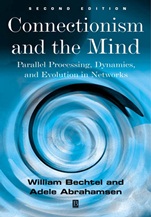
Connectionism and the Mind: Parallel Processing, Dynamics, and Evolution in Networks
ISBN 9780631207139
Autor: William Bechtel, Adele Abrahamsen
Wydawca: Wiley
Dostępność: 3-6 tygodni
Cena: 226,80 zł
Przed złożeniem zamówienia prosimy o kontakt mailowy celem potwierdzenia ceny.
ISBN13: |
9780631207139 |
ISBN10: |
0631207139 |
Autor: |
William Bechtel, Adele Abrahamsen |
Oprawa: |
Paperback |
Rok Wydania: |
2001-11-08 |
Numer Wydania: |
2nd Edition |
Ilość stron: |
424 |
Wymiary: |
244x170 |
Tematy: |
HP |
Connectionism and the Mind provides a clear and balanced introduction to connectionist networks and explores their theoretical and philosophical implications.
As in the first edition, the first few chapters focus on network architecture and offer an accessible treatment of the equations that govern learning and the propagation of activation, including a glossary for reference. The reader is walked step–by–step through such tasks as memory retrieval and prototype formation. The middle chapters pursue the implications of connectionism′s focus on pattern recognition and completion as fundamental to cognition. Some proponents of connectionism have emphasized these functions to the point of rejecting any role for linguistically structured representations and rules, resulting in heated debates with advocates of symbol processing accounts of cognition. The coverage of this controversy has been updated and augmented by a new chapter on modular networks. Finally, three new chapters discuss the relation of connectionism to three emerging research programs: dynamical systems theory, artificial life, and cognitive neuroscience.
Preface.
1. Networks versus Symbol Systems: Two Approaches to Modeling Cognition:.
A Revolution in the Making?.
Forerunners of Connectionism: Pandemonium and Perceptrons.
The Allure of Symbol Manipulation.
The Disappearance and Re–emergence of Network Models.
New Alliances and Unfinished Business.
Notes.
Sources and Suggested Readings.
2. Connectionist Architectures:.
The Flavor of Connectionist Processing: A Simulation of Memory Retrieval.
The Design Features of a Connectionist Architecture.
The Allure of the Connectionist Approach.
Challenges Facing Connectionist Networks.
Summary.
Notes.
Sources and Suggested Readings.
3. Learning:.
Traditional and Contemporary Approaches to Learning.
Connectionist Models of Learning.
Some Issues Regarding Learning.
Notes.
Sources and Suggested Readings.
4. Pattern Recognition and Cognition:.
Networks as Pattern Recognition Devices.
Extending Pattern Recognition to Higher Cognition.
Logical Inference as Pattern Recognition.
Beyond Pattern Recognition.
Notes.
Sources and Suggested Readings.
5. Are Rules Required to Process Representations?:.
Is Language Use Governed by Rules?.
Rumelhart and McClelland′s Model of Past–Tense Acquisition.
Pinker and Prince′s Arguments for Rules.
Accounting for the U–Shaped Learning Function.
Conclusion.
Notes.
Sources and Suggested Readings.
6. Are Syntactically Structured Representations Needed?:.
Fodor and Pylyshyn′s Critique: The Need for Symbolic Representations with Constituent Structure.
First Connectionist Response: Explicitly Implementing Rules and Representations.
Second Connectionist Response: Implementing Functionally Compositional Representations.
Third Connectionist Response: Employing Procedural Knowledge with External Symbols.
Using External Symbols to Provide Exact Symbol Processing.
Clarifying the Standard: Systematicity and Degree of Generalizability.
Conclusion.
Notes.
Sources and Suggested Readings.
7. Simulating Higher Cognition: A Modular Architecture for Processing Scripts:.
Overview of Scripts.
Overview of Miikkulainen′s DISCERN System.
Modular Connectionist Architectures.
FGREP: An Architecture that Allows the System to Devise Its Own Representations.
A Self–organizing Lexicon using Kohonen Feature Maps.
Encoding and Decoding Stories as Scripts.
A Connectionist Episodic Memory.
Performance: Paraphrasing Stories and Answering Questions.
Evaluating DISCERN.
Paths Beyond the First Decade of Connectionism.
Notes.
Sources and Suggested Readings.
8. Connectionism and the Dynamical Approach to Cognition:.
Are We on the Road to a Dynamical Revolution?.
Basic Concepts of DST: The Geometry of Change.
Using Dynamical Systems Tools to Analyze Networks.
Putting Chaos to Work in Networks.
Is Dynamicism a Competitor to Connectionism?.
Is Dynamicism Complementary to Connectionism?.
Conclusion.
Notes.
Sources and Suggested Readings.
9. Networks, Robots, and Artificial Life:.
Robots and the Genetic Algorithm.
Cellular Automata and the Synthetic Strategy.
Evolution and Learning in Food–seekers.
Evolution and Development in Khepera.
The Computational Neuroethology of Robots.
When Philosophers Encounter Robots.
Conclusion.
Sources and Suggested Readings.
10. Connectionism and the Brain:.
Connectionism Meets Cognitive Neuroscience.
Four Connectionist Models of Brain Processes.
The Neural Implausibility of Many Connectionist Models.
Wither Connectionism?.
Notes.
Sources and Suggested Readings.
Appendix A: Notation.
Appendix B: Glossary.
Bibliography.
Name Index.
Subject Index.
William Bechtel is Professor of Philosophy at the University of California, San Diego and Editor of the journal Philosophical Psychology. His publications include Philosophy of Mind (1988), Philosophy of Science (1988), and Discovering Complexity (1993, with Robert Richardson), A Companion to Cognitive Science (with George Graham, Blackwell 1999), Philosophy and the Neurosciences (with Pete Mandik, Jennefer Mundale and Robert S. Stufflebeam, Blackwell 2001).
Adele Abrahamsen is Associate Professor of Psychology and Undergraduate Director of the Philosophy–Neuroscience–Psychology and Linguistics Programs at Washington University in St. Louis. She is the author of Child Language (1977).
"Much more than just an update, this is a thorough and exciting re–build of the classic text. Excellent new treatments of modularity, dynamics, artificial life, and cognitive neuroscience locate connectionism at the very heart of contemporary debates. A superb combination of detail, clarity, scope, and enthusiasm." Andy Clark, University of Sussex
"Connectionism and the Mind is an extraordinarily comprehensive and thoughtful review of connectionism, with particular emphasis on recent developments. This new edition will be a valuable primer to those new to the field. But there is more: Bechtel and Abrahamsen′s trenchant and even–handed analysis of the conceptual issues that are addressed by connectionist models constitute an important original theoretical contribution to cognitive science." Jeff Elman, University of California at San Diego
Koszyk
Książek w koszyku: 0 szt.
Wartość zakupów: 0,00 zł
Informacje


Kontakt
Gambit
Centrum Oprogramowania
i Szkoleń Sp. z o.o.
Al. Pokoju 29b/22-24
31-564 Kraków
Siedziba Księgarni
ul. Kordylewskiego 1
31-542 Kraków
+48 12 410 5991
+48 12 410 5987
+48 12 410 5989
Subskrypcje
Administratorem danych osobowych jest firma Gambit COiS Sp. z o.o. Na podany adres będzie wysyłany wyłącznie biuletyn informacyjny.
Autoryzacja płatności

Informacje na temat autoryzacji płatności poprzez PayU.

© Copyright 2012: GAMBIT COiS Sp. z o.o. Wszelkie prawa zastrzeżone.
Projekt i wykonanie: Alchemia Studio Reklamy