


Wydawcy
Katalog tematyczny
- Archeologia (109)
- Ekonomia, finanse, business (13704)
- Filozofia (1445)
- Historia (3040)
- Języki i językoznawstwo (2356)
- Lifestyle, hobby i rozrywka (475)
- Medycyna (9704)
- Nauki humanistyczne (4)
- Nauki o Ziemi i środowisku (2638)
- Nauki ścisłe (20412)
- Nauki społeczne (8486)
- Nauki techniczne (13450)
- Prawo (1696)
- Publikacje informacyjne i interdyscyplinarne (1288)
- Religia i wierzenia (917)
- Technika komputerowa (4067)
- Zdrowie, relacje międzyludzkie i rozwój osobisty (657)





Informacje szczegółowe o książce
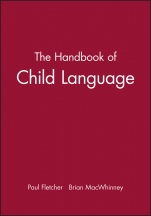
The Handbook of Child Language
ISBN 9780631203124
Autor: Paul Fletcher, Brian MacWhinney
Wydawca: Wiley
Dostępność: 3-6 tygodni
Cena: 318,15 zł
Przed złożeniem zamówienia prosimy o kontakt mailowy celem potwierdzenia ceny.
ISBN13: |
9780631203124 |
ISBN10: |
0631203125 |
Autor: |
Paul Fletcher, Brian MacWhinney |
Oprawa: |
Paperback |
Rok Wydania: |
1996-11-09 |
Ilość stron: |
800 |
Wymiary: |
254x178 |
Tematy: |
CF |
This volume, in its 25 definitive chapters on normal and nonnormal language development, represents the authoritative and up–to–date complete sourcebook on child language development. All aspects of child language development are addressed, including phonetics, phonology, grammar, and lexical development. Connectionism and government–binding theory, as applied to language development, are fully represented. The relevance of input, cognition, and social factors to language development is explored. Chapters on methodology, particularly using computer databases, are provided for both normal and nonnormal acquisition.
List of Contributors. Acknowledgments. Part I: Theory, Method, and Context. Introduction. Theoretical Approaches. 1. Parameters in Acquisition: Jürgen M. Meisel (University of Hamburg). 2. Connectionist Approaches to Language Acquisition: Kim Plunkett (Oxford University). 3. The Impact of Language Socialization on Grammatical Development: Elinor Ochs (University of California at Los Angeles) and Bambi Schieffelin (New York University). Methods. 4. Individual Differences and their Implications for Theories of Language Development: Elizabeth Bates (University of California at San Diego), Philip S. Dale (University of Washington), and Donna Thal (San Diego State University). 5. Computational Analysis of Interactions: Brian MacWhinney (Carnegie Mellon University). Social and Contextual Influences. 6. Issues in the Study of Input: Finetuning, Universality, Individual and Developmental Differences, and Necessary Causes: Catherine E. Snow (Harvard University Graduate School of Education). 7. Discourse Organization and the Development of Reference to Person, Space, and Time: Maya Hickmann (Université René Descartes, Paris Centre National de la Recherche Scientifique, EPHE). 8. Bilingual Language Acquisition: Annick de Houwer (Belgian National Science Foundation and University of Antwerp). 9. Socialization across Contexts: Richard Ely (Boston University) and Jean Berko Gleason (Boston University). Part II: The Emergence and Consolidation of Linguistic Abilities: . Introduction. The Spoken Language: Early Speech Development. 10. Development of the Capacity for Spoken Language: John L. Locke (Massachusetts General Hospital and Harvard Medical School). 11. Phonetic Abilities in the First Year of Life: Ray D. Kent (University of Wisconsin–Madison) and Giuliana Miolo (University of Wisconsin–Madison). 12. Phonological Development: Lise Menn (University of Colorado) and Carol Stoel–Gammon (University of Washington). Learning Words. 13. Early Lexical Development: Martyn Barrett (University of Surrey). 14. Later Lexical Development and Word Formation: Eve V. Clark (Stanford University). 15. The Role of Syntax in Verb Learning: Lila R. Gleitman (University of Pennsylvania) and Jane Gillette (University of Pennsylvania). Learning Grammar. 16. Reinterpreting Children′s Sentence Comprehension: Toward a New Framework: Roberta Michnick Golinkoff (University of Delaware) and Kathy Hirsh–Pasek (Temple University). 17. Strategies in the Acquisition of Syntax: Ann M. Peters (University of Hawai´i). 18. Phrase Structure and Functional Categories: Andrew Radford (University of Essex). 19. Empty Categories and Complex Sentences: The Case of wh–Questions: Jill de Villiers (Smith College). Part III: Nonnormal Language Development. Introduction. 20. Computational Approaches to the Analysis of Language Impairment: Jon F. Miller (University of Wisconsin–Madison) and Thomas Klee (University of Newcastle upon Tyne). 21. Phonological Impairment: Laurence B. Leonard (Purdue University). 22. Grammatical Impairment: Paul Fletcher (Reading University) and Richard Ingham (University of Reading). 23. Pragmatic Impairments: Holly K. Craig (University of Michigan). 24. Language Development in Children and Adolescents with Down Syndrome: Robin S. Chapman (University of Wisconsin–Madison). 25. Lexical and Grammatical Development in Children with Early Hemisphere Damage: A Cross–sectional View from Birth to Adolescence: Julie A. Eisele (Skidmore College) and Dorothy M. Aram (Emerson College). References. Index.
Paul Fletcher is Professor of Linguistics at the University of Reading. Brian MacWhinney is Professor of Psychology at Carnegie Mellon University.
"It has something to offer both the child language specialist, who can follow up specific themes through the extensive bibliography, and the general linguist, whom it provides a state of the art survey." Margaret Deuchar, University of Wales "I consider this to be a useful book ... It has something to offer both the child language specialist, who can follow up specific themes through the extensive bibliography, and the general linguist, to whom it provides with a state of the art survey." Marja Etelamaki, Journal of Linguistics
Koszyk
Książek w koszyku: 0 szt.
Wartość zakupów: 0,00 zł
Informacje


Kontakt
Gambit
Centrum Oprogramowania
i Szkoleń Sp. z o.o.
Al. Pokoju 29b/22-24
31-564 Kraków
Siedziba Księgarni
ul. Kordylewskiego 1
31-542 Kraków
+48 12 410 5991
+48 12 410 5987
+48 12 410 5989
Subskrypcje
Administratorem danych osobowych jest firma Gambit COiS Sp. z o.o. Na podany adres będzie wysyłany wyłącznie biuletyn informacyjny.
Autoryzacja płatności

Informacje na temat autoryzacji płatności poprzez PayU.

© Copyright 2012: GAMBIT COiS Sp. z o.o. Wszelkie prawa zastrzeżone.
Projekt i wykonanie: Alchemia Studio Reklamy