


Wydawcy
Katalog tematyczny
- Archeologia (109)
- Ekonomia, finanse, business (13704)
- Filozofia (1445)
- Historia (3040)
- Języki i językoznawstwo (2356)
- Lifestyle, hobby i rozrywka (475)
- Medycyna (9704)
- Nauki humanistyczne (4)
- Nauki o Ziemi i środowisku (2638)
- Nauki ścisłe (20412)
- Nauki społeczne (8486)
- Nauki techniczne (13450)
- Prawo (1696)
- Publikacje informacyjne i interdyscyplinarne (1288)
- Religia i wierzenia (917)
- Technika komputerowa (4067)
- Zdrowie, relacje międzyludzkie i rozwój osobisty (657)





Informacje szczegółowe o książce
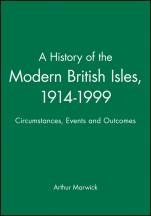
A History of the Modern British Isles, 1914–1999: Circumstances, Events and Outcomes
ISBN 9780631195221
Autor: Arthur Marwick
Wydawca: Wiley
Dostępność: 3-6 tygodni
Cena: 244,65 zł
Przed złożeniem zamówienia prosimy o kontakt mailowy celem potwierdzenia ceny.
ISBN13: |
9780631195221 |
ISBN10: |
063119522X |
Autor: |
Arthur Marwick |
Oprawa: |
Paperback |
Rok Wydania: |
2000-04-17 |
Ilość stron: |
436 |
Wymiary: |
252x181 |
Tematy: |
HB |
This book presents a "total history" of the British Isles from the outbreak of the First World War through to the late 1990s. Written by one of the pioneers of twentieth–century history, the volume offers readers a multi–layered narrative combining social, economic, cultural and political perspectives on this era of significant and rapid change. The author describes the "big events" that dominated British politics through the twentieth–century. He gives due weight to developments outside England in Scotland and Wales, and provides substantial coverage of the Irish question, highlighting the extent to which Ireland has been a preoccupation throughout the period. Alongside this narrative, Professor Marwick explains the underlying forces operating at each stage, linking these long–term "circumstances" to the political decisions of the time. This dual approach allows for penetrating analysis and reflection, helping to create for the reader a full picture of British life in the period. For instance, the book offers not only a discussion of the politics of the First and Second World Wars, but also an analysis of the economic and ideological repercussions of the wars and their consequences for British society at large. The volume also covers themes such as the cultural revolution, women′s and gay liberation, economic recession and recovery, and social change in the 1990s. Professor Marwick writes in an engaging way, suitable for general readers and students. Throughout he emphasizes the "reflexive quality" of the book, inviting readers to reflect on the nature of historical study and to participate actively in the historical enquiry.
Preface. Part I: War, 1914–1918. 1. Irish Nationalists, Ulstermen and the War Against the German Empire: Ireland and Germany. War. Ireland. 2. The Limits on, and the Possibilities of, Change: Fundamental Circumstances governing Change. Ideologies. Institutions. 3. The Politics of Total War: The Liberal Government 1914–15. The Asquith Coalition Government May 1915–December 1916. The Lloyd George Coalition. Votes for Women (and Men). Conscientious Objectors. What about the Workers?. Reconstruction and General Election. Part II: Between Two Wars, 1919–1939. 4. The Structural, Ideological and Institutional Context: Hard Facts. A Divided Country. Political Faiths. 5. The Pendulum that Wouldn′t Swing: High Politics 1919–1939: Ireland. The Government and Labour. Social Reform and Expenditure Cuts. Result, Reform and Expenditure Cuts. Result, and Return, of the Conservatives. The First Labour Government. A Second Baldwin Government. The General Strike. Conservative Social Reform. The Liberal Yellow Book and the 1929 General Election. The Second Labour Government. The National Government.′Secular Anglicanism′ and the ′Social Service State′. Jarrow, Abdication, and Appeasement. 6. Modernism and Mass Society: Modernism in the Arts. Aspects of Mass Society. National Identities. Part III: War and Aftermath, 1939–1955. 7. World War: The Phoney War. The Churchill Coalition. Dunkirk and the Fall of France. The Battle of Britain, the Blitz, and the Battle of the Atlantic. North Africa, the Far East, Italy. The Bombing of Germany. Domestic Politics. The Invasion of France and the End of the War. 8. The Context of Change: Demographics of War. Economic Costs of War. Ideological and Institutional Repercussion of War. 9. Labour Takes Power and Hands it Back to the Conservatives: General Elections 1945–55. Policies of the Labour Government. The Economy under Labour. The Welfare State. Ageing Labour and the Korean War. The Second Churchill Government. 10. Society in the Aftermath of War: Science and Technology. Ireland, Scotland and Wales. The Regions of England. Transport and Ordinary Life. Media and the Arts. Architecture and the Festival of Britain. Part IV: Affluent Britain, 1955–1974. . 11. Structural, Ideological, and Institutional Imperatives. 12. The Politics of Consensus: Suez. Macmillan as Prime Minister. The Labour Opposition. Wilson in Office. From Wilson to Heath. Northern Ireland, c.1963–1975. Enter the Provisional IRA. Economic and Industrial Policies of the Heath Government. 13. The Cultural Revolution: The Basics of Cultural Transformation. Consumerism and Youth. International Success of British Popular Culture. Family, Permissiveness, Frankness. Protest. Women′s Liberation and Gay Liberation. Innovation in the Arts. Multiculturalism. Part V: The Ending of Consensus and The ′Thatcher Revolution′, 1975–1990. . 14. Ideology, Economy and the Advent of Thatcherism: Key Circumstances. Early Thatcherism. Nationalism. Key Statistics. 15. The Collapse of Labour and the Triumph of Thatcher: The Third Wilson Government. The Callaghan Government. Northern Ireland. The End of the Callaghan Government. Thatcher in Power. The Miners′ Strike and Rising Levels of Violence. Prosperity, Privatisation and a Third Election Victory. Thatcher and Ireland. The Fall of Thatcher. 16. The People Versus Their Rulers: A Fractured Society. Economy and Geography. Service, Security and Safety. Welfare ′Reform′. Class, Race, Gender, Religion. Drugs and Crime. Life and Leisure. The Persistence of Permissiveness. Part VI: The Nineties: Nasty, then Nice? . 17. Recession, Recovery – and Recession?. 18. John Major and a Society at Odds with Itself: The Rise of John Major. End of Poll Tax: to ′Heart of Europe′. Election Victory and the Emergence of Tony Blair. Trials and Tribulations of the Major Government. Social Policy (Stingy) and Public Service (Lousy). A Sea of Troubles. Ireland. 19. Consensus Regained?: Ten Contentious Issues. Identities: Ireland, America, Europe.
Professor Arthur Marwick is Hed of the History Department and was founding Professor of History at the Open University. He has held visiting professorships at The State University of New York at Buffalo, Stanford University, L’Ecole des Hautes Etudes en Sciences Sociales in Paris, Rhodes College, Memphis and the University of Perugia. His many books include The Sixties (1998), The Penguin Social History of Britain: British Society since 1945 (1996), The Deluge: British Society and the First World War (1991) and The Nature of History (1989) for which he is currently preparing a fourth edition.
"Lucid, sound and authoritative, it exhibits a deep familiairty with secondary and primary sources, the fruits of a long and productive study of 20th–century British history." Times Higher Education Supplement "This is a useful general history and an invaluable work of reference." Irish Democrat "There are many positive aspects to this book. Above all, it is extremely well written. It also draws upon the author′s extensive and detailed knowledge of the twentieth century ... Marwick′s material on Britian during both wars is impressive. His treatment of cultural and literary issues is impeccable ... The last chapter, ′The Nineties, Nasty, then Nice′ is well drawn and assesses the emergence, achievements and failures of ′New Labour, New Britain′ ... Marwick has produced a book which must be one of the first ports of call for any student seeking a background knowledge of the issues and events of British twentieth–century history." History "... a narrative of high quality, marked by erudition, apposite quotations and economy of words ... Students will undoubtedly benefit from its clarity and range..." Contemporary British History
Koszyk
Książek w koszyku: 0 szt.
Wartość zakupów: 0,00 zł
Informacje


Kontakt
Gambit
Centrum Oprogramowania
i Szkoleń Sp. z o.o.
Al. Pokoju 29b/22-24
31-564 Kraków
Siedziba Księgarni
ul. Kordylewskiego 1
31-542 Kraków
+48 12 410 5991
+48 12 410 5987
+48 12 410 5989
Subskrypcje
Administratorem danych osobowych jest firma Gambit COiS Sp. z o.o. Na podany adres będzie wysyłany wyłącznie biuletyn informacyjny.
Autoryzacja płatności

Informacje na temat autoryzacji płatności poprzez PayU.

© Copyright 2012: GAMBIT COiS Sp. z o.o. Wszelkie prawa zastrzeżone.
Projekt i wykonanie: Alchemia Studio Reklamy