


Wydawcy
Katalog tematyczny
- Archeologia (109)
- Ekonomia, finanse, business (13704)
- Filozofia (1445)
- Historia (3040)
- Języki i językoznawstwo (2356)
- Lifestyle, hobby i rozrywka (475)
- Medycyna (9704)
- Nauki humanistyczne (4)
- Nauki o Ziemi i środowisku (2638)
- Nauki ścisłe (20412)
- Nauki społeczne (8486)
- Nauki techniczne (13450)
- Prawo (1696)
- Publikacje informacyjne i interdyscyplinarne (1288)
- Religia i wierzenia (917)
- Technika komputerowa (4067)
- Zdrowie, relacje międzyludzkie i rozwój osobisty (657)





Informacje szczegółowe o książce
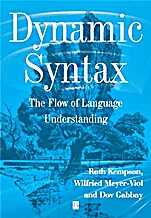
Dynamic Syntax: The Flow of Language Understanding
ISBN 9780631176138
Autor: Ruth Kempson, Wilfried Meyer–Viol, Dov M. Gabbay
Wydawca: Wiley
Dostępność: 3-6 tygodni
Cena: 334,95 zł
Przed złożeniem zamówienia prosimy o kontakt mailowy celem potwierdzenia ceny.
ISBN13: |
9780631176138 |
ISBN10: |
0631176136 |
Autor: |
Ruth Kempson, Wilfried Meyer–Viol, Dov M. Gabbay |
Oprawa: |
Paperback |
Rok Wydania: |
2000-11-30 |
Ilość stron: |
364 |
Wymiary: |
252x182 |
Tematy: |
CF |
This ground–breaking volume sets out an original model of the dynamics of language processing, which can be used to explain the structural properties of language in a simple and elegant way. The model is introduced both informally and formally, and is applied to a range of languages. Alongside formal definitions, the authors use step–by–step derivations and detailed lexical definitions to illustrate this new form of syntactic analysis and to show how the model can be applied to a broad range of languages. In this way, the reader gets a sense of the rich potential the framework provides for general application to linguistic analysis. In bringing together explanations of knowledge of language, and the way language is used in parsing, the book challenges basic assumptions of linguistic theory, and is an essential read for anyone interested in what it means to know a language.
1.Towards a Syntactic Model of Interpretation. Natural Language as a Formal Language?. Underspecification in Language Processing. The Representational Theory of Mind. Pronominal Anaphora: Semantic Problems. The Problem of Multiple Ambiguity. The Problem of Uniqueness. The Problem of Indirect Reference. Quantification. Syntactic Processes of Anaphora. The Anaphora Solution –– Towards a Representational Account. 2. The General Framework. A Preliminary Sketch. The Data Structures of the Parsing Model. Atomic Formulae. Tree Modalities. Basic Tree Structures. Partial Tree Structures. Requirements. Descriptions of Tree Structures. 3. The Dynamics of Tree Building. The Parsing Process – A Sketch. A Basic Example. A Left–Dislocation Example. Verb–final Languages and the Grammar–parser Problem. The Parsing Process Defined. Computational Rules. Lexical Transitions. Pragmatic Actions and Lexical Constraints. Summary. 4. Linked Tree Structures. Relative Clauses –– Preliminaries. The LINK Relation. The Data Reviewed. The Analysis –– A Sketch for English. Defining Linked Tree Structures. Relativisers Annotating Unfixed Nodes. Relatives: Towards a Dynamic Typology. Relativisers Projecting a Requirement. Variation in Locality. Topic Structures and Relatives. Variation in Order –– Head–Final Relatives. Head–internal Relatives. The Potential for Lexical Variation. Genitive Constructions as LINK Structures. Summary. 5. Wh Questions: A General Perspective. Introduction. The Semantic Diversity of wh Questions. Scopal Properties of wh Expressions. Wh –initial vs wh –in–situ Structures. Wh –in–situ Structures. Wh –in–situ from a Dynamic Perspective. Expletive wh Structures. Partial Movement. Partial Movement as a Reflex of a Requirement. Wh Expressions and Scope Effects. 6. Crossover Phenomena. Crossover –– The Problem. Crossover –– The Dynamic Account. Crossover in Relatives. Crossover Phenomena in Questions. Summary. 7. Quantification Preliminaries. Introduction. Scope Effects and Indefinites. Quantification. Quantified NPs. Scope. Term Reconstructions. Applications –– E –type Anaphora. 8. Reflections on Language Design. The Overall Perspective. Underspecification and the Formal Language Metaphor. English is not a Formal Language. Wellformedness and Availability of Interpretations. Universals and Language Variation. On Knowledge of Language. 9. Appendix: The Formal Framework. Introduction. Declarative Structure. Feature Decorated Tree Construction. Goal–directedness. The Structure of Goal–directed Pointed Partial Tree Models. Tree Descriptions. Procedural Structure. Actions over Goal–directed Partial Tree Models. Natural Languages. Axioms. Finite Binary trees. Partial Trees. Requirements. Actions. Partial Order. Logical Forms. Computational Rules. Update Actions. Pragmatic Actions. General Index. Symbol Index.
Ruth Kempson is Leverhulme Research Professor of Linguistics at the Department of Philosophy, King′s College London. She is editor of Mental Representations (1988) and Deduction and Language (1995). Wilfried Meyer–Viol is Lecturer in the Department of Philosophy at King′s College London. He is a logician with a background in psychology who has published on cognitive psychology and on classical, intuitionistic and modal logic. Dov Gabbay is Professor of Computer Science at King′s College London. He is one of the world′s foremost authorities on non–classical logics and their applications in computing. He has published over 170 papers and books on this subject, and initiated several currently active research areas in logic and computation.
"The framework of Dynamic Syntax is the most exciting new development in syntactic theory to emerge in recent years. As well as providing a full introduction to the framework, this book provides in–depth discussions of relative clause constructions, wh questions and crossover phenomena in a range of languages including English, Arabic and Japanese. This book is likely to become a classic and will be of interest to all those interested in the syntactic modelling of natural languages." Ronnie Cann, University of Edinburgh "This is an important book and ... the ideas presented in it deserve the close attention of syntacticians and semanticists." Linguist List
Koszyk
Książek w koszyku: 0 szt.
Wartość zakupów: 0,00 zł
Informacje


Kontakt
Gambit
Centrum Oprogramowania
i Szkoleń Sp. z o.o.
Al. Pokoju 29b/22-24
31-564 Kraków
Siedziba Księgarni
ul. Kordylewskiego 1
31-542 Kraków
+48 12 410 5991
+48 12 410 5987
+48 12 410 5989
Subskrypcje
Administratorem danych osobowych jest firma Gambit COiS Sp. z o.o. Na podany adres będzie wysyłany wyłącznie biuletyn informacyjny.
Autoryzacja płatności

Informacje na temat autoryzacji płatności poprzez PayU.

© Copyright 2012: GAMBIT COiS Sp. z o.o. Wszelkie prawa zastrzeżone.
Projekt i wykonanie: Alchemia Studio Reklamy