


Wydawcy
Katalog tematyczny
- Archeologia (109)
- Ekonomia, finanse, business (13704)
- Filozofia (1445)
- Historia (3040)
- Języki i językoznawstwo (2356)
- Lifestyle, hobby i rozrywka (475)
- Medycyna (9704)
- Nauki humanistyczne (4)
- Nauki o Ziemi i środowisku (2638)
- Nauki ścisłe (20412)
- Nauki społeczne (8486)
- Nauki techniczne (13450)
- Prawo (1696)
- Publikacje informacyjne i interdyscyplinarne (1288)
- Religia i wierzenia (917)
- Technika komputerowa (4067)
- Zdrowie, relacje międzyludzkie i rozwój osobisty (657)





Informacje szczegółowe o książce
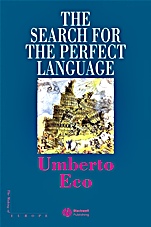
The Search for the Perfect Language
ISBN 9780631174653
Autor: Umberto Eco
Wydawca: Wiley
Dostępność: 3-6 tygodni
Cena: 528,15 zł
Przed złożeniem zamówienia prosimy o kontakt mailowy celem potwierdzenia ceny.
ISBN13: |
9780631174653 |
ISBN10: |
0631174656 |
Autor: |
Umberto Eco |
Oprawa: |
Hardback |
Rok Wydania: |
1995-09-09 |
Ilość stron: |
396 |
Wymiary: |
245x166 |
Tematy: |
CF |
The idea that there once existed a language which perfectly andunambiguously expressed the essence of all possible things andconcepts has occupied the minds of philosophers, theologians,mystics and others for at least two millennia. This is aninvestigation into the history of that idea and of its profoundinfluence on European thought, culture and history.
From the early Dark Ages to the Renaissance it was widelybelieved that the language spoken in the Garden of Eden was justsuch a language, and that all current languages were its decadentdescendants from the catastrophe of the Fall and at Babel. Therecovery of that language would, for theologians, express thenature of divinity, for cabbalists allow access to hidden knowledgeand power, and for philosophers reveal the nature of truth.Versions of these ideas remained current in the Enlightenment, andhave recently received fresh impetus in attempts to create anatural language for artificial intelligence.
The story that Umberto Eco tells ranges widely from the writingsof Augustine, Dante, Descartes and Rousseau, arcane treatises oncabbalism and magic, to the history of the study of language andits origins. He demonstrates the initimate relation betweenlanguage and identity and describes, for example, how and why theIrish, English, Germans and Swedes – one of whom presented Godtalking in Swedish to Adam, who replied in Danish, while theserpent tempted Eve in French – have variously claimed theirlanguage as closest to the original. He also shows how the lateeighteenth–century discovery of a proto–language (Indo–European)for the Aryan peoples was perverted to support notions of racialsuperiority.
To this subtle exposition of a history of extraordinarycomplexity, Umberto Eco links the associated history of the mannerin which the sounds of language and concepts have been written andsymbolized. Lucidly and wittily written, the book is, in sum, atour de force of scholarly detection and culturalinterpretation, providing a series of original perspectives on twothousand years of European History.
The paperback edition of this book is not available throughBlackwell outside of North America.
Series Editor′s Preface.
Introduction.
1. From Adam to Confusio Linguarum. .
Genesis 2, 10, 11.
Before and After Europe.
Side–effects.
A Semiotic Model for Natural Language.
2. The Kabbalistic Pansemioticism. .
The Reading of the Torah.
Cosmic Permutability and the Kabbala of Names.
The Mother Tongue.
3. The Perfect Language of Dante.
Latin and the Vernacular.
Language and Lingusitic Behavior.
The First Gift to Adam.
Dante and Universal Grammar.
The Illustrious Vernacular.
Dante and Abulafia.
4. The Ars Magna of Raymond Lull. .
The Elements of the Ars Combinatoria. .
The Alphabet and the Four Figures.
The Arbor Scientarium.
The Concordia Universalis of Nicholas of Cusa.
5. The Monogenetic Hypothesis and the Mother Tongues..
The Return to Hebrew.
Postel′s Universalistic Utopia.
The Etymological Furor.
Conventionalism, Epicureanism and Polygenesis.
The Pre–Hebraic Language.
The Nationalistic Hypotheses.
Philosophers against Monogeneticism.
A Dream that refused to Die.
New Prospects for the Monogenetic Hypothesis.
6. Kabbalism and Lullism in Modern Culture.
Magic Names and Kabbalistic Hebrew.
Kabbalism and Lullism in the Steganographies.
Lullian Kabbalism.
Bruno: Ars Combinatoria and Infinite Worlds.
Infinite Songs and Locutions.
7. The Perfect Language of Images.
Horapollo′s Hieroglyphica.
The Egyptian Alphabet.
Kircher′s Egyptology.
Kircher′s Chinese.
The Kircherian Ideology.
Later Critics.
The Egyptian vs. the Chinese Way.
Images for Aliens.
8. Magic Language.
Hypotheses.
Dee′s Magic Language.
Perfection and Secrecy.
9. Polygraphies.
Kircher′s Polygraphy.
Beck and Becher.
First Attempts at a Content Organizations.
10. A Priori Philosophical Languages. .
Bacon.
Comenius.
Descarted and Mersenne.
The English Debate on Character and Traits.
Primitives and Organization Content.
11. George Dalgarno.
12. John Wilkins. .
The Tables and the Grammar.
The Real Characters.
The Dictionary: Synonyms, Periphrases, Metaphors.
An Open Classification?.
The Limits of Classification.
The Hypertext of Wilkins.
13. Francis Lodwick. .
14. From Liebniz to the Encyclopédie.
Characteristica and Calculus.
The Problem of the Primitives.
The Encyclopedia and the Aphabet of Thought.
Blind Thought.
The I Ching and the Binary Calculus.
Side–effects.
The ′Library′ of Liebnitz and the Encyclopédie.
15. Philosophic Language from the Enlightenment to Today..
Eighteenth–century Projects.
The Last Flowering of Philosophic Languages.
Space Languages.
Artificial Intelligence.
Some Ghosts of the Perfect Language.
16. The Internatonal Auxiliary Languages.
The Mixed Systems.
The Babel of A Posteriori Languages.
Esperanto.
An Optimized Grammar.
Theoretical Objections and Counter–objections.
The ′Political′ Possibilitites of an IAL.
Limits and Effability of an IAL.
Conclusion.
Translation.
The Gift to Adam.
Notes.
Bibliography.
Index.
Umberto Eco was born in Alessandria in 1932 and has been Professor of Semiotics at the University of Bologna since 1975 and the President of the International Center for Semiotic and Cognitive Studies at the Universityu of San Marino since 1988. His books include The Name of the Rose (1980), Foucault′s Pendulum (1988) and the more recent works include Semiotics and Philosophy of Lanaguage (1984) and The Limits of Interpretation (1990).
"This is as much a history of the study of language and its origins as it is a tour de force pursuit using scholarly detection and cultural interpretation, thus providing a series of original perspectives on two thousand years of European history." The Medieval Review
Koszyk
Książek w koszyku: 0 szt.
Wartość zakupów: 0,00 zł
Informacje


Kontakt
Gambit
Centrum Oprogramowania
i Szkoleń Sp. z o.o.
Al. Pokoju 29b/22-24
31-564 Kraków
Siedziba Księgarni
ul. Kordylewskiego 1
31-542 Kraków
+48 12 410 5991
+48 12 410 5987
+48 12 410 5989
Subskrypcje
Administratorem danych osobowych jest firma Gambit COiS Sp. z o.o. Na podany adres będzie wysyłany wyłącznie biuletyn informacyjny.
Autoryzacja płatności

Informacje na temat autoryzacji płatności poprzez PayU.

© Copyright 2012: GAMBIT COiS Sp. z o.o. Wszelkie prawa zastrzeżone.
Projekt i wykonanie: Alchemia Studio Reklamy