


Wydawcy
Katalog tematyczny
- Archeologia (109)
- Ekonomia, finanse, business (13704)
- Filozofia (1445)
- Historia (3040)
- Języki i językoznawstwo (2356)
- Lifestyle, hobby i rozrywka (475)
- Medycyna (9704)
- Nauki humanistyczne (4)
- Nauki o Ziemi i środowisku (2638)
- Nauki ścisłe (20412)
- Nauki społeczne (8486)
- Nauki techniczne (13450)
- Prawo (1696)
- Publikacje informacyjne i interdyscyplinarne (1288)
- Religia i wierzenia (917)
- Technika komputerowa (4067)
- Zdrowie, relacje międzyludzkie i rozwój osobisty (657)





Informacje szczegółowe o książce
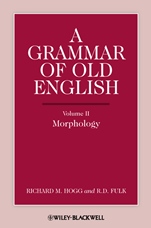
A Grammar of Old English, Volume 2: Morphology
ISBN 9780631136712
Autor: Richard M. Hogg, R. D. Fulk
Wydawca: Wiley
Dostępność: 3-6 tygodni
Cena: 570,15 zł
Przed złożeniem zamówienia prosimy o kontakt mailowy celem potwierdzenia ceny.
ISBN13: |
9780631136712 |
ISBN10: |
0631136711 |
Autor: |
Richard M. Hogg, R. D. Fulk |
Oprawa: |
Hardback |
Rok Wydania: |
2011-01-28 |
Ilość stron: |
410 |
Wymiary: |
254x143 |
Tematy: |
CF |
A Grammar of Old English, Volume II: Morphology completes the two–volume analysis of the sounds and grammatical forms of the Old English language that began with Richard M. Hogg′s highly regarded Grammar of Old English: Phonology . Initiated by Richard Hogg, and revised and completed by R.D. Fulk, this new volume incorporates insights derived from recent theoretical and technological advances, focusing on the morphological structure of Old English words. Most helpful in this regard is the use of digital resources, foremost of which are databases compiled by the Dictionary of Old English project at the University of Toronto . Hogg and Fulk explore the separation of diachronic and synchronic considerations in the frequently complex analysis of noun morphology. This volume also includes extensive bibliographical coverage of Old English morphology, and consideration of recent controversies in Germanic linguistics, particularly in the treatment of verbs. A Grammar of Old English, Volume II: Morphology offers rich and rewarding insights into an important branch of linguistics relating to the development of an early form of the English language. This work, paired with the re–released Volume 1 , is essential for scholars in the field.
Preface. Acknowledgments. List of abbreviations. 1. Preliminaries. 2. Nouns: Stem Classes. I Early backgrounds (§§1 9). II Vocalic stems (§§10 77). 1 a –stem nouns (§§10 33). (a) Simple a –stems (§§11 18). (b) ja –stems (§§19 26). (c) wa –stems (§§27 33). 2 o– stem nouns (§§34 54). (a) Simple o– stems (§§35 44). (b) j o– stems (§§45 51). (c) w o –stems (§§52 4). 3 i –stem nouns (§§55 70). 4 u –stem nouns (§§71 7). III Consonantal stems (§§78 114). 1 n –stem nouns (§§78 90). (a) on –stems (§§80 7). (b) in –stems (§§88 90). 2 r –stem nouns (§§91 4). 3 s –stem nouns (§§95 101). 4 þ –stem nouns (§§102 3). 5 nd –stem nouns (§§104 8). 6 Root–stem nouns (§§109 14). 3. Nouns: Declensions. I Introduction (§§1 6). II as –declension (§§7 72). 1 Inflexions (§§8 11). 2 Allomorphic variation (§§12 72). (a) Restoration of a (§§14 17). (b) Palatalization (§§18 20). (c) Back umlaut (§§21 4). (d) Loss of [h] (§§25 9). (e) Devoicing (§§30 1). (f) Nominative singular in – e (§§32 8). (g) Geminate consonants (§§39 41). (h) Nominative singular in – u (§42). (i) Nominative singular in – w (§§43 9). (j) Apocope (§§50 1). (k) Double plurals (§§52 5). (l) Disyllabic nouns (§§56 72). III a –declension (§§73 104). 1 Inflexions (§§74 80). 2 Allomorphic variation (§§81 104). (a) Restoration of a (§§83 4). (b) Palatalization (§85). (c) Back umlaut (§§86 7). (d) Loss of [h] and final devoicing (§§88 9). (e) Geminate consonants (§§90 1). (f) Stem–final /w/ (§§92 4). (g) Apocope (§§95 9). (h) Disyllabic nouns (§§100 4). IV an –declension (§§105 16). 1 Inflexions (§§106 15). 2 Allomorphic variation (§116). V Minor declensions (§§117 31). 1 Minor a –plurals (§§117 21). 2 Mutation plurals (§§122 7). 3 Miscellanea (§§128 31). VI Gender and declension (§§132 43). 1 Gender (§§133 9). 2 Declension (§§140 3). VII Nominal compounding (§§144 7). 4. Adjectives, Adverbs and Numerals. I Introduction (§§1 3). II Indefinite (strong) adjectives (§§4 56). 1 Historical origins (§§4 8). 2 Inflexions (§§9 20). 3 Allomorphic variation (§§21 56). (a) Restoration of a (§§22 4). (b) Loss of [x] (§§25 30). (c) Nominative singular in – e (§§31 5). (d) Geminate consonants (§§36 7). (e) Nominative singular masculine in – u (§§38 9). (f) Nominative singular in – w (§40). (g) Apocope (§§41 3). (h) Disyllabic and polysyllabic stems (§§44 52). (i) Past participles (§§53 6). III Definite (weak) adjectives (§§57 60). 1 Historical origins and inflexions (§§57 9). 2 Allomorphic variation (§60). IV Comparison of adjectives (§§61 75). 1 Historical origins (§§61 4). 2 Variation in Old English (§§65 75). V Adverbs (§§76 9). VI Numerals (§§80 91). 1 Cardinals (§§80 9). 2 Ordinals (§§90 1). 5. Pronouns. I Introduction (§§1 2). II Demonstrative pronouns (§§3 13). III The anaphoric pronoun (§§14 17). IV Interrogative pronouns (§§18 21). V Personal pronouns (§§22 32). VI Indefinite pronouns (§§33 7). VII Other pronominal types (§§38 9). 6. Verbs. I Early background (§§1 5). II Strong verbs (§§6 76). 1 Inflexions (§§6 30). (a) Indicative present (§§11 20). (b) Indicative preterite (§§21 2). (c) Subjunctive (§§23 5). (d) Imperative (§26). (e) Non–finite forms (§§27 30). 2 Stems (§§31 76). (a) Ablaut patterns (§§33 6). (b) Variant stem types (§§37 42). (i) Weak presents (§37). (ii) Contracted verbs (§§38 41). (iii) Alternations under Verner’s Law (§42). (c) Classes of strong verbs (§§43 76). (i) Class 1 (§§43 6). (ii) Class 2 (§§47 50). (iii) Class 3 (§§51 7). (iv) Class 4 (§§58 60). (v) Class 5 (§§61 4). (vi) Class 6 (§§65 8). (vii) Class 7 (§§69 76). III Weak verbs (§§77 130). 1 Weak class I (§§78 103). (a) Inflexions (§§80 8). (b) Stems (§§89 103). (i) Stems with original geminate (§92). (ii) Stems in dental consonant (§§93 5). (iii) Stems in original final sonorant (§§96 8). (iv) Contracted verbs with loss of [h] (§99). (v) Stems in final velar consonant (§§100 3). 2 Weak class II (§§104 20). (a) Inflexions (§§106 13). (b) Stems (§§114 20). 3 Weak class III (§§121 30). (a) Inflexions (§122 6). (b) Stems (§§127 30). IV Preterite–present verbs (§§131 44). 1 Inflexion and classes (§§132 40). (a) Classes 1 and 2 (§§133 4). (b) Class 3 (§§135 6). (c) Classes 4 and 5 (§§137 8). (d) Classes 6 and 7 (§§139 40). 2 Historical development (§§141 4). V Athematic verbs (§§145 63). 1 The verb b eon , wesan (§§146 51). 2 The verb d on (§§152 5). 3 The verb g an (§§156 9). 4 The verb willan (§§160 3). References. Word index. Subject Index.
The late Richard M. Hogg was Professor of English Language at the University of Manchester. He was the General Editor of the Cambridge History of the English Language and author, with C. B. McCully, of Metrical Phonology: A Coursebook (1987), and editor, with David Denison, of A History of the English Language (2008). R. D. Fulk is Chancellor′s Professor of English at Indiana University. His books include The Origins of Indo–European Quantitative Ablaut (1986), A History of Old English Meter (1992), and as editor, with Robert E. Bjork and John D. Niles, Klaeber′s Beowulf and the Fight at Finnsburg, 4th Edition (2008).
“Above all, A Grammar of Old English. Volume 2: Morphology definitely serves its purpose as a work of reference. Its paragraphs are numbered separately and the inclusion of indexes of words as well as of subjects makes the work easy to consult. These features, combined with the undisputed quality of its contents, make this volume the reference work of choice for all Old English scholars and their overly ambitious students.” ( English Studies , 1 October 2013 “Old English has a new authoritative grammar that will take its place as a reliable resource for decades to come and inspire more studies on the language. It is a striking accomplishment.” ( English Language and Linguistics, 1 January 2013)
Koszyk
Książek w koszyku: 0 szt.
Wartość zakupów: 0,00 zł
Informacje


Kontakt
Gambit
Centrum Oprogramowania
i Szkoleń Sp. z o.o.
Al. Pokoju 29b/22-24
31-564 Kraków
Siedziba Księgarni
ul. Kordylewskiego 1
31-542 Kraków
+48 12 410 5991
+48 12 410 5987
+48 12 410 5989
Subskrypcje
Administratorem danych osobowych jest firma Gambit COiS Sp. z o.o. Na podany adres będzie wysyłany wyłącznie biuletyn informacyjny.
Autoryzacja płatności

Informacje na temat autoryzacji płatności poprzez PayU.

© Copyright 2012: GAMBIT COiS Sp. z o.o. Wszelkie prawa zastrzeżone.
Projekt i wykonanie: Alchemia Studio Reklamy