


Wydawcy
Katalog tematyczny
- Archeologia (109)
- Ekonomia, finanse, business (13704)
- Filozofia (1445)
- Historia (3040)
- Języki i językoznawstwo (2356)
- Lifestyle, hobby i rozrywka (475)
- Medycyna (9704)
- Nauki humanistyczne (4)
- Nauki o Ziemi i środowisku (2638)
- Nauki ścisłe (20412)
- Astronomia (294)
- Biologia (5119)
- Biochemia (575)
- Biologia człowieka (14)
- Biologia komórkowa (377)
- Biologia molekularna (398)
- Biologia rozwoju (130)
- Biologia, ogólnie (1277)
- Botanika (280)
- Hydrobiologia (92)
- Mikrobiologia (363)
- Mykologia (22)
- Zoologia (303)
- Chemia (6540)
- Fizyka (3309)
- Matematyka (4574)
- Nauki ścisłe, ogólnie (503)
- Nauki społeczne (8486)
- Nauki techniczne (13450)
- Prawo (1696)
- Publikacje informacyjne i interdyscyplinarne (1288)
- Religia i wierzenia (917)
- Technika komputerowa (4067)
- Zdrowie, relacje międzyludzkie i rozwój osobisty (657)





Informacje szczegółowe o książce
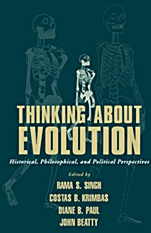
Thinking about Evolution
ISBN 9780521620703
Autor: Edited by Rama S. Singh , Costas B. Krimbas , Diane B. Paul , John Beatty
Wydawca: Cambridge University Press
Dostępność: 3-6 tygodni
Cena: 719,25 zł
Przed złożeniem zamówienia prosimy o kontakt mailowy celem potwierdzenia ceny.
ISBN13: |
9780521620703 |
ISBN10: |
0521620708 |
Autor: |
Edited by Rama S. Singh , Costas B. Krimbas , Diane B. Paul , John Beatty |
Oprawa: |
Hardback |
Rok Wydania: |
2001-01-11 |
Ilość stron: |
600 |
Wymiary: |
234 x 156 mm |
Tematy: |
Genetics (non-medical) |
This is the second of two volumes published by Cambridge University Press in honor of Richard Lewontin.
The first volume, Evolutionary Genetics from Molecules to Morphology, honors Lewontin’s more technical contributions to genetics and evolutionary biology.
In this second volume of essays, we honor the philosophical, historical, and political dimensions of his work.
It is fitting that the volume covers such a wide range of perspectives on modern biology, given the range of Lewontin’s own contributions.
He is not just a very successful practitioner of evolutionary genetics, but a rigorous critic of the practices of genetics and evolutionary biology and an articulate analyst of the social, political and economic contexts and consequences of genetic and evolutionary research.
The volume begins with an essay by Lewontin on Natural History and Formalism in Evolutionary Genetics.
Chapter 2 is an extended interview with Lewontin, covering the history of evolutionary genetics as seen from his perspective and as exemplified by his career.
The remaining chapters, contributed by former students, post-docs, colleagues and collaborators, cover issues ranging from the history and conceptual foundations of evolutionary biology and genetics, to the implications of human genetic diversity, to the political economy of agriculture and public health.
Spis treści:
Preface
Introduction
1. Does culture evolve? Richard Lewontin
Part A. History of and in Evolutionary Biology
2. The nature of evolutionary biology, an interchange among Richard Lewontin, Diane Paul, John Beatty and Costas Krimbas
3. Hannah Arendt and Karl Popper, Darwinism, Fatalism and Totalitarianism John Beatty
4. The genetics of experimental populations, LHeritier and Teissers population cages Jean Gayon and Michel Veuille
5. Did eugenics rest on an elementary mistake? Diane Paul and Hamish Spencer
6. Can the norm of reaction save the gene concept? Rafi Falk
7. The apportionment of human diversity twenty-five years later Maryellen Ruvolo and Mark Seielstad
8. The Indian caste system, origin, evolution and impact on human diversity Rama Singh
Part B. Philosophy of Evolutionary Biology
9. Selfish genes or developmental systems? Russel Gray
10. The evolutionary definition of selective agency, the validation of the theory of hierarchical selection, and the fallacy of the selfish gene Stephen J. Gould
11. Reductionism in genetics and the human genome project Sahotra Sarkar
12. Organism and environment Peter Godfrey-Smith
13. Levels and units of selection Lisa Lloyd
14. In defense of neo-Darwinism, Poppers Darwinism as a metaphysical programme revisited Costas Krimbas
15. The two faces of fitness Elliot Sober
16. Evolvability, adaptation and modularity Jeffrey C. Schank and Bill Wimsatt
17. Organism and environment revisited Robert Brandon
18. An irreducible component of cognition Massimo Piattelli-Palmarini
Part C. The Politics of Evolutionary Biology
19. What causes cancer? A political history of recent debates Robert Proctor
20. Battling the undead, how (and how not) to resist genetic determinism Philip Kitcher
21. The rise of neurogenetic determinism Steven Rose
22. Behavior genetics, Galens prophecy or Malpighis legacy? Evan Balaban
23. Identity politics and biology Ruth Hubbard
24. The agroecosystem, the modern vision in crisis, the alternative evolving John Vandermeer
25. Political economy of agricultural genetics Jean-Pierre Berlan
26. The butterfly ex machina Richard Levins
27. Evoking transmutational dread, military and civilian uses of nuclear and genetic alchemies Robert Haynes
28. From natural selection to natural construction to disciplining unruly complexity, the challenge of integrating ecological dynamics into evolutionary theory Peter Taylor.
Koszyk
Książek w koszyku: 0 szt.
Wartość zakupów: 0,00 zł
Informacje


Kontakt
Gambit
Centrum Oprogramowania
i Szkoleń Sp. z o.o.
Al. Pokoju 29b/22-24
31-564 Kraków
Siedziba Księgarni
ul. Kordylewskiego 1
31-542 Kraków
+48 12 410 5991
+48 12 410 5987
+48 12 410 5989
Subskrypcje
Administratorem danych osobowych jest firma Gambit COiS Sp. z o.o. Na podany adres będzie wysyłany wyłącznie biuletyn informacyjny.
Autoryzacja płatności

Informacje na temat autoryzacji płatności poprzez PayU.

© Copyright 2012: GAMBIT COiS Sp. z o.o. Wszelkie prawa zastrzeżone.
Projekt i wykonanie: Alchemia Studio Reklamy