


Wydawcy
Katalog tematyczny
- Archeologia (109)
- Ekonomia, finanse, business (13704)
- Filozofia (1445)
- Historia (3040)
- Języki i językoznawstwo (2356)
- Lifestyle, hobby i rozrywka (475)
- Medycyna (9704)
- Nauki humanistyczne (4)
- Nauki o Ziemi i środowisku (2638)
- Nauki ścisłe (20412)
- Nauki społeczne (8486)
- Nauki techniczne (13450)
- Prawo (1696)
- Publikacje informacyjne i interdyscyplinarne (1288)
- Religia i wierzenia (917)
- Technika komputerowa (4067)
- Zdrowie, relacje międzyludzkie i rozwój osobisty (657)





Informacje szczegółowe o książce
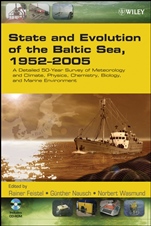
State and Evolution of the Baltic Sea, 1952–2005: A Detailed 50–Year Survey of Meteorology and Climate, Physics, Chemistry, Biology, and Marine Environment
ISBN 9780471979685
Autor: Rainer Feistel, Günther Nausch, Norbert Wasmund
Wydawca: Wiley
Dostępność: 3-6 tygodni
Cena: 1 266,30 zł
Przed złożeniem zamówienia prosimy o kontakt mailowy celem potwierdzenia ceny.
ISBN13: |
9780471979685 |
ISBN10: |
0471979686 |
Autor: |
Rainer Feistel, Günther Nausch, Norbert Wasmund |
Oprawa: |
Hardback |
Rok Wydania: |
2008-05-23 |
Ilość stron: |
704 |
Wymiary: |
256x183 |
Tematy: |
AT |
Based on a fifty–year study conducted by the Leibniz Institute for Baltic Sea Research, this book brings together a comprehensive summary of their observations and findings. Written by well–known experts, this revealing book concentrates on long–term changes in the Baltic Sea—which can be extrapolated to shed light on the environmental problems of other shelf seas, brackish seas, and large estuaries—thereby contributing to our understanding of water exchange processes, eutrophication, and climatic impacts at the forefront of international concern.
Spis treści:
1. Introduction.
2. General oceanography of the Baltic Sea.
2.1.Specific natural conditions and their consequences.
2.2.Estuarine circulation.
2.2.1.Long term exchange.
2.2.2.Short term barotropic exchange.
2.2.3.Stratification and mixing in the channels.
2.2.4.Quantifying the stochastic salt exchange associated with the barotropic water exchange.
2.3.Wind driven currents.
2.3.1.Ekman current and transport.
2.3.2.Upwelling and coastal jets.
2.4.Surface waves, tides, seiches, surges.
2.4.1.Surface gravity waves.
2.4.2.Seiches and wind stau.
2.4.3.Tides.
2.5.Kelvin waves, topographic waves and eddies.
2.5.1.Kelvin waves.
2.5.2.Coastal trapped waves and continental shelf waves.
2.5.3.Eddies.
2.6.Internal waves, turbulence, diapycnical mixing.
2.6.1.Introduction.
2.6.2.Vertical mixing in the interior.
2.7.References.
3. The history of long–term observations in Warnemünde.
3.1.Introduction.
3.2.Ship–borne measurements at fixed stations.
3.2.1.Basic oceanographic instrumentation for ship–borne measurements.
3.2.2.Oceanographic observations in the 1950s and 1960s.
3.2.3.International cooperation 1969–2005.
3.2.4.Activities in the frame of BMP, 1979–2005.
3.3.Buoy stations and measuring platforms.
3.3.1.The first buoy stat
ions.
3.3.2.MARNET stations.
3.3.3.Current meter stations in the central Baltic Sea.
3.4.Parameters measured.
3.5.Data quality.
3.6.References110.
4. Weather of the Baltic Sea.
4.1.Introduction.
4.2.Extreme weather conditions.
4.2.1.Hurricanes, gales.
4.2.2.Storm surges.
4.3.Special weather situations.
4.3.1.Baltic cyclones.
4.3.2.Land and sea breeze.
4.3.3.Warnemnder wind.
4.3.4.General Vb– and Omega–weather types.
4.4.Greenhouse effect.
4.5.Acknowledgment.
4.6.References.
5. Baltic climate change.
5.1.Introduction.
5.2.Seasonal cycles.
5.3.Climatic trends.
5.4.Climatic variability.
5.4.1.Year–to–year fluctuations.
5.4.2.Decadal scale changes.
5.4.3.Possible trigger mechanisms.
5.5.Conclusions and outlook.
5.6.References.
6. Current Observations in the western Baltic Sea.
6.1.Introduction.
6.2.Great Belt and Fehmarnbelt.
6.2.1.Great Belt.
6.2.2.Fehmarnbelt.
6.3.Arkona Sea West and Drogden Sill.
6.3.1.Darss Sill.
6.3.2.Drogden Sill.
6.3.3.From Kriegers Flak to Hiddensee.
6.4.Around Rgen.
6.4.1.West off Hiddensee.
6.4.2.Wittow.
6.4.3.Kap Arkona.
6.4.4.Tromper Wiek.
6.4.5.From Landtief A to Jan Heweliusz.
6.4.6.Oderbank.
6.5.Conclusions.
6.6.Acknowledgement.
6.7.References.
7. Sea state and tides.
7.1.Sea state.
7.1.1.History of observation and research.
7.1.2.Observation and measurement.
7.1.3.Sea state characteristics and wave generating factors.
7.1.3.1.Wind sea characteristics.
7.1.3.2.Wave height frequency distribution.
7.1.3.3.Wave spectra.
7.1.3.4.Wave generating and wave modifying factors (wind, fetch, wind duration, water depth).
7.1.3.5.Special phenomena (air–sea temperature, currents, crossing seas).
7.1.4.Calculation and forecast of the sea state.
7.1.4.1.Empirical wave parameter calculation.
7.1.4.2.Empirical wave spectr
a.
7.1.4.3.Numerical models.
7.1.5.Wave climatology.
7.1.5.1.Open sea wave climate.
7.1.5.2.Wave climate of the coastal zone.
7.1.6.Extreme wave conditions.
7.2.Tides.
7.2.1.History of tidal research in the Baltic Sea.
7.2.2.Theory of tides in the Baltic Sea and a proper model concept.
7.2.3.Modelling of co–oscillating and direct tides.
7.3.References.
8. Ice.
8.1.Introduction.
8.2.The Baltic Sea and winter time maritime transportation.
8.3.Frequency of ice occurrence in the Baltic Sea as well as mean and extreme ice parameters from representative stations in the period 1956 – 2005.
8.4.Ice conditions in the Baltic Sea and adjacent waters in 1956 – 2005.
8.4.1.Transition area between the North Sea and Baltic Sea.
8.4.2.Western Baltic.
8.4.3.Southern Baltic.
8.4.4.Northern Baltic.
8.4.5.Gulf of Riga.
8.4.6.Gulf of Finland.
8.4.7.Gulf of Bothnia.
8.5.Classification of ice winters.
8.5.1.Maximum extent of ice cover in the Baltic Sea 1720 – 2005.
8.5.2.Ice winter severity indicator – Swedish coast.
8.5.3.Ice winter severity indicator for the Southern Baltic Sea.
8.5.4.Accumulated areal ice volume for the Western Baltic Sea.
8.5.5.Changes of sea ice conditions in the Western Baltic from 1300 to present.
8.6.References.
9. Satellite–derived Sea Surface Temperature for the period 1990 – 2005.
9.1.Introduction.
9.2.Methodology.
9.3.Seasonal, regional, and inter–annual variations of SST in the Baltic Sea.
9.4.Trends in the development of SST.
9.5.Relation to climate indices.
9.6.Regional particularities in SST–Patterns.
9.6.1.Upwelling and other dynamical features in the Baltic Sea.
9.6.2.Oder river discharge and Oder flood.
9.6.3.Coastal wind–driven processes along the German Baltic Sea coast.
9.7.Summary and conclusions.
9.8.Acknowledgment.
9.9.References.
10. The inflo
w of highly saline water into the Baltic Sea.
10.1.Introduction.
10.2.The causes of MBIs and their basic impact on the Baltic Sea.
10.3.The statistical analysis of major Baltic inflows.
10.4.The analysis of selected events.
10.4.1.MBIs in the 1950s and 1960s.
10.4.2.The 1970s.
10.4.3.The very strong MBI in January 1993.
10.4.4.The warm water MBI in autumn 1997.
10.4.5.The specific MBI in January 2003.
10.5.The analysis of baroclinic summer inflows.
10.6.The effects of MBIs and baroclinic summer inflows in the central Baltic deep water.
10.6.1.The effects on the hydrographic parameters temperature, salinity and oxygen concentration.
10.6.2.The effects on inorganic nutrients.
10.7.References.
11. BALTIC: Monthly time series 1900 – 2005.
11.1.Introduction.
11.2.Data material.
11.3.Quality control and uncertainties.
11.3.1.IOW data.
11.3.2.SMHI data.
11.3.3.NERI data.
11.3.4.IMGW data.
11.3.5.Additional data.
11.4.Monthly time series 1900 – 2005.
11.5.References.
12. Nutrient concentrations, trends and their relation to eutrophication.
12.1.Introduction.
12.2.Nutrient inputs.
12.3.Annual inorganic nutrient cycles and long term nutrient trends in the surface layer.
12.4.Inorganic nutrient reservoirs in the deep basins.
12.5.Organic nutrients.
12.6.Conclusions.
12.7.References.
13. Trace metals in Baltic Seawater.
13.1.The state of knowledge until 1993.
13.2.Trace metal trends in the western and central Baltic Sea between saltwater inflow events in 1993 and 2003.
13.3.The influence of major saltwater inflow events and stagnant anoxic deepwater conditions on trace metal trends in the Gotland Deep.
13.3.1.Pb, Cd, Cu, and Zn trends "Above and Below Halocline".
13.3.2.Quantification of trace metal fluxes across the redox interface caused by vertical turbulent mixing..
13.3.3.The relation between external and internal flu
Koszyk
Książek w koszyku: 0 szt.
Wartość zakupów: 0,00 zł
Informacje


Kontakt
Gambit
Centrum Oprogramowania
i Szkoleń Sp. z o.o.
Al. Pokoju 29b/22-24
31-564 Kraków
Siedziba Księgarni
ul. Kordylewskiego 1
31-542 Kraków
+48 12 410 5991
+48 12 410 5987
+48 12 410 5989
Subskrypcje
Administratorem danych osobowych jest firma Gambit COiS Sp. z o.o. Na podany adres będzie wysyłany wyłącznie biuletyn informacyjny.
Autoryzacja płatności

Informacje na temat autoryzacji płatności poprzez PayU.

© Copyright 2012: GAMBIT COiS Sp. z o.o. Wszelkie prawa zastrzeżone.
Projekt i wykonanie: Alchemia Studio Reklamy