


Wydawcy
Katalog tematyczny
- Archeologia (109)
- Ekonomia, finanse, business (13704)
- Filozofia (1445)
- Historia (3040)
- Języki i językoznawstwo (2356)
- Lifestyle, hobby i rozrywka (475)
- Medycyna (9704)
- Nauki humanistyczne (4)
- Nauki o Ziemi i środowisku (2638)
- Nauki ścisłe (20412)
- Astronomia (294)
- Biologia (5119)
- Chemia (6540)
- Fizyka (3309)
- Elektryczność i magnetyzm (90)
- Fizyka atomowa i molekularna (110)
- Fizyka cząstek elementarnych (36)
- Fizyka jądra atomowego (36)
- Fizyka kwantowa (210)
- Fizyka matematyczna (121)
- Fizyka relatywistyczna (36)
- Fizyka statystyczna (51)
- Fizyka stosowana (498)
- Mechanika klasyczna (186)
- Optyka i światło (133)
- Stany materii (202)
- Matematyka (4574)
- Nauki ścisłe, ogólnie (503)
- Nauki społeczne (8486)
- Nauki techniczne (13450)
- Prawo (1696)
- Publikacje informacyjne i interdyscyplinarne (1288)
- Religia i wierzenia (917)
- Technika komputerowa (4067)
- Zdrowie, relacje międzyludzkie i rozwój osobisty (657)





Informacje szczegółowe o książce
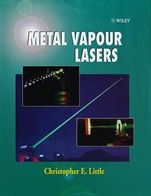
Metal Vapour Lasers: Physics, Engineering and Applications
ISBN 9780471973874
Autor: Christopher E. Little
Wydawca: Wiley
Dostępność: 3-6 tygodni
Cena: 2 735,25 zł
Przed złożeniem zamówienia prosimy o kontakt mailowy celem potwierdzenia ceny.
ISBN13: |
9780471973874 |
ISBN10: |
0471973874 |
Autor: |
Christopher E. Little |
Oprawa: |
Hardback |
Rok Wydania: |
1999-01-26 |
Ilość stron: |
646 |
Wymiary: |
256x193 |
Tematy: |
PH |
Metal Vapour Lasers Christopher E. Little University of St Andrews, St Andrews, Scotland Since the first successful demonstration of a metal vapour laser (MVL) in 1962, this class of laser has become widely used in a broad range of fields including precision materials processing, isotope separation and medicine. The MVLs that are used today have a range of impressive characteristics that are not readily available using other technologies. In particular, the combination of high average output powers, pulse recurrence frequencies and beam quality available from green/yellow Cu vapour lasers (CVLs) and Cu bromide lasers, coupled with the high–quality, multiwatt ultraviolet (265–289 nm) radiation that can be produced using simple nonlinear optical techniques, means that Cu lasers will continue to be important for many years. Metal Vapour Lasers covers all the most commercially important and scientifically interesting pulsed and continuous wave (CW) gas–discharge MVLs, and includes device histories, operating characteristics, engineering, kinetics, commercial exploitation and applications. Short descriptions of gas discharges and excitation techniques make this volume self–consistent. A comprehensive bibliography is also provided. The greater part of this book is devoted to CVLs and their variants, including new sealed–off, high–power ′kinetically enhanced′ CVLs and Cu bromide lasers. However, many other self–terminating MVLs are also discussed, including the red AuVL, green/infrared MnVL and infrared BaVL. Pulsed, high–gain, high average power lasers in the UV/violet (373.7, 430.5 nm) spectral regions are represented by Sr¯+ and Ca¯+ discharge–afterglow recombination lasers. The most commercially successful of the MVLs – the CW, UV/blue cataphoretic He–Cd¯+ ion laser – is described. Hollow cathode lasers are represented in two guises: ′white light′ (blue/green
/red) He–Cd¯+ ion lasers and UV/infrared Ne/He–Cu¯+ ion lasers. This unique volume is an essential reference source for all those working on metal vapour lasers, and all those who use them, from postgraduate students through to experienced scientists and engineers. It will also be extremely useful to all those working in other gas laser technologies, and in gas discharge physics.
Spis treści:
Self–terminating Metal Vapour Lasers.
Copper Vapour Lasers.
Molecular–donor Copper Lasers.
Engineering and Electrical Excitation of Pulsed Copper Lasers.
Gain Behaviour, Optical Resonators and Beam Quality of Pulsed Copper Lasers.
Frequency Extension of Copper Lasers and Other Resonance–metastable MVLs.
Applications of Copper Lasers and Other Resonance–metastable Metal Vapour Lasers.
Strontium and Calcium Ion Recombination Lasers.
Cataphoretic Helium–Cadmium Ion Lasers.
White–light Helium–Cadmium Ion Lasers.
Ultraviolet and Infrared Copper, Silver and Gold Ion Lasers.
Bibliography.
Index.
Okładka tylna:
Metal Vapour Lasers Christopher E. Little University of St Andrews, St Andrews, Scotland Since the first successful demonstration of a metal vapour laser (MVL) in 1962, this class of laser has become widely used in a broad range of fields including precision materials processing, isotope separation and medicine. The MVLs that are used today have a range of impressive characteristics that are not readily available using other technologies. In particular, the combination of high average output powers, pulse recurrence frequencies and beam quality available from green/yellow Cu vapour lasers (CVLs) and Cu bromide lasers, coupled with the high–quality, multiwatt ultraviolet (265–289 nm) radiation that can be produced using simple nonlinear optical techniques, means that Cu lasers will continue to be important for many years. Met
al Vapour Lasers covers all the most commercially important and scientifically interesting pulsed and continuous wave (CW) gas–discharge MVLs, and includes device histories, operating characteristics, engineering, kinetics, commercial exploitation and applications. Short descriptions of gas discharges and excitation techniques make this volume self–consistent. A comprehensive bibliography is also provided. The greater part of this book is devoted to CVLs and their variants, including new sealed–off, high–power ′kinetically enhanced′ CVLs and Cu bromide lasers. However, many other self–terminating MVLs are also discussed, including the red AuVL, green/infrared MnVL and infrared BaVL. Pulsed, high–gain, high average power lasers in the UV/violet (373.7, 430.5 nm) spectral regions are represented by Sr¯+ and Ca¯+ discharge–afterglow recombination lasers. The most commercially successful of the MVLs – the CW, UV/blue cataphoretic He–Cd¯+ ion laser – is described. Hollow cathode lasers are represented in two guises: ′white light′ (blue/green/red) He–Cd¯+ ion lasers and UV/infrared Ne/He–Cu¯+ ion lasers. This unique volume is an essential reference source for all those working on metal vapour lasers, and all those who use them, from postgraduate students through to experienced scientists and engineers. It will also be extremely useful to all those working in other gas laser technologies, and in gas discharge physics.
Koszyk
Książek w koszyku: 0 szt.
Wartość zakupów: 0,00 zł
Informacje


Kontakt
Gambit
Centrum Oprogramowania
i Szkoleń Sp. z o.o.
Al. Pokoju 29b/22-24
31-564 Kraków
Siedziba Księgarni
ul. Kordylewskiego 1
31-542 Kraków
+48 12 410 5991
+48 12 410 5987
+48 12 410 5989
Subskrypcje
Administratorem danych osobowych jest firma Gambit COiS Sp. z o.o. Na podany adres będzie wysyłany wyłącznie biuletyn informacyjny.
Autoryzacja płatności

Informacje na temat autoryzacji płatności poprzez PayU.

© Copyright 2012: GAMBIT COiS Sp. z o.o. Wszelkie prawa zastrzeżone.
Projekt i wykonanie: Alchemia Studio Reklamy