


Wydawcy
Katalog tematyczny
- Archeologia (109)
- Ekonomia, finanse, business (13704)
- Filozofia (1445)
- Historia (3040)
- Języki i językoznawstwo (2356)
- Lifestyle, hobby i rozrywka (475)
- Medycyna (9704)
- Nauki humanistyczne (4)
- Nauki o Ziemi i środowisku (2638)
- Nauki ścisłe (20412)
- Astronomia (294)
- Biologia (5119)
- Chemia (6540)
- Chemia analityczna (361)
- Chemia fizyczna (346)
- Chemia nieorganiczna (137)
- Chemia organiczna (535)
- Krystalografia (27)
- Minerologia (46)
- Fizyka (3309)
- Matematyka (4574)
- Nauki ścisłe, ogólnie (503)
- Nauki społeczne (8486)
- Nauki techniczne (13450)
- Prawo (1696)
- Publikacje informacyjne i interdyscyplinarne (1288)
- Religia i wierzenia (917)
- Technika komputerowa (4067)
- Zdrowie, relacje międzyludzkie i rozwój osobisty (657)





Informacje szczegółowe o książce
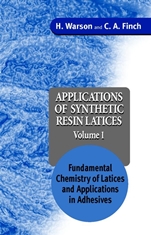
Applications of Synthetic Resin Latices: Fundamental Chemistry of Latices and Applications in Adhesives
ISBN 9780471952688
Autor: H. Warson, C. A. Finch
Wydawca: Wiley
Dostępność: 3-6 tygodni
Cena: 2 198,70 zł
Przed złożeniem zamówienia prosimy o kontakt mailowy celem potwierdzenia ceny.
ISBN13: |
9780471952688 |
ISBN10: |
0471952680 |
Autor: |
H. Warson, C. A. Finch |
Oprawa: |
Hardback |
Rok Wydania: |
2001-08-29 |
Ilość stron: |
732 |
Wymiary: |
235x170 |
Tematy: |
PN |
The production of polymer latices has developed over the past half–century from pioneer status to a major industry with an annual production of over 6 million tonnes of polymers. Over this period, increased understanding of their many technical applications has extended the usefulness of water–based latices both technically and commercially. With present trends in ensuring environmental safety, water–based latices play an ever–increasing role, overcoming the limitations of water–soluble and solvent–based polymers in a diverse range of applications.
This title is one of a three volume set entitled The Applications of Synthetic Resin Latices, which discusses the preparation and application of specific groups of latices or polymer emulsions.
Volume 1, Fundamental Chemistry of Latices and Applications in Adhesives, surveys the fundamentals of polymer chemistry, the principles and practice of emulsion polymerisation and of the resulting latices and their properties, including alkali–soluble latices, in relation to the requirements of specific applications, including pigmented systems and technical latices. This volume also includes a comprehensive account of the formulation of latex–based adhesives for the bonding of many different substances.
Spis treści:
Preface.
Applications—A Note on References.
Patent Viability.
Introduction.
FUNDAMENTALS OF POLYMER CHEMISTRY.
The Concept of a Polymer.
Historical Introduction.
Definitions.
Addition Polymerisation.
Free radical polymerisation.
Copolymerisation.
Chain Branching; Block and Graft Copolymers.
Chain Branching.
Graft Copolymers.
Polymer Structure and Properties.
Polymer structure.
Molecular weight effects.
Transition points.
Technology of Polymerisation.
Bulk polymerisation.
Solution polymerisation.
Suspension polymerisation.
The Principal Monomers
and Their Polymer.
Hydrocarbons.
Vinyl esters.
Clorinated monomers.
Acrylics.
Polymerisable acids and anhydrides.
Self–emulsifying monomers.
Esters for copolymerisation.
Monomers with several double bonds.
Allyl derivatives.
Vinyl ethers.
Miscellaneous monomers containing nitrogen.
Toxicity and handling.
Physical Properties of Monomers.
Appendix.
References.
EMULSIONS AND COLLOIDS.
Introduction to Colloid Chemistry.
Historical.
Emulsions.
Surfactants and Stabilisers.
A Survey of Technical Surfactants.
Anionic types–fatty acids and allied salts.
Sulfates and sulfonates.
Hydrotropes.
Phosphates.
Fluorochemical emulsifiers.
Non–ionic types.
Biodegradable emulsifiers.
Cationic types.
Amphoteric emulsifiers.
Polymerisable agents.
Dispersing agents.
Solid dispersants.
Colloids and High Molecular Weight Stabilisers.
Starch and dextrin.
Cellulose ethers.
Other semi–synthetic colloids.
Polyvinyl alcohol.
Polyelectrolytes.
Other synthetic water–soluble polymers.
Associative thickeners.
References.
Supplementary references for Section 3.9.
EMULSION POLYMERISATION.
General Principles.
Chemistry and fundamentals.
Technology, Laboratory and Large Scale.
Monomers.
Pilot plants and large–scale reactors.
Special techniques; continuous processes.
Varied polymerisation techniques.
Vinyl Acetate and Copolymer Latices.
Historical development of latices.
Polyvinyl acetate and related coploymers.
Copolymers of vinyl acetate.
Alkali–soluble polymers.
Equivalence of ′external′ and ′internal′ plasticisation.
Acrylic Latices.
Typical acrylic formulations.
Developments in polymerisation of acrylics.
Styrene Latices.
Processes–general.
Diene Polymers and Copolymers.
Introduction.
Dienes: non–rubber applications.
Carboxylat
ed latex formulations.
Vinyl Halides.
Vinyl chloride polymers and copolymers.
Vinylidene chloride polymers and copolymers.
Monomers containing bromine.
Vinyl compounds containing fluorine.
Emulsion Polymerisation–Theoretical Considerations.
Types of mechanism.
Theories of Harkins and Smith and Ewart.
Theory of Medvedev.
Theoretical developments–Fitch and Ugelstadt.
Copolymerisation–theoretical.
Specificity of surfactants and stabilisers.
Latex particle stablization.
Further quantitative investigations.
1 Styrene.
Emulsion polymerisation, acrylic and methacrylic esters.
Emulsion polymerisation of vinyl acetate.
Styrene copolymers (except with dienes).
Butadiene copolymers.
Copolymerisation including a water–soluble monomer.
Emulsion Polymerisation in Supercritical Carbon Dioxide.
Inverse Emulsions.
Interpenetrating Networks (IPN).
Conclusions.
References.
LATEX PROPERTIES RELATIVE TO APPLICATIONS.
Introduction.
Various Properties and Descriptions.
Emulsion particles and resultant properties.
Particle characterization.
Core–shell copolymers–surface and buried groups.
Adsorption of surfactants on latex particles.
Emulsion viscosity.
Freeze–Thaw and Tropical Stability.
Freeze–thaw stability–general principles.
Freeze–thaw stability–technical methods of control.
Freeze–thaw stability–tests.
Tropical stability.
Emulsion Films.
Film formation.
Theoretical developments.
Minimum film–forming temperature.
Specific studies–film formation.
Summary.
Addition of Plasticisers and Coalescing Solvents.
Introduction.
The mechanism of platicisation in emulsion.
Plasticisation of principle polymers.
Transient plasticisers (coalescing solvents).
Pigementation.
Introduction.
Pigmentary power.
Some common pigments and extenders.
Pigmentatio
n of latices.
General properties of pigmented systems.
Critical pigment volume concentration.
Pigment encapsulation.
Organic Extenders.
References.
CROSSLINKING AND CURING.
Introduction.
Problems of crosslinking in latices.
A survey of crosslinking.
Estimation of Crosslinking.
Cure studies.
Cure tests.
Multiple Double Bonds.
Polymers including divinylbenzene and allied monomers.
Polymers derived from acrylic and allied esters–multiple double bonds.
Allyl polymers–multiple double bonds.
Diene polymers.
Other vinyl–type polymers with residual unsaturation.
The Carboxyl Function in Polymers.
Introduction.
Combinations with hydroxyl and epoxide groups.
Metal oxides.
The Hydroxyl Function.
Reactions with aldehydes.
Dioxalane derivatives.
The Epoxide Function.
Internal epoxide groups in unsaturated monomer.
External epoxide compounds.
Di–Isocyanates and Polyurethanes In Vinyl–Type Cures.
Polymers Containing (Meth)Acrylamide.
Chemistry of the reactions.
Simple derivatives of acrylamide.
Diacetoneacrylamide (DAAM).
Methylene bis acrylamide (MBAM).
The aminimides.
Acrylamidoglycollates.
Other amide derivatives with unsaturation.
Cure with aminoplasts.
Polymers Containing Halogens.
Radiation Curing.
Ultraviolet curing.
Cure by electron beam (EB).
Incorporation of Siloxanes.
Cure of Eva and Saturated Polymers.
Other Crosslinking Systems.
Acid and alkali induced crosslinking.
Crosslinking via &b.beta;–ketonic acid esters.
Crosslinking with reactive nitrogen compounds.
Intra– and inter–molecular reactions.
Unspecified.
References.
TECHNICAL POLYMER LATICES.
Introduction.
Polyvinyl Acetate and Related Polymers.
Polyvinyl acetate.
Copolymers of dinyl acetate.
Typical commercial products.
Acrylic Polymers and Copolymers.
Properties of acrylic polyme
Koszyk
Książek w koszyku: 0 szt.
Wartość zakupów: 0,00 zł
Informacje


Kontakt
Gambit
Centrum Oprogramowania
i Szkoleń Sp. z o.o.
Al. Pokoju 29b/22-24
31-564 Kraków
Siedziba Księgarni
ul. Kordylewskiego 1
31-542 Kraków
+48 12 410 5991
+48 12 410 5987
+48 12 410 5989
Subskrypcje
Administratorem danych osobowych jest firma Gambit COiS Sp. z o.o. Na podany adres będzie wysyłany wyłącznie biuletyn informacyjny.
Autoryzacja płatności

Informacje na temat autoryzacji płatności poprzez PayU.

© Copyright 2012: GAMBIT COiS Sp. z o.o. Wszelkie prawa zastrzeżone.
Projekt i wykonanie: Alchemia Studio Reklamy