


Wydawcy
Katalog tematyczny
- Archeologia (109)
- Ekonomia, finanse, business (13704)
- Filozofia (1445)
- Historia (3040)
- Języki i językoznawstwo (2356)
- Lifestyle, hobby i rozrywka (475)
- Medycyna (9704)
- Chirurgia (272)
- Inne gałęzie medycyny (1871)
- Medycyna kliniczna (4187)
- Medycyna niekonwencjonalna (14)
- Medycyna przedkliniczna (269)
- Medycyna, ogólnie (1740)
- Historia medycyny (3)
- Lekarze, sprawy zawodowe (8)
- Medycyna, aspekty prawne (10)
- Służba zdrowia (36)
- Wyposażenie medyczne (157)
- Zdrowie publiczne (460)
- Medyczne służby pomocnicze (745)
- Studia medyczne (16)
- Weterynaria (548)
- Nauki humanistyczne (4)
- Nauki o Ziemi i środowisku (2638)
- Nauki ścisłe (20412)
- Nauki społeczne (8486)
- Nauki techniczne (13450)
- Prawo (1696)
- Publikacje informacyjne i interdyscyplinarne (1288)
- Religia i wierzenia (917)
- Technika komputerowa (4067)
- Zdrowie, relacje międzyludzkie i rozwój osobisty (657)





Informacje szczegółowe o książce
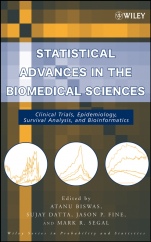
Statistical Advances in the Biomedical Sciences: Clinical Trials, Epidemiology, Survival Analysis, and Bioinformatics
ISBN 9780471947530
Autor: Atanu Biswas, Sujay Datta, Jason P. Fine, Mark R. Segal
Wydawca: Wiley
Dostępność: 3-6 tygodni
Cena: 827,40 zł
Przed złożeniem zamówienia prosimy o kontakt mailowy celem potwierdzenia ceny.
ISBN13: |
9780471947530 |
ISBN10: |
0471947539 |
Autor: |
Atanu Biswas, Sujay Datta, Jason P. Fine, Mark R. Segal |
Oprawa: |
Hardback |
Rok Wydania: |
2008-02-08 |
Ilość stron: |
616 |
Wymiary: |
244x162 |
Tematy: |
MBNS |
The Most Comprehensive and Cutting–Edge Guide to Statistical Applications in Biomedical Research
With the increasing use of biotechnology in medical research and the sophisticated advances in computing, it has become essential for practitioners in the biomedical sciences to be fully educated on the role statistics plays in ensuring the accurate analysis of research findings. Statistical Advances in the Biomedical Sciences explores the growing value of statistical knowledge in the management and comprehension of medical research and, more specifically, provides an accessible introduction to the contemporary methodologies used to understand complex problems in the four major areas of modern–day biomedical science: clinical trials, epidemiology, survival analysis, and bioinformatics.
Composed of contributions from eminent researchers in the field, this volume discusses the application of statistical techniques to various aspects of modern medical research and illustrates how these methods ultimately prove to be an indispensable part of proper data collection and analysis. A structural uniformity is maintained across all chapters, each beginning with an introduction that discusses general concepts and the biomedical problem under focus and is followed by specific details on the associated methods, algorithms, and applications. In addition, each chapter provides a summary of the main ideas and offers a concluding remarks section that presents novel ideas, approaches, and challenges for future research.
Complete with detailed references and insight on the future directions of biomedical research, Statistical Advances in the Biomedical Sciences provides vital statistical guidance to practitioners in the biomedical sciences while also introducing statisticians to new, multidisciplinary frontiers of application. This text is an excellent reference for graduate– and PhD–level courses in various areas of biostatistics and the medical sci
ences and also serves as a valuable tool for medical researchers, statisticians, public health professionals, and biostatisticians.
Spis treści:
SECTION I.CLINICAL TRIALS.
1. Phase I Clinical Trials in Oncology (Anastasia Ivanova and Nancy Flournoy).
1.1 Introduction.
1.2 Phase I Trials in Healthy Volunteers.
1.3 Phase I Trials With Toxic Outcomes Enrolling Patients.
1.4 Other Design Problems in Dose Finding.
1.5 Concluding Remarks.
References.
2. Phase II Clinical Trials (Nigel Stallard).
2.1 Introduction.
2.2 Frequentist methods in phase II clinical trials.
2.3 Bayesian methods in phase II clinical trials.
2.4 Decision theoretic methods in phase II clinical trials.
2.5 Clinical trials combining phases II and III.
2.6 Outstanding issues in phase II clinical trials.
References.
3. Response Adaptive Designs in Phase III Clinical Trials (Atanu Biswas, Uttam Bandyopadhyay and Rahul Bhattacharya).
3.1 Introduction
3.3 Adaptive Designs for Binary Treatment Responses Incorporating Covariates.
3.4 Adaptive Designs for Categorical Responses.
3.5 Adaptive Designs for Continuous Responses.
3.6 Optimal Adaptive Designs.
3.7 Delayed Responses in Adaptive Designs.
3.8 Biased Coin Designs.
3.9 Real Adaptive Clinical Trials.
3.10 Data Study for Different Adaptive Scheme.
3.11 Concluding Remarks.
References.
4. Inverse Sampling for Clinical Trials: A Brief Review of Theory and Practice (Atanu Biswas and Uttam Bandyopadhyay).
4.1 Introduction.
4.2 Two–Sample Randomized Inverse Sampling for Clinical Trials.
4.3 An Example of Inverse Sampling: Boston ECMO.
4.4 Inverse Sampling in Adaptive Designs.
4.5 Concluding.
5. The Design and Analysis Aspects of Cluster Randomized Trials (Hrishikesh Chakraborty).
5.1 Introduction: Cluster Randomized Trials.
5.2 Intra–Cluster Correlation Coefficient and Confidence I
nterval.
5.3 Sample Size Calculation for Cluster Randomized Trials.
5.4 Analysis of Cluster Randomized Trial Data.
5.5 Concluding Remarks.
References.
SECTION II. EPIDEMIOLOGY.
6. HIV Dynamics Modeling and Prediction of Clinical Outcomes in AIDS Clinical Research (Yangxin Huang and Hulin Wu).
6.1 Introduction.
6.2 HIV Dynamic Model and Treatment Effects Models.
6.3 Statistical Methods for Predictions of Clinical Outcomes.
6.4 Simulation Study.
6.5 Clinical Data Analysis.
6.6 Concluding Remarks.
References.
7. Spatial Epidemiology (Lance A. Waller).
7.1 Space and Disease.
7.2 Basic Spatial Questions and Related Data.
7.3 Quantifying Pattern in Point Data.
7.4 Predicting Spatial Observations.
7.5 Concluding Remarks.
References.
8. Modeling Disease Dynamics: Cholera as a Case Study (Edward L. Ionides, Carles Breto and Aaron A. King).
8.1 Introduction.
8.2 Data Analysis via Population Models.
8.3 Sequential Monte Carlo.
8.4 Modeling Cholera.
8.5 Concluding Remarks.
References.
9. Misclassification and Measurement Error Models in Epidemiological Studies (Surupa Roy and Tathagata Banerjee).
9.1 Introduction.
9.2 A Few Examples.
9.3 Binary Regression Models with Two Types of Errors.
9.4 Bivariate Binary Regression Models with Two Types of Errors.
9.5 Models for Analyzing Mixed Misclassified Binary and Continuous Responses.
9.6 Atom Bomb Data Analysis.
9.7 Concluding Remarks.
References.
SECTION III. SURVIVAL ANALYSIS.
10. Semiparametric Maximum Likelihood Inference in Survival Analysis (Michael R. Kosorok).
10.1 Introduction
10.2 Examples of Survival Models.
10.3 Basic Estimation and Limit Theory.
10.4 The Bootstrap.
10.5 The Profile Sampler.
10.6 The Piggyback Bootstrap.
10.7 Other Approaches.
10.8 Concluding Remarks.
References.
11. An Overview of the Semi–Competing Risks
Problem (Limin Peng, Hongyu Jiang, Richard J. Chappell and Jason P. Fine).
11.1 Introduction.
11.2 Nonparametric Inferences.
11.3 Semiparmetric One–Sample Inference.
11.4 Semiparametric Regression Method.
11.5 Concluding Remarks.
References.
12. Tests for Time–Varying Covariate Effects within Aalen′s Additive Hazards Model (Thomas H. Scheike and Torben Martinussen).
12.1 Introduction.
12.2 Model Specification and Inferential Procedures.
12.3 Numerical Results.
12.4 Concluding Remarks.
12.5 Summary.
References.
13. Analysis of Outcomes Subject to Induced Dependent Censoring: A Marked Point Process Perspective (Eugene Huang).
13.1 Introduction.
13.2 Induced Dependent Censoring and Associated Identifiability Issues.
13.3 Marked Point Process.
13.4 Modeling Strategy for Testing and Regression.
13.5 Concluding Remarks.
References.
14. Analysis of Dependence in Multivariate Failure–Time Data (Zoe Moodie and Li Hsu).
14.1 Introduction.
14.2 Nonparametric Bivariate Survivor Function Estimation.
14.3 Non– and Semi–Parametric Estimation of Dependence Measures.
14.4 Concluding Remarks.
References.
15. Robust Estimation for Analyzing Recurrent Events Data in the Presence of Terminal Events (Rajeshwari Sundaram).
15.1 Introduction.
15.2 Inference Procedures.
15.3 Large Sample Properties.
15.4 Numerical Results.
15.5 Concluding Remarks.
References.
16. Tree–Based Methods for Survival Data (Mousumi Banerjee and Anne–Michelle Noone).
16.1 Introduction.
16.2 Review of CART.
16.3 Trees for Survival Data.
16.4 Simulations to Compare Different Splitting Methods.
16.5 Example: Breast Cancer Prognostic Study.
16.6 Random forest for Survival Data.
16.7 Concluding Remarks.
References.
17. Bayesian Estimation of the Hazard Function with Randomly Right–Censored Data (J
Koszyk
Książek w koszyku: 0 szt.
Wartość zakupów: 0,00 zł
Informacje


Kontakt
Gambit
Centrum Oprogramowania
i Szkoleń Sp. z o.o.
Al. Pokoju 29b/22-24
31-564 Kraków
Siedziba Księgarni
ul. Kordylewskiego 1
31-542 Kraków
+48 12 410 5991
+48 12 410 5987
+48 12 410 5989
Subskrypcje
Administratorem danych osobowych jest firma Gambit COiS Sp. z o.o. Na podany adres będzie wysyłany wyłącznie biuletyn informacyjny.
Autoryzacja płatności

Informacje na temat autoryzacji płatności poprzez PayU.

© Copyright 2012: GAMBIT COiS Sp. z o.o. Wszelkie prawa zastrzeżone.
Projekt i wykonanie: Alchemia Studio Reklamy