


Wydawcy
Katalog tematyczny
- Archeologia (1)
- Ekonomia, finanse, business (698)
- Filozofia (20)
- Historia (57)
- Języki i językoznawstwo (4)
- Lifestyle, hobby i rozrywka (32)
- Medycyna (1025)
- Nauki humanistyczne (2)
- Nauki o Ziemi i środowisku (430)
- Nauki ścisłe (1681)
- Nauki społeczne (1297)
- Nauki techniczne (530)
- Budownictwo lądowe (6)
- Chemia przemysłowa (27)
- Elektronika i telekomunikacja (163)
- Energetyka (25)
- Inne nauki stosowane (16)
- Inżynieria biochemiczna (11)
- Inżynieria transportu (17)
- Mechanika i materiały (176)
- Nauka o środowisku (27)
- Rolnictwo (8)
- Technika, ogólnie (46)
- Prawo (1437)
- Publikacje informacyjne i interdyscyplinarne (32)
- Religia i wierzenia (15)
- Technika komputerowa (237)
- Zdrowie, relacje międzyludzkie i rozwój osobisty (4)





Informacje szczegółowe o książce
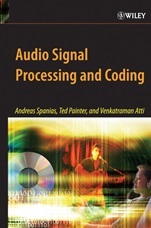
Audio Signal Processing and Coding
ISBN 9780471791478
Autor: Andreas Spanias, Ted Painter, Venkatraman Atti
Wydawca: Wiley
Dostępność: 3-6 tygodni
Cena: 681,45 zł
Przed złożeniem zamówienia prosimy o kontakt mailowy celem potwierdzenia ceny.
ISBN13: |
9780471791478 |
ISBN10: |
0471791474 |
Autor: |
Andreas Spanias, Ted Painter, Venkatraman Atti |
Oprawa: |
Hardback |
Rok Wydania: |
2007-03-02 |
Ilość stron: |
488 |
Wymiary: |
234x156 |
Tematy: |
TJ |
Master algorithms and standards for transparent coding of high–fidelity audio
Here is an in–depth treatment of algorithms and standards for transparent coding of high–fidelity audio. Readers learn how algorithms for high–quality digital audio deliver transparent signal reproduction with a minimum number of bits. The unique features of the book include detailed coverage of topics such as filter banks, transform coding, sinusoidal analysis, linear prediction, hybrid algorithms, perceptual evaluation methods, scalable algorithms, Internet applications, MP3 and MP4 stereo systems, and current international and commercial audio standards.
Following a general introduction, the authors present fundamental signal processing concepts relevant to audio coding and then introduce waveform and entropy quantization schemes. Next are thorough treatments of the following topics:Linear prediction, ADPCM, and CELP algorithms for narrowband and wideband codingCellular telephony vocoders versus CD–quality audio codersPerceptual modules including the ISO/IEC 11172–3 (MPEG–1) psychoacoustic analysis modelDetailed descriptions of the MPEG–1 Layer III (MP3) and the AAC (MP4) algorithmsDescriptions of the algorithms behind successful products such as the Apple iPodFilter bank design and algorithms and the Modified Discrete Cosine Transform (MDCT)Established and emerging standards for transparent coding of CD–quality stereo audio signalsStandardization activities in high–fidelity audio coding, including DVD–Audio, Super Audio CD (SACD), Dolby AC3, Digital, Digital Theater Systems (DTS), and Sony SDDS surround soundLossless audio coding and digital audio watermarking techniques, including SHORTEN, DVD–algorithm, MUSICompress, AudioPaK, C–LPAC, LTAC, and IntMDCT lossless coding schemesSurround sound compression algorithms
for cinema and super audio CD applicationsDigital audio watermarking, content protection, and copyright issuesComplexity, delay, error control, and subjective quality in perceptual audio coding
Computer exercises and MATLAB® hands–on projects complement the algorithm theory and reinforce concept learning. A comprehensive bibliography with more than 600 references to additional sources of information to explore individual topics in greater depth.
This textbook includes all the right elements and topics for a senior and/or graduate–level course in speech/audio processing and multimedia. Moreover, it is highly recommended for practitioners, scientists, and audio engineers who want to master coding algorithms for high–fidelity audio.
Spis treści:
Preface.
1. Introduction.
2. Signal Processing Essentials.
3. Quantization and Entropy Coding.
4. Linear Prediction in Narrowband and Wideband Coding.
5. Psychoacoustic Principles.
6. Time–Frequency Analysis: Filter Banks and Transforms.
7. Transform Coders.
8. Subband Coders.
9. Sinusoidal Coders.
10. Audio Coding Standards and Algorithms.
11. Lossless Audio Coding and Digital Watermarking.
12. Quality Measures for Perceptual Audio Coding.
References.
Index.
Nota biograficzna:
ANDREAS SPANIAS, PhD, is Professor in Electrical Engineering at Arizona State University (ASU). He has led the development of the award–winning online software Java–DSP. His research interests include adaptive filters, speech/audio processing, multimedia, and sensor arrays. He is an IEEE Fellow and co–recipient of the IEEE Donald Fink Prize Paper Award for his work on audio coding. He was recognized by Intel Corporation for his contributions to the 60172 architecture. He is currently Associate Director of the ASU AME program and Co–Director of the ASU SenSIP Center.
TED PAINT
ER, PhD, obtained his doctorate at ASU in 2000. He is a multimedia software architect in the Mobility and Wireless Group at Intel Corporation. His work focuses on architectural analysis, high–performance multimedia software design for mobile handsets, and definition of industry standards. He is editor of the Khronos OpenMAX DL specification. His research interests include psychoacoustics and speech and audio processing. He is co–recipient of the IEEE Donald Fink Prize Paper Award for his work on perceptual coding of digital audio.
VENKATRAMAN ATTI, PhD, obtained his doctorate at ASU in 2006. He currently works as a senior engineer at Acoustic Technologies, Inc. While at ASU, he contributed to speech and audio coding, and to the Java–DSP package. His work in integrating perceptual criteria in linear predictive coding was nominated for an award at IEEE ICASSP–2005. At Acoustics Technologies, his work focuses on research and development of acoustic echo cancellation and noise reduction algorithms.
Okładka tylna:
Master algorithms and standards for transparent coding of high–fidelity audio
Here is an in–depth treatment of algorithms and standards for transparent coding of high–fidelity audio. Readers learn how algorithms for high–quality digital audio deliver transparent signal reproduction with a minimum number of bits. The unique features of the book include detailed coverage of topics such as filter banks, transform coding, sinusoidal analysis, linear prediction, hybrid algorithms, perceptual evaluation methods, scalable algorithms, Internet applications, MP3 and MP4 stereo systems, and current international and commercial audio standards.
Following a general introduction, the authors present fundamental signal processing concepts relevant to audio coding and then introduce waveform and entropy quantization schemes. Next are thorough treatments of the following topics:L
inear prediction, ADPCM, and CELP algorithms for narrowband and wideband codingCellular telephony vocoders versus CD–quality audio codersPerceptual modules including the ISO/IEC 11172–3 (MPEG–1) psychoacoustic analysis modelDetailed descriptions of the MPEG–1 Layer III (MP3) and the AAC (MP4) algorithmsDescriptions of the algorithms behind successful products such as the Apple iPodFilter bank design and algorithms and the Modified Discrete Cosine Transform (MDCT)Established and emerging standards for transparent coding of CD–quality stereo audio signalsStandardization activities in high–fidelity audio coding, including DVD–Audio, Super Audio CD (SACD), Dolby AC3, Digital, Digital Theater Systems (DTS), and Sony SDDS surround soundLossless audio coding and digital audio watermarking techniques, including SHORTEN, DVD–algorithm, MUSICompress, AudioPaK, C–LPAC, LTAC, and IntMDCT lossless coding schemesSurround sound compression algorithms for cinema and super audio CD applicationsDigital audio watermarking, content protection, and copyright issuesComplexity, delay, error control, and subjective quality in perceptual audio coding
Computer exercises and MATLAB® hands–on projects complement the algorithm theory and reinforce concept learning. A comprehensive bibliography with more than 600 references to additional sources of information to explore individual topics in greater depth.
This textbook includes all the right elements and topics for a senior and/or graduate–level course in speech/audio processing and multimedia. Moreover, it is highly recommended for practitioners, scientists, and audio engineers who want to master coding algorithms for high–fidelity audio.
Koszyk
Książek w koszyku: 0 szt.
Wartość zakupów: 0,00 zł
Informacje


Kontakt
Gambit
Centrum Oprogramowania
i Szkoleń Sp. z o.o.
Al. Pokoju 29b/22-24
31-564 Kraków
Siedziba Księgarni
ul. Kordylewskiego 1
31-542 Kraków
+48 12 410 5991
+48 12 410 5987
+48 12 410 5989
Subskrypcje
Administratorem danych osobowych jest firma Gambit COiS Sp. z o.o. Na podany adres będzie wysyłany wyłącznie biuletyn informacyjny.
Autoryzacja płatności

Informacje na temat autoryzacji płatności poprzez PayU.

© Copyright 2012: GAMBIT COiS Sp. z o.o. Wszelkie prawa zastrzeżone.
Projekt i wykonanie: Alchemia Studio Reklamy