


Wydawcy
Katalog tematyczny
- Archeologia (109)
- Ekonomia, finanse, business (13704)
- Filozofia (1445)
- Historia (3040)
- Języki i językoznawstwo (2356)
- Lifestyle, hobby i rozrywka (475)
- Medycyna (9704)
- Nauki humanistyczne (4)
- Nauki o Ziemi i środowisku (2638)
- Nauki ścisłe (20412)
- Nauki społeczne (8486)
- Nauki techniczne (13450)
- Prawo (1696)
- Publikacje informacyjne i interdyscyplinarne (1288)
- Religia i wierzenia (917)
- Technika komputerowa (4067)
- Zdrowie, relacje międzyludzkie i rozwój osobisty (657)





Informacje szczegółowe o książce
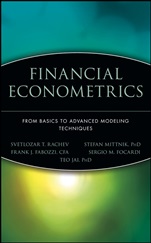
Financial Econometrics: From Basics to Advanced Modeling Techniques
ISBN 9780471784500
Autor: Svetlozar T. Rachev, Stefan Mittnik, Frank J. Fabozzi, Sergio M. Focardi, Teo Ja ić
Wydawca: Wiley
Dostępność: 3-6 tygodni
Cena: 557,55 zł
Przed złożeniem zamówienia prosimy o kontakt mailowy celem potwierdzenia ceny.
ISBN13: |
9780471784500 |
ISBN10: |
0471784508 |
Autor: |
Svetlozar T. Rachev, Stefan Mittnik, Frank J. Fabozzi, Sergio M. Focardi, Teo Ja ić |
Oprawa: |
Hardback |
Rok Wydania: |
2007-01-12 |
Ilość stron: |
576 |
Wymiary: |
244x167 |
Tematy: |
KF |
Financial econometrics combines mathematical and statistical theory and techniques to understand and solve problems in financial economics. Modeling and forecasting financial time series, such as prices, returns, interest rates, financial ratios, and defaults, are important parts of this field.
In Financial Econometrics, you′ll be introduced to this growing discipline and the concepts associated with it—from background material on probability theory and statistics to information regarding the properties of specific models and their estimation procedures.
With this book as your guide, you′ll become familiar with:Autoregressive conditional heteroskedasticity (ARCH) and GARCH modelingPrincipal components analysis (PCA) and factor analysisStable processes and ARMA and GARCH models with fat–tailed errorsRobust estimation methodsVector autoregressive and cointegrated processes, including advanced estimation methods for cointegrated systemsAnd much more
The experienced author team of Svetlozar Rachev, Stefan Mittnik, Frank Fabozzi, Sergio Focardi, and Teo Jasic not only presents you with an abundant amount of information on financial econometrics, but they also walk you through a wide array of examples to solidify your understanding of the issues discussed.
Filled with in–depth insights and expert advice, Financial Econometrics provides comprehensive coverage of this discipline and clear explanations of how the models associated with it fit into today′s investment management process.
Spis treści:
Preface.
Abbreviations and Acronyms.
About the Authors.
CHAPTER 1: Financial Econometrics: Scope and Methods.
The Data Generating Process.
Financial Econometrics at Work.
Time Horizon of Models.
Applications.
Appendix: Investment Management Process.
Concepts Explained in this Chapter (in order of presentation).
CHAPTER 2: Review of Probability and Statistics.
Concepts of Probability.
Principles of Estimation.
Bayesian Modeling.
Appendix A: Information Structures.
Appendix B: Filtration.
Concepts Explained in this Chapter (in order of presentation).
CHAPTER 3: Regression Analysis: Theory and Estimation.
The Concept of Dependence.
Regressions and Linear Models.
Estimation of Linear Regressions.
Sampling Distributions of Regressions.
Determining the Explanatory Power of a Regression.
Using Regression Analysis in Finance.
Stepwise Regression.
Nonnormality and Autocorrelation of the Residuals.
Pitfalls of Regressions.
Concepts Explained in this Chapter (in order of presentation) .
CHAPTER 4: Selected Topics in Regression Analysis.
Categorical and Dummy Variables in Regression Models.
Constrained Least Squares.
The Method of Moments and its Generalizations.
Concepts Explained in this Chapter (in order of presentation).
CHAPTER 5: Regression Applications in Finance.
Applications to the Investment Management Process.
A Test of Strong–Form Pricing Efficiency.
Tests of the CAPM.
Using the CAPM to Evaluate Manager Performance: The Jensen Measure.
Evidence for Multifactor Models.
Benchmark Selection: Sharpe Benchmarks.
Return–Based Style Analysis for Hedge Funds.
Hedge Fund Survival.
Bond Portfolio Applications.
Concepts Explained in this Chapter (in order of presentation).
CHAPTER 6: Modeling Univariate Time Series.
Difference Equations.
Terminology and Definitions.
Stationarity and Invertibility of ARMA Processes.
Linear Processes.
Identification Tools.
Concepts Explained in this Chapter (in order of presentation).
CHAPTER 7: Approaches to ARIMA Modeling and Forecasting.
Overview of Box–Jenkins Procedure.
Identification of Degree of Differencing.
Identification of Lag Orders.
Model Estimation.
Diagnostic Checking.
Forecasting.
Concepts Explained in this Chapter (in order of presentation).
CHAPTER 8: Autoregressive Conditional Heteroskedastic Models.
ARCH Process.
GARCH Process.
Estimation of the GARCH Models.
Stationary ARMA–GARCH Models.
Lagrange Multiplier Test.
Variants of the GARCH Model.
GARCH Model with Student’s t–Distributed Innovations.
Multivariate GARCH Formulations.
Appendix: Analysis of the Properties of the GARCH(1,1) Model.
Concepts Explained in this Chapter (in order of presentation).
CHAPTER 9: Vector Autoregressive Models I.
VAR Models Defined.
Stationary Autoregressive Distributed Lag Models.
Vector Autoregressive Moving Average Models.
Forecasting with VAR Models.
Appendix: Eigenvectors and Eigenvalues.
Concepts Explained in this Chapter (in order of presentation).
CHAPTER 10: Vector Autoregressive Models II.
Estimation of Stable VAR Models.
Estimating the Number of Lags.
Autocorrelation and Distributional Properties of Residuals.
VAR Illustration.
Concepts Explained in this Chapter (in order of presentation).
CHAPTER 11: Cointegration and State Space Models.
Cointegration.
Error Correction Models.
Theory and Methods of Estimation of Nonstationary VAR Models.
State–Space Models.
Concepts Explained in this Chapter (in order of presentation).
CHAPTER 12: Robust Estimation.
Robust Statistics.
Robust Estimators of Regressions.
Illustration: Robustness of the Corporate Bond Yield Spread Model.
Concepts Explained in this Chapter (in order of presentation).
CHAPTER 13: Principal Components Analysis and Factor Analysis.
Factor Models.
Principal Components Analysis.
Factor Analysis.
PCA and Factor Analysis Compared.
Concepts Explained in this Chapter (in order of presentation).
CHAPTER 14: Heavy–Tailed and Stable Distributions in
Financial Econometrics.
Basic Facts and Definitions of Stable Distributions.
Properties of Stable Distributions.
Estimation of the Parameters of the Stable Distribution.
Applications to German Stock Data.
Appendix: Comparing Probability Distributions.
Concepts Explained in this Chapter (in order of presentation).
CHAPTER 15: ARMA and ARCH Models with Infinite–Variance Innovations.
Infinite Variance Autoregressive Processes.
Stable GARCH Models.
Estimation for the Stable GARCH Model.
Prediction of Conditional Densities.
Concepts Explained in this Chapter (in order of presentation).
APPENDIX: Monthly Returns for 20 Stocks: December 2000–November 2005.
INDEX.
Nota biograficzna:
Svetlozar (Zari) T. Rachev completed his Ph.D. Degree in 1979 from Moscow State (Lomonosov) University, and his Doctor of Science Degree in 1986 from Steklov Mathematical Institute in Moscow. Currently he is Chair–Professor in Statistics, Econometrics and Mathematical Finance at the University of Karlsruhe in the School of Economics and Business Engineering. He is also Professor Emeritus at the University of California, Santa Barbara in the Department of Statistics and Applied Probability. He has published seven monographs, eight handbooks and special–edited volumes, and over 250 research articles. Professor Rachev is cofounder of Bravo Risk Management Group specializing in financial risk–management software. Bravo Group was recently acquired by FinAnalytica for which he currently serves as Chief–Scientist.
Stefan Mittnik studied at the Technical University Berlin, Germany, the University of Sussex, England, and at Washington University in St. Louis, where he received his doctorate degree in economics. He is now Professor of Financial Econometrics at the University of Munich, Germany, and research director at the Ifo Institute for Economic Research in Munich.
Koszyk
Książek w koszyku: 0 szt.
Wartość zakupów: 0,00 zł
Informacje


Kontakt
Gambit
Centrum Oprogramowania
i Szkoleń Sp. z o.o.
Al. Pokoju 29b/22-24
31-564 Kraków
Siedziba Księgarni
ul. Kordylewskiego 1
31-542 Kraków
+48 12 410 5991
+48 12 410 5987
+48 12 410 5989
Subskrypcje
Administratorem danych osobowych jest firma Gambit COiS Sp. z o.o. Na podany adres będzie wysyłany wyłącznie biuletyn informacyjny.
Autoryzacja płatności

Informacje na temat autoryzacji płatności poprzez PayU.

© Copyright 2012: GAMBIT COiS Sp. z o.o. Wszelkie prawa zastrzeżone.
Projekt i wykonanie: Alchemia Studio Reklamy