


Wydawcy
Katalog tematyczny
- Archeologia (109)
- Ekonomia, finanse, business (13704)
- Filozofia (1445)
- Historia (3040)
- Języki i językoznawstwo (2356)
- Lifestyle, hobby i rozrywka (475)
- Medycyna (9704)
- Nauki humanistyczne (4)
- Nauki o Ziemi i środowisku (2638)
- Nauki ścisłe (20412)
- Astronomia (294)
- Biologia (5119)
- Chemia (6540)
- Chemia analityczna (361)
- Chemia fizyczna (346)
- Chemia nieorganiczna (137)
- Chemia organiczna (535)
- Krystalografia (27)
- Minerologia (46)
- Fizyka (3309)
- Matematyka (4574)
- Nauki ścisłe, ogólnie (503)
- Nauki społeczne (8486)
- Nauki techniczne (13450)
- Prawo (1696)
- Publikacje informacyjne i interdyscyplinarne (1288)
- Religia i wierzenia (917)
- Technika komputerowa (4067)
- Zdrowie, relacje międzyludzkie i rozwój osobisty (657)





Informacje szczegółowe o książce
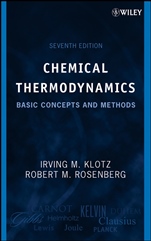
Chemical Thermodynamics: Basic Concepts and Methods
ISBN 9780471780151
Autor: Irving M. Klotz, Robert M. Rosenberg
Wydawca: Wiley
Dostępność: 3-6 tygodni
Cena: 746,55 zł
Przed złożeniem zamówienia prosimy o kontakt mailowy celem potwierdzenia ceny.
ISBN13: |
9780471780151 |
ISBN10: |
0471780154 |
Autor: |
Irving M. Klotz, Robert M. Rosenberg |
Oprawa: |
Hardback |
Rok Wydania: |
2008-06-24 |
Numer Wydania: |
7th Edition |
Ilość stron: |
586 |
Wymiary: |
244x164 |
Tematy: |
PN |
A new edition of the classic treatment of chemical thermodynamics
For more than fifty years, this critically acclaimed and highly influential publication has been the textbook of choice in the field of chemical thermodynamics. This Seventh Edition not only brings the text thoroughly up to date with the latest developments and applications, it also offers new features that better enable students to master key concepts and apply them in practice.
While thoroughly revised and updated, the text′s fundamental objectives remain unchanged: to present the foundations and interrelationships of thermodynamics and to enable students to apply basic concepts in solving problems typically encountered by chemists, biologists, geologists, and materials scientists. Moreover, the text continues to maintain a logical unity throughout by focusing on the laws of classical thermodynamics and applications to gases, solutions, phase equilibria, and chemical equilibria.
Designed to meet the needs of today′s students and instructors, the text offers:
Rigorous explanations of abstract concepts that are clear and simple
Logical organization of materials that enables students to progressively build and apply knowledge
Worked examples demonstrating how concepts are applied to solve actual problems
Detailed coverage of essential mathematical tools, with mathematical review chapters provided for additional support
A thorough presentation of graphical, numerical, and analytical computational techniques
Exercises that accurately reflect the types of problems encountered by practicing scientists
An explanation of the treatment of mixtures of gases, followed by an explanation of thetreatment of chemical equilibrium
A new discussion of the relation of Henry′s law to regular solutions and the relation of regular solutions to limited miscibility
Updated to reflect
the latest applications in science and engineering, Chemical Thermo–dynamics continues to set the standard in its field.
Spis treści:
PREFACE.
1 INTRODUCTION.
1.1 Origins of Chemical Thermodynamics.
1.2 Objectives of Chemical Thermodynamics.
1.3 Limitations of Classic Thermodynamics.
References.
2 MATHEMATICAL PREPARATION FOR THERMODYNAMICS.
2.1 Variables of Thermodynamics.
Extensive and Intensive Quantities.
Units and Conversion Factors.
2.2 Analytic Methods.
Partial Differentiation.
Exact Differentials.
Homogeneous Functions.
Exercises.
ReferencesÂ
3 THE FIRST LAW OF THERMODYNAMICS.
3.1 Definitions.
Temperature.
Work.
3.2 The First Law of Thermodynamics.
Energy.
Heat.
General Form of the First Law.
Exercises.
References.
4 ENTHALPY, ENTHALPY OF REACTION, AND HEAT CAPACITY.
4.1 Enthalpy.
Definition.
Relationship between Qv and Qp.
4.2 Enthalpy of Reactions.
Definitions and Conventions.
4.3 Enthalpy as a State Function.
Enthalpy of Formation from Enthalpy of Reaction.
Enthalpy of Formation from Enthalpy of Combustion.
Enthalpy of Transition from Enthalpy of Combustion.
Enthalpy of Conformational Transition of a Protein from Indirect Calorimetric Measurements.
Enthalpy of Solid–State Reaction from Measurements of Enthalpy of Solution.
4.4 Bond Enthalpies.
Definition of Bond Enthalpies.
Calculation of Bond Enthalpies.
Enthalpy of Reaction from Bond Enthalpies.
4.5 Heat Capacity.
Definition.
Some Relationships between Cp and Cv.
Heat Capacities of Gases.
Heat Capacities of Solids.
Heat Capacities of Liquids.
Other Sources of Heat Capacity Data.
4.6 Enthalpy of Reaction as a Function of Temperature.
Analytic Method.
Arithmetic Method.
Graphical or Numerical Methods.
Exercises.
References.
5 A
PPLICATIONS OF THE FIRST LAW TO GASES.
5.1 Ideal Gases.
Definition.
Enthalpy as a Function of Temperature Only.
Relationship Between Cp and Cv.
Calculation of the Thermodynamic Changes in Expansion Processes.
5.2 Real Gases.
Equations of State.
JouleâThomson Effect.
Calculations of Thermodynamic Quantities in Reversible Expansions.
Exercises.
References.
6 THE SECOND LAW OF THERMODYNAMICS.
6.1 The Need for a Second Law.
6.2 The Nature of the Second Law.
Natural Tendencies Toward Equilibrium.
Statement of the Second Law.
Mathematical Counterpart of the Verbal Statement.
6.3 The Carnot Cycle.
The Forward Cycle.
The Reverse Cycle.
Alternative Statement of the Second Law.
Carnotâs Theorem.
6.4 The Thermodynamic Temperature Scale.
6.5 The Definition of S, the Entropy of a System.
6.6 The Proof that S is a Thermodynamic Property.
Any Substance in a Carnot Cycle.
Any Substance in Any Reversible Cycle.
Entropy S Depends Only on the State of the System.
6.7 Entropy Changes in Reversible Processes.
General Statement.
Isothermal Reversible Changes.
Adiabatic Reversible Changes.
Reversible Phase Transitions.
Isobaric Reversible Temperature Changes.
Isochoric Reversible Temperature Changes.
6.8 Entropy Changes in Irreversible Processes.
Irreversible Isothermal Expansion of an Ideal Gas.
Irreversible Adiabatic Expansion of an Ideal Gas.
Irreversible Flow of Heat from a Higher Temperature to a Lower Temperature.
Irreversible Phase Transitions.
Irreversible Chemical Reactions.
General Statement.
6.9 General Equations for the Entropy of Gases.
Entropy of the Ideal Gas.
Entropy of a Real Gas.
6.10 TemperatureâEntropy Diagram.
6.11 Entropy as an Index of Exhaustion.
Exercises.
References.
7 EQUILIBRIUM AND SPONTANEITY FOR SYSTEMS AT CONSTANT TEMPERATURE.
7.1 Re
versibility, Spontaneity, and Equilibrium.
Systems at Constant Temperature and Volume.
Systems at Constant Temperature and Pressure.
Heat of Reaction as an Approximate Criterion of Spontaneity.
7.2 Properties of the Gibbs, Helmholtz, and Planck Functions.
The Functions as Thermodynamic Properties.
Relationships among G, Y, and A.
Changes in the Functions for Isothermal Conditions.
Equations for Total Differentials.
Pressure and Temperature Derivatives of the Functions.
Equations Derived from the Reciprocity Relationship.
7.3 The Gibbs Function and Chemical Reactions.
Standard States.
7.4 Pressure and Temperature Dependence of ÎG.
7.5 Useful Work and the Gibbs and Helmholtz Functions.
Isothermal Changes.
Changes at Constant Temperature and Pressure.
Relationship between ÎHp and Qp When Useful Work is Performed.
Application to Electrical Work.
GibbsâHelmholtz Equation.
The Gibbs Function and Useful Work in Biologic Systems.
Exercises.
References.
8 APPLICATION OF THE GIBBS FUNCTION AND THE PLANCK FUNCTION TO SOME PHASE CHANGES.
8.1 Two Phases at Equilibrium as a Function of Pressure and Temperature.
Clapeyron Equation.
ClausiusâClapeyron Equation.
8.2 The Effect of an Inert Gas on Vapor Pressure.
Variable Total Pressure at Constant Temperature.
Variable Temperature at Constant Total Pressure.
8.3 Temperature Dependence of Enthalpy of Phase Transition.
8.4 Calculation of Change in the Gibbs Function for Spontaneous Phase Change.
Arithmetic Method.
Analytic Method.
Exercises.
References.
9 THERMODYNAMICS OF SYSTEMS OF VARIABLE COMPOSITION.
9.1 State Functions for Systems of Variable Composition.
9.2 Criteria of Equilibrium and Spontaneity in Systems of Variable Composition.
9.3 Relationships Among Partial Molar Properties of a Single Component.
9.4 Relationships B
Koszyk
Książek w koszyku: 0 szt.
Wartość zakupów: 0,00 zł
Informacje


Kontakt
Gambit
Centrum Oprogramowania
i Szkoleń Sp. z o.o.
Al. Pokoju 29b/22-24
31-564 Kraków
Siedziba Księgarni
ul. Kordylewskiego 1
31-542 Kraków
+48 12 410 5991
+48 12 410 5987
+48 12 410 5989
Subskrypcje
Administratorem danych osobowych jest firma Gambit COiS Sp. z o.o. Na podany adres będzie wysyłany wyłącznie biuletyn informacyjny.
Autoryzacja płatności

Informacje na temat autoryzacji płatności poprzez PayU.

© Copyright 2012: GAMBIT COiS Sp. z o.o. Wszelkie prawa zastrzeżone.
Projekt i wykonanie: Alchemia Studio Reklamy