


Wydawcy
Katalog tematyczny
- Archeologia (109)
- Ekonomia, finanse, business (13704)
- Filozofia (1445)
- Historia (3040)
- Języki i językoznawstwo (2356)
- Lifestyle, hobby i rozrywka (475)
- Medycyna (9704)
- Nauki humanistyczne (4)
- Nauki o Ziemi i środowisku (2638)
- Nauki ścisłe (20412)
- Nauki społeczne (8486)
- Nauki techniczne (13450)
- Prawo (1696)
- Publikacje informacyjne i interdyscyplinarne (1288)
- Religia i wierzenia (917)
- Technika komputerowa (4067)
- Zdrowie, relacje międzyludzkie i rozwój osobisty (657)





Informacje szczegółowe o książce
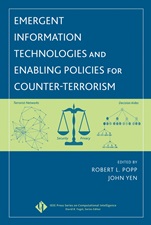
Emergent Information Technologies and Enabling Policies for Counter–Terrorism
ISBN 9780471776154
Autor: Robert L. Popp, John Yen
Wydawca: Wiley
Dostępność: 3-6 tygodni
Cena: 849,45 zł
Przed złożeniem zamówienia prosimy o kontakt mailowy celem potwierdzenia ceny.
ISBN13: |
9780471776154 |
ISBN10: |
0471776157 |
Autor: |
Robert L. Popp, John Yen |
Oprawa: |
Hardback |
Rok Wydania: |
2006-07-11 |
Ilość stron: |
468 |
Wymiary: |
263x185 |
Tematy: |
LA |
Explores both counter–terrorism and enabling policy dimensions of emerging information technologies in national security
After the September 11th attacks, "connecting the dots" has become the watchword for using information and intelligence to protect the United States from future terrorist attacks. Advanced and emerging information technologies offer key assets in confronting a secretive, asymmetric, and networked enemy. Yet, in a free and open society, policies must ensure that these powerful technologies are used responsibly, and that privacy and civil liberties remain protected.
Emergent Information Technologies and Enabling Policies for Counter–Terrorism provides a unique, integrated treatment of cutting–edge counter–terrorism technologies and their corresponding policy options. Featuring contributions from nationally recognized authorities and experts, this book brings together a diverse knowledge base for those charged with protecting our nation from terrorist attacks while preserving our civil liberties.
Topics covered include:Counter–terrorism modelingQuantitative and computational social scienceSignal processing and information management techniquesSemantic Web and knowledge management technologiesInformation and intelligence sharing technologiesText/data processing and language translation technologiesSocial network analysisLegal standards for data miningPotential structures for enabling policiesTechnical system design to support policy
Countering terrorism in today′s world requires innovative technologies and corresponding creative policies; the two cannot be practically and realistically addressed separately. Emergent Information Technologies and Enabling Policies for Counter–Terrorism offers a comprehensive examination of both areas, serving as an essential resource for students, practitioners, researchers, developers, and decision̵
1;makers.
Spis treści:
Foreword.
Preface.
Contributors.
Chapter 1: Utilizing Information and Social Science Technology to Understand and Counter the Twenty–First Century Strategic Threat 1 (Robert L. Popp, David Allen, and Claudio Cioffi–Revilla).
Chapter 2: Hidden Markov Models and Bayesian Networks for Counter–Terrorism (Krishna Pattipati, Peter Willett, Jeffrey Allanach, Haiying Tu, and Satnam Singh).
Chapter 3: Anticipatory Models for Counter–Terrorism (Mark Lazaroff and David Snowden).
Chapter 4: Information Processing at Very High Speed Data Ingestion Rates (J. Brian Sharkey, Doyle Weishar, John W. Lockwood, Ron Loui, Richard Rohwer, John Byrnes, Krishna Pattipati, Stephen Eick, David Cousins, and Michael Nicoletti).
Chapter 5: Analysis of Heterogeneous Data in Ultrahigh Dimensions (R. A. Ammar, S. A. Demurjian , Sr., I. R. Greenshields, Krishna Pattipati, and S. Rajasekaran).
Chapter 6: Semantic Web Technologies for Terrorist Network Analysis (Jennifer Golbeck, Aaron Mannes, and James Hendler).
Chapter 7: Improving National and Homeland Security Through Context Knowledge Representation and Reasoning Technologies (Nazli Choucri, Stuart E. Madnick, and Michael D. Siegel).
Chapter 8: Anonymized Semantic Directories and a Privacy–Enhancing Architecture for Enterprise Discovery (Jeff Jonas and John Karat).
Chapter 9: Facilitating Information Sharing Across Intelligence Community Boundaries Using Knowledge Management and Semantic Web Technologies (Brian Kettler, Gary Edwards, and Mark Hoffman).
Chapter 10: Applying Semantic Web Reasoning to Counter–Terrorism (Paul Kogut, Yui Leung, Kathleen M. Ryan, Linda Gohari, Mieczyslaw M. Kotar, and Jerzy J. Letkowski).
Chapter 11: Schemer: Consensus–Based Knowledge Validation and Collaboration Services for Virtual Teams of Intelligence Experts (Cliffor
d Behrens, Hyong–Sop Shim, and Devaisis Bassu).
Chapter 12: Sharing Intelligence Using Information Supply Chains (Shuang Sun, Xiaocong Fan, and John Yen).
Chapter 13: Supporting Knowledge Management In Emergency Crisis Management Domains: Envisioned Designs for Collaborative Work (Michael D. McNeese, Isaac Brewer, Rashaad E. T. Jones, and Erik S. Connors).
Chapter 14: Agent–Based Simulations for Disaster Rescue Using the DEFACTO Coordination System (Janusz Marecki, Nathan Schurr, and Milind Tambe).
Chapter 15: Transcending the Tower of Babel: Supporting Access to Multilingual Information with Cross–Language Information Retrieval (Douglas W. Oard).
Chapter 16: Journey from Analysis to Inquiry: Technology and Transformation of Counter–Terrorism Analysis (Aaron B. Frank and Desmond Saunders–Newton).
Chapter 17: Behavioral Network Analysis for Terrorist Detection (Seth A. Greenblatt, Thayne Coffman, and Sherry E. Marcus).
Chapter 18: Detecting Terrorist Activities in the Twenty–First Century: A Theory of Detection for Transactional Networks (Tom Mifflin, Chris Boner, Greg Godfrey, and Michael Greenblatt).
Chapter 19: Social Network Analysis Via Matrix Decompositions (D. B. Skillicorn).
Chapter 20: Legal Standards for Data Mining (Fred H. Cate).
Chapter 21: Privacy and Consequences: Legal and Policy Structures for Implementing New Counter–Terrorism Technologies and Protecting Civil Liberty (Paul Rosenzweig).
Chapter 22: Designing Technical Systems to Support Policy: Enterprise Architecture, Policy Appliances, and Civil Liberties (K. A. Taipale).
Index.
About the Editors.
Nota biograficzna:
ROBERT L. POPP, PhD, is currently an Executive Vice President of Aptima, Inc., and formerly a senior executive within the Defense Department, serving in the Office of the Secretary of Defense and Defen
se Advanced Research Projects Agency (DARPA). He is an expert in national security and counter–terrorism, authoring numerous scientific papers and providing many technical briefings and interviews on the subject. He is a member of the Defense Science Board (DSB), Senior Associate for the Center for Strategic and International Studies (CSIS), Senior Member of the IEEE, member of ACM and AAAS, founding Fellow of the University of Connecticut Academy of Distinguished Engineers, and a lifetime member of HOG (the Harley Owners Group).
JOHN YEN, PhD, is currently University Professor of Information Sciences and Technology and Professor in Charge, College of Information Sciences and Technology at The Pennsylvania State University. He is the author of numerous papers, holds one patent, chairs IEEE FIPA standard working groups on human agent communications, and is a member and Fellow of IEEE.
Okładka tylna:
Explores both counter–terrorism and enabling policy dimensions of emerging information technologies in national security
After the September 11th attacks, "connecting the dots" has become the watchword for using information and intelligence to protect the United States from future terrorist attacks. Advanced and emerging information technologies offer key assets in confronting a secretive, asymmetric, and networked enemy. Yet, in a free and open society, policies must ensure that these powerful technologies are used responsibly, and that privacy and civil liberties remain protected.
Emergent Information Technologies and Enabling Policies for Counter–Terrorism provides a unique, integrated treatment of cutting–edge counter–terrorism technologies and their corresponding policy options. Featuring contributions from nationally recognized authorities and experts, this book brings together a diverse knowledge base for those charged with protecting our nation from terrorist attacks while preserving our c
Koszyk
Książek w koszyku: 0 szt.
Wartość zakupów: 0,00 zł
Informacje


Kontakt
Gambit
Centrum Oprogramowania
i Szkoleń Sp. z o.o.
Al. Pokoju 29b/22-24
31-564 Kraków
Siedziba Księgarni
ul. Kordylewskiego 1
31-542 Kraków
+48 12 410 5991
+48 12 410 5987
+48 12 410 5989
Subskrypcje
Administratorem danych osobowych jest firma Gambit COiS Sp. z o.o. Na podany adres będzie wysyłany wyłącznie biuletyn informacyjny.
Autoryzacja płatności

Informacje na temat autoryzacji płatności poprzez PayU.

© Copyright 2012: GAMBIT COiS Sp. z o.o. Wszelkie prawa zastrzeżone.
Projekt i wykonanie: Alchemia Studio Reklamy