


Wydawcy
Katalog tematyczny
- Archeologia (109)
- Ekonomia, finanse, business (13704)
- Filozofia (1445)
- Historia (3040)
- Języki i językoznawstwo (2356)
- Lifestyle, hobby i rozrywka (475)
- Medycyna (9704)
- Nauki humanistyczne (4)
- Nauki o Ziemi i środowisku (2638)
- Nauki ścisłe (20412)
- Nauki społeczne (8486)
- Nauki techniczne (13450)
- Prawo (1696)
- Publikacje informacyjne i interdyscyplinarne (1288)
- Religia i wierzenia (917)
- Technika komputerowa (4067)
- Zdrowie, relacje międzyludzkie i rozwój osobisty (657)





Informacje szczegółowe o książce
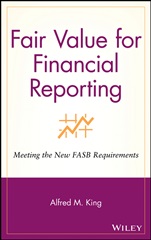
Fair Value for Financial Reporting: Meeting the New FASB Requirements
ISBN 9780471771845
Autor: Alfred M. King
Wydawca: Wiley
Dostępność: 3-6 tygodni
Cena: 510,30 zł
Przed złożeniem zamówienia prosimy o kontakt mailowy celem potwierdzenia ceny.
ISBN13: |
9780471771845 |
ISBN10: |
0471771848 |
Autor: |
Alfred M. King |
Oprawa: |
Hardback |
Rok Wydania: |
2006-06-09 |
Ilość stron: |
352 |
Wymiary: |
241x162 |
Tematy: |
KF |
Is Purchase Price Equal to Fair Value?
With the FASB changing the requirements for increasing categories of assets and liabilities to be shown at current fair value, Fair Value for Financial Reporting answers this and other pertinent questions with crystal clarity. Alfred King, a top expert in the field, provides financial executives and auditors with a deep understanding of fair value reporting, the appraisal process, and appraisal services, and demystifies this topic with practical advice and helpful knowledge, making it a trusted reference on the ins and outs of fair value financial disclosure.
Fair Value for Financial Reporting highlights the accounting and auditing requirements for fair value information and offers a detailed explanation of how the FASB is going to change "fair value" with topics including: the FASB′s fair value proposals; determining the fair value of intangible assets; whether fair value can truly be audited; valuation of liabilities and contingent payments; valuation of hard assets and real estate; why two appraisers come up with different results; auditing of valuation reports; and selecting and working with an appraiser.
PREFACE.
CHAPTER 1. Impact of Fair Value on Earnings Per Share.
Fundamentals of SFAS 141R.
Developing Fair Value in a Business Combination.
How an Appraiser Looks at Intangibles.
Intended Use of Intangible Assets: Market Participants .
Estimated Life of Assets.
Impact on Earnings Per Share of Fair Value Calculations.
Conclusion.
CHAPTER 2. What Is Fair Value?
Purpose of an Appraisal.
Three Different Values Do Not Disprove Appraiser Integrity.
Why Two Appraisers Provide Different Results.
Importance of Assumptions.
Evaluating an Appraisal Report.
Accuracy of Appraisal Reports.
Conclusion.
CHAPTER 3. What Is Fair Value Reporting?
FASB Leads the Way.
Balance Sheet versus Income Statement.
Changes in Balance Sheets Measure Income.
Unrealized Gains Can Be Manipulated to Create Income.
Should We Have Fair Value?
Volatility.
Concepts Statement 7.
FASB s Fair Value Proposals.
Conclusion.
CHAPTER 4. How Appraisers Develop Fair Value.
Basic Valuation Principles.
Use of the Three Approaches.
Correlating the Answer.
Value In–Use versus Value In–Exchange.
What Is Value In–Use?
What Is Value In–Exchange?
FASB s Dilemma.
Can Fair Value Be Audited?
Market Participants.
Income Taxes and Subchapters Considerations in Valuation.
Selecting an Appraiser.
Conclusion.
CHAPTER 5. Allocation of Purchase Price (SFASs 141R and 142).
Is the Purchase Price Equal to Fair Value?
Testing Fair Value.
Weighted Average Cost of Capital.
Synergies.
Comparing SFAS 141R with Its Predecessor, SFAS 141.
Transaction Costs.
Contingent Consideration.
Fair Value of Equity Securities Issued.
Contingent Assets and Liabilities.
Restructuring Costs.
Identifying Specific Intangible Assets.
Unpatented Technology.
Backlog.
Assembled Workforce.
Bargain Purchases.
Partial Acquisitions and Noncontrolling Interests.
Conclusion.
CHAPTER 6. Determining the Fair Value of Intangible Assets.
Trademarks, Trade Names.
Internet Domain Names.
Noncompetition Agreements.
Customer Lists and Customer Relationships.
Customer Relationships.
Franchise Agreements.
Operating and Broadcast Rights.
Patented and Unpatented Technology.
Software.
Software Developed for Sale to Others.
Conclusion.
CHAPTER 7. Valuation of Liabilities and Contingent Payments.
FASB s New Approach to Liabilities: Expected Value .
Estimating and Valuing Legal Liabilities.
Valuing Environmental Liabilities.
Valuation of Contingent Purchase Price.
Conclusion.
CHAPTER 8. Testing for Impairment.
Testing Goodwill for Impairment.
Valuing Reporting Units.
Phase 2: Implied Goodwill.
Testing Identifiable Intangibles with an Indefinite Life.
Testing Identifiable Intangibles with a Definite Life.
Impairment of Property, Plant, and Equipment.
Conclusion.
CHAPTER 9. Valuation of Hard Assets and Real Estate.
Highest and Best Use.
Value In–Use versus Value In–Exchange.
Physical Inspection and the Condition of Assets.
Accounting Depreciation versus Appraisal Depreciation.
Negative Goodwill.
Hierarchy of Earnings.
Assets Held for Sale.
What to Do About Undervalued Assets.
Sarbanes–Oxley Required Controls on PP&E.
Size of the PP&E Problem.
Controlling PP&E.
A Perfect Solution.
A Workable Solution.
Minimum Capitalization Amounts Should Be Raised.
Conclusion.
CHAPTER 10. In–Process Research and Development.
Cost versus Value.
Development of In–Process Research and Development.
Valuation of IPR&D.
Conclusion.
CHAPTER 11. Valuation of Inventories and Receivables.
True Cost of Inventory.
LIFO: Half of Fair Value.
Net Realizable Value.
Selling Expenses.
What Is a Reasonable Profit ?
Work–in–Process and Raw Materials.
Inventory Obsolescence.
Summary of Fair Value of Inventories.
Valuation of Receivables.
Summary of Fair Value of Receivables.
Conclusion.
CHAPTER 12. Valuing Stock Options.
Valuation of Options Under SFAS 123R.
Seven Variables of Option Valuation.
Valuation Methodology for Stock Options.
Developing Supportable Assumptions for the Valuation.
Conclusion.
CHAPTER 13. Auditing of Valuation Reports and Selecting an Appraiser.
Be Careful What You Ask For!
Auditor Review of Valuation Reports.
Every Appraisal Has at Least One Key Assumption.
How to Choose an Appraiser.
Obtaining and Evaluating Proposals for Valuation.
Conclusion.
INDEX.
Alfred M. King (Spotsylvania, VA), CMA, is the Vice Chairman of Marshall & Stevens, a national firm of appraisers. He is also a past Chairman of the Accounting Committee of the Institute of Management Accountants.
Koszyk
Książek w koszyku: 0 szt.
Wartość zakupów: 0,00 zł
Informacje


Kontakt
Gambit
Centrum Oprogramowania
i Szkoleń Sp. z o.o.
Al. Pokoju 29b/22-24
31-564 Kraków
Siedziba Księgarni
ul. Kordylewskiego 1
31-542 Kraków
+48 12 410 5991
+48 12 410 5987
+48 12 410 5989
Subskrypcje
Administratorem danych osobowych jest firma Gambit COiS Sp. z o.o. Na podany adres będzie wysyłany wyłącznie biuletyn informacyjny.
Autoryzacja płatności

Informacje na temat autoryzacji płatności poprzez PayU.

© Copyright 2012: GAMBIT COiS Sp. z o.o. Wszelkie prawa zastrzeżone.
Projekt i wykonanie: Alchemia Studio Reklamy