


Wydawcy
Katalog tematyczny
- Archeologia (109)
- Ekonomia, finanse, business (13704)
- Filozofia (1445)
- Historia (3040)
- Języki i językoznawstwo (2356)
- Lifestyle, hobby i rozrywka (475)
- Medycyna (9704)
- Nauki humanistyczne (4)
- Nauki o Ziemi i środowisku (2638)
- Nauki ścisłe (20412)
- Nauki społeczne (8486)
- Nauki techniczne (13450)
- Prawo (1696)
- Publikacje informacyjne i interdyscyplinarne (1288)
- Religia i wierzenia (917)
- Technika komputerowa (4067)
- Zdrowie, relacje międzyludzkie i rozwój osobisty (657)





Informacje szczegółowe o książce
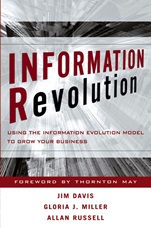
Information Revolution: Using the Information Evolution Model to Grow Your Business
ISBN 9780471770725
Autor: Jim Davis, Gloria J. Miller, Allan Russell
Wydawca: Wiley
Dostępność: 3-6 tygodni
Cena: 152,25 zł
Przed złożeniem zamówienia prosimy o kontakt mailowy celem potwierdzenia ceny.
ISBN13: |
9780471770725 |
ISBN10: |
0471770728 |
Autor: |
Jim Davis, Gloria J. Miller, Allan Russell |
Oprawa: |
Hardback |
Rok Wydania: |
2006-01-20 |
Ilość stron: |
224 |
Wymiary: |
235x155 |
Tematy: |
KF |
A strategic model for identifying, evaluating, and improving information use
"Fundamentally changes how you look at the role of information technology and takes it to the leadership level, which is the only way for business performance to be maximized in this global economy."
—Ron Milton, Executive Vice President, Computerworld
"Information Revolution is truly a must–read for those who generate, support, and make decisions for their respective organizations. By the way, that would be everybody."
—Bob Schwartz, Vice President and Chief Information Officer,
Panasonic Corporation of North America
"As this book clearly describes, information management advances both through evolution and intelligent design. The ideas herein will help any organization avoid extinction!"
—Thomas H. Davenport, President′s Distinguished Professor and Director of Research, Babson College
"This model captures the best practices from the early stage of Business Intelligence development through the most sophisticated environments where the value and nature of information is unquestioned. All of us should strive to reach the final level. And now we have the ultimate guide to help us get there."
—Claudia Imhoff, President, Intelligent Solutions, Inc.
"Managing a successful Business Intelligence effort requires a long–term view and this means leaders must have a methodology to guide them as they navigate their organization through the BI evolution. Information Revolution provides the prag–matic road map all executives can understand and follow."
—Irving Tyler, Chief Information Officer, Quaker Chemical Corporation
"Information Revolution is the perfect blend of ′what,′ ′how,′ and especially ′why.′ This book is a must–read for those driven to excel in this information–based world, instead of being another ′me, too′ along for the ride."
R
12;Bruce Barnes, former chief information officer, Nationwide Financial Services
"Information Revolution provides a powerful framework for assessing the current state of your company′s systems and its decision making capabilities. It then presents a clear process for moving your systems and your company toward an adaptive and innovative enterprise."
—Michael Hugos, Chief Information Officer, Network Services Company
Spis treści:
Foreword.
Preface.
Acknowledgments.
Chapter 1: Seven Realities That Jeopardize Business Survival: Why Organizations Have to Reassess Their Information Management Strategies.
Reassess Your Information Management Strategy.
The Permanently Volatile World.
Darwinism on a New–Millennium Timeline.
Chapter 2: Information Evolution Model: An Evolutionary Path to Corporate Survival.
Five Steps to Maximize the Value of Information.
Level 1: The Operational Enterprise: Focus on the Individual and Day–to–Day Tactics.
Level 2: The Consolidated Enterprise: Gaining Department–Level Perspective.
Level 3: The Integrated Enterprise: An Enterprise–Wide Perspective.
Level 4: The Optimized Enterprise: Nimble, Adaptable, and Efficient.
Level 5: The Adaptive, Innovating Enterprise: Creating Continuous and Sustainable Growth through Innovation.
Practical Applications of the Model.
Chapter 3: On the Levels: Information Evolution in the RealWorld.
A Closer Look at the Level 1 (Operate) Organization: Individualism and Day–to–Day Tactical Mode.
A Closer Look at the Level 2 (Consolidate) Organization: Consolidating Goals and Information into a Departmental View.
A Closer Look at the Level 3 (Integrate) Organization: Integrated into an Enterprise–Wide View.
A Closer Look at the Level 4 (Optimize) Organization: Optimized for Efficiency and Productivity.
A Closer Look at the Level 5 (Innovate) Organization
: Driven by Continuous Innovation.
Chapter 4: Dimension Tension: When the Whole Is Less Than the Sum of the Parts.
What Happens When Dimensions Are Out of Alignment.
Different Types of “Dimension Tension”.
Chapter 5: Your Business GPS: Objectively Gauge Where Your Organization Stands.
Where Does Your Organization Stand?
Information Evolution Model Self–Assessment Quiz.
What Your Quiz Score Reveals.
What Happens If You Don’t Assess Where You Stand?
Where Should Your Organization Be on the Evolutionary Scale?
Advancing up the Levels.
Chapter 6: Getting out of Operational Mode: The Transition from Level 1 to Level 2.
Making the Transition from Level 1 to Level 2.
Potential Challenges along the Way.
Landmarks of Progress.
What the Organization Gains from Reaching Level 2.
Chapter 7: Gaining an Enterprise View: The Transition from Level 2 to Level 3.
Making the Transition from Level 2 to Level 3.
Potential Challenges along the Way.
Landmarks of Progress.
What the Organization Gains from Reaching Level 3.
Chapter 8: Gaining Market Leadership: The Transition from Level 3 to Level 4.
Making the Transition from Level 3 to Level 4.
Potential Challenges along the Way.
Landmarks of Progress.
What the Organization Gains from Reaching Level 4.
Chapter 9: Reaching Sustainable Growth: The Transition from Level 4 to Level 5.
Making the Transition from Level 4 to Level 5.
Potential Challenges along the Way.
Landmarks of Progress.
What the Organization Gains from Reaching Level 5.
Chapter 10: Information Evolution Assessment Process.
Information Evolution Assessment Process.
Why Go through This Formal Assessment Process?
Interview Questions for the Infrastructure Dimension.
Interview Questions for the Knowledge Process Dimension.
Interview Questions for the Human Capital Dimension.
Interview Questions f
or the Culture Dimension.
Transforming Interview Responses into an Assessment.
Chapter 11: Business Intelligence, Intelligently Applied: What You Can Gain from a Business Intelligence Competency Center.
Why Are Business Intelligence Projects Falling Short of Potential?
What Does a Business Intelligence Competency Center Do?
Benefits of a Corporate Business Intelligence Competency Center.
How Do You Fund a Business Intelligence Competency Center?
Importance of Staying Strategic.
Chapter 12: Funding Evolution: IngeniousWays to Pay Your Way up the Levels.
Reduce Hardware Costs with Grid Computing.
Reduce Software Costs through IT Portfolio Management.
Reduce Software Costs by Streamlining the IT Portfolio.
Pay as You Go, by Using an Application Service Provider.
Turn Mature Products into Cash Cows.
Capitalize Your Information Assets.
Calculating the Cost: Evolution or Status Quo.
Closing Thoughts.
Appendix: Information Evolution AssessmentWorksheet.
Index.
Nota biograficzna:
Senior Vice President and Chief Marketing Officer, SAS
Jim Davis, senior vice president and chief marketing officer for SAS, is responsible for providing strategic direction for SAS products, solutions and services as well as global messaging about SAS.
Upholding the company’s focus to be customer driven, Davis helped lead the transformation of SAS from a tools provider to the customerdriven software solutions provider it is today. He has built a team of strategists with industry–specific expertise who research the marketplace and partner with engineers in R&D to hone customized solutions for each industry. He has overseen a dramatic increase in SAS’ profile.
Also known for his industry leadership, he has helped develop the Information Evolution Model, a means for companies to assess how effectively they use information to drive business. By outlining
Koszyk
Książek w koszyku: 0 szt.
Wartość zakupów: 0,00 zł
Informacje


Kontakt
Gambit
Centrum Oprogramowania
i Szkoleń Sp. z o.o.
Al. Pokoju 29b/22-24
31-564 Kraków
Siedziba Księgarni
ul. Kordylewskiego 1
31-542 Kraków
+48 12 410 5991
+48 12 410 5987
+48 12 410 5989
Subskrypcje
Administratorem danych osobowych jest firma Gambit COiS Sp. z o.o. Na podany adres będzie wysyłany wyłącznie biuletyn informacyjny.
Autoryzacja płatności

Informacje na temat autoryzacji płatności poprzez PayU.

© Copyright 2012: GAMBIT COiS Sp. z o.o. Wszelkie prawa zastrzeżone.
Projekt i wykonanie: Alchemia Studio Reklamy