


Wydawcy
Katalog tematyczny
- Archeologia (109)
- Ekonomia, finanse, business (13704)
- Filozofia (1445)
- Historia (3040)
- Języki i językoznawstwo (2356)
- Lifestyle, hobby i rozrywka (475)
- Medycyna (9704)
- Nauki humanistyczne (4)
- Nauki o Ziemi i środowisku (2638)
- Nauki ścisłe (20412)
- Nauki społeczne (8486)
- Nauki techniczne (13450)
- Prawo (1696)
- Publikacje informacyjne i interdyscyplinarne (1288)
- Religia i wierzenia (917)
- Technika komputerowa (4067)
- Zdrowie, relacje międzyludzkie i rozwój osobisty (657)





Informacje szczegółowe o książce
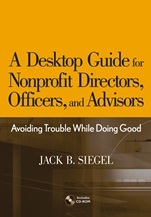
A Desktop Guide for Nonprofit Directors, Officers, and Advisors: Avoiding Trouble While Doing Good
ISBN 9780471768128
Autor: Jack B. Siegel
Wydawca: Wiley
Dostępność: 3-6 tygodni
Cena: 1 004,85 zł
Przed złożeniem zamówienia prosimy o kontakt mailowy celem potwierdzenia ceny.
ISBN13: |
9780471768128 |
ISBN10: |
047176812X |
Autor: |
Jack B. Siegel |
Oprawa: |
Hardback |
Rok Wydania: |
2006-06-09 |
Ilość stron: |
744 |
Wymiary: |
260x187 |
Tematy: |
KM |
How to keep any nonprofit out of trouble, running smoothly, and accomplishing its mission
"Jack Siegel—lawyer, accountant, management consultant, and computer whiz—takes the putative director or officer of a nonprofit organization on a useful and often entertaining voyage throughout the realm of the tax–exempt organizations universe, pointing out its quirks, foibles, and legal liabilities along the way. His handbook will make mandatory—and arresting—reading for those who are already serving as trustees, directors, officers, and key employees of exempt organizations, particularly charitable ones. Siegel′s goal, in which he succeeds, is to help directors and officers of nonprofit organizations ′make better decisions.′ The book is full of large policy analyses and paragraphs on the details, such as board size, board committees, board meeting formats, the contents of minutes, and the duties of officers.
Salted with some excellent real–life examples, what also sets this book apart from most in its genre is the tone: the writing style, the brusqueness, the bluntness. He complains that too many directors ′check their good judgment at the boardroom door.′ He advises individuals who ′desire agreement and demand adulation′ to stay off boards; he insists on ′commitment′ and ′institutional tension′ with the executive director. He warns prospective directors that some organizations want, in addition to time and judgment, ′either your money or your ability to raise money.′ To my delight, he extols the virtues of ′some level of expenditures′ for qualified lawyers and accountants.
Please join me in adding this most helpful handbook to your nonprofit library."
—Bruce R. Hopkins, Attorney at Law, author of The Law of Tax–Exempt Organizations, Eighth Edition and Starting and Managing a Nonprofit Organization: A Legal Gu
ide, Fourth Edition
Spis treści:
Chapter 1: Setting the Stage: Some Preliminaries.
1.1 The Need for Action.
1.2 Part of the Bigger Scheme.
1.3 Assumption.
1.4 Generality of Coverage.
1.5 Using Qualified Professionals.
1.6 Before Starting a New Organization.
(a) Start by Looking for an Existing Charity.
(b) Consider Partnering Opportunities.
(c) Identify Funders.
(d) Retain a Qualified Attorney.
(e) Advice to the Wealthy.
1.7 Concluding the Preliminaries.
Chapter 2: Before Signing On.
2.1 “Give, Get, or Get Off”.
2.2 Ask Questions.
2.3 Review Materials.
2.4 Meet with the Executive Director and Other Officers.
2.5 Review Other Resources.
2.6 Step Aside if the Information Is Not Forthcoming.
2.7 Your Role.
Chapter 3: Organizational Basics.
3.1 Nonprofit versus Tax–Exempt Status.
3.2 The Corporate Form Is the Prevalent One.
3.3 The Players.
(a) The Board of Directors.
(b) The Officers.
(c) Members.
(d) The Regulators—State Attorneys General.
(e) Standing.
3.4 Organizational Documents.
(a) Using Forms.
(b) Core Documents.
(c) Statutory Default Provisions.
(d) Amendments.
(e) Director Review.
(f) More than Boilerplate.
3.5 Meetings.
(a) A Recommended Meeting Format.
(b) Meeting Minutes.
(c) Executive Sessions.
(d) The Internet and Meetings.
3.6 Major Events.
(a) Formation.
(b) Dissolution.
(c) Operations.
Chapter 4: Legal Duties and Obligations.
4.1 A Well–Known Case.
4.2 Director Duties and Responsibilities.
(a) The Duty of Care.
(b) The Duty of Loyalty.
(c) The Duty of Obedience.
4.3 Standards for Judging Behavior.
(a) Business Judgment or Ordinary Prudence.
(b) Other Statutory Duties That Can Lead to Liability.
(c) Liability Arising from Joint Ventures and Subsidiaries.
4.4 The Standards as Applied to Comm
on Decisions.
(a) Exercising Due Care—Compensation.
(b) Exercising Due Diligence—Investments.
(c) Avoiding Conflicts of Interest—Selling Assets.
(d) Resisting Founder’s Syndrome—Diversification.
4.5 Director Rights.
4.6 A Further Look at Investment Decisions.
(a) What the Process Is Not.
(b) Reserves or Endowment?
(c) Investing Endowment—The Standard.
(d) Translating Legal Standards into Actual Conduct.
(e) Corporate Trustees and Charitable Beneficiaries.
4.7 Another Look at Conflicts of Interest.
(a) Need for a Conflict–of–Interest Policy.
(b) Loans to Directors and Officers.
4.8 Moving from a Volunteer Director to a Paid Employee.
4.9 Relief for Directors and Officers.
(a) State Relief.
(b) Federal Relief under the Volunteer Protection Act.
4.10 Good Faith: A Storm on the Horizon for Nonprofit Directors.
4.11 Avoiding Trouble As a Director.
4.12 Avoiding Trouble As an Officer.
4.13 The Litmus Test for Good Conduct.
Chapter 5: Financial Statements, Internal Controls, and Sarbanes–Oxley.
5.1 Where Accounting Rules Come From.
5.2 The Three Nonprofit Financial Statements.
(a) Statement of Financial Position.
(b) Statement of Activities.
(c) Statement of Cash Flows.
5.3 Guidance for the Bookkeeper.
5.4 Ratio Analysis.
(a) Seven Basic Ratios.
(b) Other Ratios.
5.5 The Milwaukee Public Museum—What the Financial Information Foretold.
5.6 Donor Insights into Financial Information.
(a) Using GAAP–Prepared Statements versus IRS Form 990.
(b) Disclosing Fundraising Expenses.
(c) Expensing Fundraising Expenditures.
(d) Allocating Overhead.
(e) Consideration of Contributed Services.
(f) Consolidating Affiliated Entities.
5.7 Auditor’s Report.
5.8 Audit Committee.
(a) Audit Committee Review.
(b) Audit Committee and Whistleblowers.
(c) Audit Committee Membership.<
br>(d) California’s Approach to Audit Committee Membership.
5.9 GAO Audit Guidelines.
(a) Best Practices.
(b) Prohibited and Permitted Services.
(c) Case: Big Food Basket and Personal Impairments.
5.10 Internal Controls.
(a) Three Basic Internal Control Functions.
(b) A Closer Look at Financial Controls.
(c) A Case Study.
(d) Recommended Internal Controls.
(e) Considerations for Organizations Making Grants.
5.11 Financial Control Recommendations and Requirements for Recipients of Federal Funds.
5.12 Fraud and Theft.
(a) The Three Categories of Fraud.
(b) Avoid a Narrow Focus.
(c) Employee Tips.
5.13 Internal Fraud Detection.
5.14 The Lone Perpetrator Accounts for the Highest Percentage of Frauds.
(a) Background Checks May Not Be the Answer.
(b) Tenure Is an Erroneous Basis for Trust.
(c) Loss Recovery.
(d) The Lessons.
5.15 Fraud and the Certified Audit.
5.16 Sarbanes–Oxley Reforms.
(a) Financial Certification.
(b) Auditor Independence.
(c) Auditor Rotation.
(d) Audit Committee Member Independence.
(e) Financial Expertise.
(f) Making Audited Financial Statements Publicly Available.
(g) Other Sarbanes–Oxley Provisions.
5.17 Summation: Steps for the Board.
Chapter 6: Federal Tax Exemption.
6.1 Tax–Exempt Entities.
(a) Charitable Organizations.
(b) Social Welfare Organizations.
(c) Labor and Agricultural Organizations.
(d) Business Leagues.
(e) Social Clubs.
(f) Fraternal Societies.
(g) Veterans’ Organizations.
(h) Employees’ Associations.
(i) Political Organizations.
6.2 The Breakdown.
6.3 A Detailed Look at Section 501(c)(3) Status.
(a) Definitions of Educational and Religious.
(b) Organizational Test—The First Requirement.
(c) Operational Test—The Second Requirement.
(d) No Private Inurement—The Third Requirement.
6.4 Obtaining Tax–Exempt Status.
Koszyk
Książek w koszyku: 0 szt.
Wartość zakupów: 0,00 zł
Informacje


Kontakt
Gambit
Centrum Oprogramowania
i Szkoleń Sp. z o.o.
Al. Pokoju 29b/22-24
31-564 Kraków
Siedziba Księgarni
ul. Kordylewskiego 1
31-542 Kraków
+48 12 410 5991
+48 12 410 5987
+48 12 410 5989
Subskrypcje
Administratorem danych osobowych jest firma Gambit COiS Sp. z o.o. Na podany adres będzie wysyłany wyłącznie biuletyn informacyjny.
Autoryzacja płatności

Informacje na temat autoryzacji płatności poprzez PayU.

© Copyright 2012: GAMBIT COiS Sp. z o.o. Wszelkie prawa zastrzeżone.
Projekt i wykonanie: Alchemia Studio Reklamy