


Wydawcy
Katalog tematyczny
- Archeologia (109)
- Ekonomia, finanse, business (13704)
- Filozofia (1445)
- Historia (3040)
- Języki i językoznawstwo (2356)
- Lifestyle, hobby i rozrywka (475)
- Medycyna (9704)
- Nauki humanistyczne (4)
- Nauki o Ziemi i środowisku (2638)
- Nauki ścisłe (20412)
- Astronomia (294)
- Biologia (5119)
- Chemia (6540)
- Fizyka (3309)
- Elektryczność i magnetyzm (90)
- Fizyka atomowa i molekularna (110)
- Fizyka cząstek elementarnych (36)
- Fizyka jądra atomowego (36)
- Fizyka kwantowa (210)
- Fizyka matematyczna (121)
- Fizyka relatywistyczna (36)
- Fizyka statystyczna (51)
- Fizyka stosowana (498)
- Mechanika klasyczna (186)
- Optyka i światło (133)
- Stany materii (202)
- Matematyka (4574)
- Nauki ścisłe, ogólnie (503)
- Nauki społeczne (8486)
- Nauki techniczne (13450)
- Prawo (1696)
- Publikacje informacyjne i interdyscyplinarne (1288)
- Religia i wierzenia (917)
- Technika komputerowa (4067)
- Zdrowie, relacje międzyludzkie i rozwój osobisty (657)





Informacje szczegółowe o książce
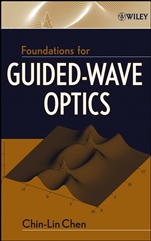
Foundations for Guided–Wave Optics
ISBN 9780471756873
Autor: Chin–Lin Chen
Wydawca: Wiley
Dostępność: 3-6 tygodni
Cena: 861,00 zł
Przed złożeniem zamówienia prosimy o kontakt mailowy celem potwierdzenia ceny.
ISBN13: |
9780471756873 |
ISBN10: |
0471756873 |
Autor: |
Chin–Lin Chen |
Oprawa: |
Hardback |
Rok Wydania: |
2006-12-20 |
Ilość stron: |
480 |
Wymiary: |
239x162 |
Tematy: |
PH |
A classroom–tested introduction to integrated and fiber optics
This text offers an in–depth treatment of integrated and fiber optics, providing graduate students, engineers, and scientists with a solid foundation of the principles, capabilities, uses, and limitations of guided–wave optic devices and systems. In addition to the transmission properties of dielectric waveguides and optical fibers, this book covers the principles of directional couplers, guided–wave gratings, arrayed–waveguide gratings, and fiber optic polarization components.
The material is fully classroom–tested and carefully structured to help readers grasp concepts quickly and apply their knowledge to solving problems. Following an overview, including important nomenclature and notations, the text investigates three major topics:Integrated opticsFiber opticsPulse evolution and broadening in optical waveguides
Each chapter starts with basic principles and gradually builds to more advanced concepts and applications. Compelling reasons for including each topic are given, detailed explanations of each concept are provided, and steps for each derivation are carefully set forth. Readers learn how to solve complex problems using physical concepts and simplified mathematics.
Illustrations throughout the text aid in understanding key concepts, while problems at the end of each chapter test the readers′ grasp of the material.
The author has designed the text for upper–level undergraduates, graduate students in physics and electrical and computer engineering, and scientists. Each chapter is self–contained, enabling instructors to choose a subset of topics to match their particular course needs. Researchers and practitioners can also use the text as a self–study guide to gain a better understanding of photonic and fiber optic devices and systems.
Spis treści:
Preface.
1
. Brief review of Electromagnetics and Guided Waves.
1.1 Introduction.
1.2 Maxwell′s equations.
1.3 Uniform plane waves in isotropic media.
1.4 State of polarization.
1.5 Reflection and refraction by a planar boundary between two dielectric media.
1.5.1. Perpendicular polarization.
1.5.1.1 Reflection and refraction.
1.5.1.2 Total internal reflection.
1.5.2. Parallel polarization.
1.5.2.1 Reflection and refraction.
1.5.2.2 Total internal reflection.
1.6 Guided waves.
1.6.1 TE modes.
1.6.2 TM modes.
1.6.3 Waveguides with constant index regions.
References.
Problems.
List of Figures.
2. Step–index Thin–film Waveguides.
2.1 Introduction.
2.2 Dispersion of step–index thin–film waveguides.
2.2.1 TE modes.
2.2.2 TM modes.
2.3 Generalized parameters.
2.3.1 a, b, c, d and V.
2.3.2 bV diagram.
2.3.3 Cutoff thickness and cutoff frequencies.
2.3.4 Number of guided modes.
2.3.5 Birefringence in thin–film waveguides.
2.4 Fields of step–index thin–film waveguides.
2.4.1 TE modes.
2.4.2 TM modes.
2.5 Cover and substrate modes.
2.6 Time–average power and confinement factors.
2.6.1 Time–average power transported by TE modes.
2.6.2 Confinement factor of TE modes.
2.6.3 Time–average power transported by TM modes.
2.7 Phase and group velocities.
References.
Problems.
List of figures.
3. Graded–index Thin–film waveguides.
3.1 Introduction.
3.2 TE modes guided by linearly graded dielectric waveguides.
3.3 Exponentially graded dielectric waveguides.
3.3.1 TE modes.
3.3.2 TM modes.
3.4 WKB method.
3.4.1 Auxiliary function.
3.4.2 Fields in the R Zone.
3.4.3 Fields in the L Zone.
3.4.4 Fields in the transition zone.
3.4.5 The constants.
3.4.6 The dispersion relation.
3.4.7 An example.
3.5 Hocker and Burns’ numerical method.
3.5.1 TE modes.
3.5.2 TM modes.
3.6 Step–index thin–film waveguides vs. graded–index dielectric waveguides.
References.
Problems.
List of figures.
4. Propagation Loss in Thin–film Waveguides.
4.1 Introduction.
4.2 Complex relative dielectric constant and complex refractive index.
4.3 Propagation loss in step–index waveguides.
4.3.1 Waveguides having weakly absorbing materials.
4.3.2 Metal–clad waveguides.
4.4 Attenuation in thick waveguides with step–index profiles.
4.5 Loss in TM0 mode.
4.6 Metal–clad waveguides with graded index profiles.
References.
Problem.
List of Figures.
5. Three–dimensional Waveguides with Rectangular Boundaries.
5.1 Fields and modes guided by rectangular waveguides.
5.2 Orders of magnitude of fields.
5.2.1 modes.
5.2.2 modes.
5.3 Marcatili′s method.
5.3.1 modes.
5.3.1.1 Expressions for Hx.
5.3.1.2 Boundary conditions along horizontal boundaries, y = ±h/2, |x| 5.3.1.3 Boundary conditions along vertical boundaries, x = ±w/2, |y| 5.3.1.4 Transverse wave vector K,sub>x.
5.3.1.5 Transverse wave vector Ky.
5.3.1.6 Approximate dispersion relation.
5.3.2 modes.
5.3.3 Discussions.
5.3.4 Generalized guide index.
5.4 Effective index method.
5.4.1 A pseudo waveguide.
5.4.2 An alternate pseudo waveguide.
5.4.3 Generalized guide index.
5.5 Comparison of methods.
References.
Problems.
List of figures.
6. Optical directional couplers and their applications.
6.1 Introduction.
6.2 Qualitative description of the operation of directional couplers.
6.3 Marcatili’s improved coupled mode equations.
6.3.1 Fields of isolated waveguides.
6.3.2 Normal mode fields of the composite waveguide.
6.3.3 Marcatili’s relation.
6.3.4 Approximate normal mode fields.
6.3.5 I
mproved coupled mode equations.
6.3.6 Coupled mode equation in an equivalent form.
6.3.7 Coupled mode equation in an alternate form.
6.4 Directional couplers with uniform cross section and constant spacing.
6.4.1 Transfer matrix.
6.4.2 Essential characteristics of couplers with K1 = K2 = K.
6.4.3 3 dB directional couplers.
6.4.4 Directional couplers as electrically controlled optical switches.
6.4.5. Switching diagram.
6.5 Switched δβ directional couplers.
6.6 Optical directional couplers filters.
6.6.1 Directional coupler filters with identical waveguides and uniform spacing.
6.6.2 Directional coupler filters with non–identical waveguides and uniform spacing.
6.6.3 Tapered directional coupler filters.
6.7 Intensity modulators based on directional couplers.
6.7.1 Electrooptic properties of lithium niobate.
6.7.2 Dielectric waveguide with an electrooptic layer.
6.7.3 Directional coupler modulator built on a Z–cut LiNbO3 plate.
6.8 Normal mode theory of directional couplers with two waveguides.
6.9 Normal mode theory of directional couplers with three or more waveguides.
References.
Problems.
List of Figures.
7. Guided–wave Gratings.
7.1 Introduction.
7.1.1 Types of guided–wave gratings.
7.1.1.1 Static gratings.
7.1.1.2 Programmable gratings.
7.1.1.3 Moving grating.
7.1.2 Applications of guided–wave gratings.
7.1.3. Two methods for analyzing guided–wave grating problems.
7.2 Perturbation theory.
7.2.1 Waveguide perturbation.
7.2.2 Fields of perturbed waveguide.
7.2.3 Coupled mode equations and coupling coefficients.
7.2.4 Co–directional coupling.
7.2.5 Contra–directional coupling.
7.3 Coupling coefficient of a rectangular grating–an example.
7.4 Graphical representation of grating equation.
7.5 Grating reflectors.
7.5.1 Coupled mode equations.
Koszyk
Książek w koszyku: 0 szt.
Wartość zakupów: 0,00 zł
Informacje


Kontakt
Gambit
Centrum Oprogramowania
i Szkoleń Sp. z o.o.
Al. Pokoju 29b/22-24
31-564 Kraków
Siedziba Księgarni
ul. Kordylewskiego 1
31-542 Kraków
+48 12 410 5991
+48 12 410 5987
+48 12 410 5989
Subskrypcje
Administratorem danych osobowych jest firma Gambit COiS Sp. z o.o. Na podany adres będzie wysyłany wyłącznie biuletyn informacyjny.
Autoryzacja płatności

Informacje na temat autoryzacji płatności poprzez PayU.

© Copyright 2012: GAMBIT COiS Sp. z o.o. Wszelkie prawa zastrzeżone.
Projekt i wykonanie: Alchemia Studio Reklamy