


Wydawcy
Katalog tematyczny
- Archeologia (109)
- Ekonomia, finanse, business (13704)
- Filozofia (1445)
- Historia (3040)
- Języki i językoznawstwo (2356)
- Lifestyle, hobby i rozrywka (475)
- Medycyna (9704)
- Nauki humanistyczne (4)
- Nauki o Ziemi i środowisku (2638)
- Nauki ścisłe (20412)
- Astronomia (294)
- Biologia (5119)
- Chemia (6540)
- Chemia analityczna (361)
- Chemia fizyczna (346)
- Chemia nieorganiczna (137)
- Chemia organiczna (535)
- Krystalografia (27)
- Minerologia (46)
- Fizyka (3309)
- Matematyka (4574)
- Nauki ścisłe, ogólnie (503)
- Nauki społeczne (8486)
- Nauki techniczne (13450)
- Prawo (1696)
- Publikacje informacyjne i interdyscyplinarne (1288)
- Religia i wierzenia (917)
- Technika komputerowa (4067)
- Zdrowie, relacje międzyludzkie i rozwój osobisty (657)





Informacje szczegółowe o książce
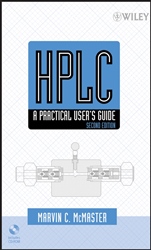
Hplc: A Practical Users Guide
ISBN 9780471754015
Autor: Marvin C. McMaster
Wydawca: Wiley
Dostępność: 3-6 tygodni
Cena: 513,45 zł
Przed złożeniem zamówienia prosimy o kontakt mailowy celem potwierdzenia ceny.
ISBN13: |
9780471754015 |
ISBN10: |
0471754013 |
Autor: |
Marvin C. McMaster |
Oprawa: |
Hardback |
Rok Wydania: |
2007-01-12 |
Numer Wydania: |
2nd Edition |
Ilość stron: |
256 |
Wymiary: |
244x164 |
Tematy: |
PN |
Everything you need to set up an HPLC systemthat takes advantage of the latest innovations
Here is the perfect handbook for both novice and experienced chromatographers. For novices, HPLC, Second Edition cuts through the technical detail, theory, and confusing variety of column types, enabling them to easily set up and maintain an HPLC system. For more experienced practitioners, the book explains how to fully exploit the most recent innovations and improvements in column technology. The latest information and techniques in high–temperature, micro–flow, and ultra–fast chromatography, as well as the linking of an HPLC to a mass spectrometer, represent just some of the new material featured in this Second Edition.
Readers benefit from the author′s twenty–five years of experience in HPLC, first as a user, then as a field sales and application support representative, and finally as a teacher and consultant. The book′s wealth of tips and troubleshooting advice originate from the author′s own laboratory and field work.
HPLC′s structure is carefully designed to give readers a solid foundationin the basics and then methodically build and refine their skills:Part I, HPLC Primer, presents the essentials needed to get an HPLC system up and runningPart II, HPLC Optimization, explains how to make the best use of the common columns and troubleshoot problemsPart III, HPLC Utilization, focuses on real–world applications, including interfacing HPLC systems with computers and robotic workstations
A CD–ROM with the author′s PowerPoint® presentation, Practical Course in HPLC, is included with the book. Plus, new appendices offer answers to frequently asked questions, tables of solvents and volatile buffers, an updated glossary of terms, and laboratory experiments. In short, everything that you need to know to confidently separate, identify, purify,
and quantify compounds is here.
Spis treści:
PREFACE.
I HPLC PRIMER.
1 Advantages and Disadvantages of HPLC.
1.1 How It Works.
1.1.1 A Separation Model of the Column.
1.1.2 Basic Hardware: A Quick, First Look.
1.1.3 Use of Solvent Gradients.
1.1.4 Ranges of Compounds.
1.2 Other Ways to Make My Separation.
1.2.1 FPLC—Fast Protein Liquid Chromatography.
1.2.2 LC—Traditional Liquid Chromatography.
1.2.3 GLC—Gas Liquid Chromatography.
1.2.4 SFC—Supercritical Fluid Chromatography.
1.2.5 TLC—Thin Layer Chromatography.
1.2.6 EP—Electrophoresis.
1.2.7 CZE—Capillary Zone Electrophoresis.
2 Selecting an HPLC System.
2.1 Characteristic Systems.
2.1.1 Finding a Fit: Detectors and Data Processing.
2.1.2 System Models: Gradient Versus Isocratic.
2.1.3 Vendor Selection.
2.1.4 Brand Names and Clones.
2.1.5 Hardware–Service–Support.
2.2 System Cost Estimates.
2.2.1 Type I System—QC Isocratic (Cost: $10–15,000).
2.2.2 Type II System—Research Gradient (Cost: $20–25,000).
2.2.3 Type III System—Automated Clinical (Cost: $25–35,000).
2.2.4 Type IV System—Automated Methods (Cost: $30–50,000).
2.3 Columns.
2.3.1 Sizes: Analytical and Preparative.
2.3.2 Separating Modes: Selecting Only What You Need.
2.3.3 Tips on Column Use.
3 Running Your Chromatograph.
3.1 Set–up and Start–up.
3.1.1 Hardware Plumbing 101: Tubing and Fittings.
3.1.2 Connecting Components.
3.1.3 Solvent Clean–up.
3.1.4 Water Purity Test.
3.1.5 Start–up System Flushing.
3.1.6 Column Preparation and Equilibration.
3.2 Sample Preparation and Column Calibration.
3.2.1 Sample Clean–up.
3.2.2 Plate Counts.
3.3 Your First Chromatogram.
3.3.1 Reproducible Injection Techniques.
3.3.2 Simple Scouting for a Mobile Phase.
3.3.
3 Examining the Chromatogram.
3.3.4 Basic Calculations of Results.
II HPLC OPTIMIZATION.
4 Separation Models.
4.1 Partition.
4.1.1 Separation Parameters.
4.1.2 Efficiency Factor.
4.1.3 Separation (Chemistry) Factor.
4.2 Ion Exchange Chromatography.
4.3 Size Exclusion Chromatography.
4.4 Affinity Chromatography.
5 Column Preparation.
5.1 Column Variations.
5.2 Packing Materials and Hardware.
5.3 Column Selection.
6 Column Aging, Diagnosis, and Healing.
6.1 Packing Degrading—Bonded–Phase Loss.
6.2 Dissolved Packing Material—End Voids.
6.3 Bound Material.
6.4 Pressure Increases.
6.5 Column Channeling—Center–Voids.
6.6 Normal Phase, Ion Exchange, and Size Columns.
6.7 Zirconium and Polymer Columns.
7 Partition Chromatography Modifications.
7.1 Reverse–Phase and Hybrid Silica.
7.1.1 Ionization Suppression.
7.1.2 Ion Pairing.
7.1.3 Organic Modifiers.
7.1.4 Chelation.
7.2 Acidic Phase Silica.
7.3 Reverse–Phase Zirconium.
7.4 Partition Mode Selection.
8 “Nonpartition” Chromatography.
8.1 Ion Exchange.
8.1.1 Cationic:Weak and Strong.
8.1.2 Anionic:Weak and Strong.
8.2 Size Exclusion.
8.2.1 Organic Soluble Samples.
8.2.2 Hydrophilic Protein Separation.
8.3 Affinity Chromatography.
8.3.1 Column Packing Modification.
8.3.2 Chelation and Optically Active Columns.
9 Hardware Specifics.
9.1 System Protection.
9.1.1 Filters, Guard Columns, and Saturation Columns.
9.1.2 Inert Surfaces and Connections.
9.2 Pumping.
9.2.1 High– and Low–Pressure Mixing Controllers.
9.2.2 Checking Gradient Performance.
9.3 Injectors and Autosamplers.
9.4 Detectors.
9.4.1 Mass Dependent Detectors.
9.4.2 Absorptive Detectors.
9.4.3 Specific Detectors.
9.5 Fraction Collectors.
9.6 Data Collection and Processing.
10 Troubleshooting
and Optimization.
10.1 Hardware and Tools—System Pacification.
10.2 Reverse Order Diagnosis.
10.3 Introduction to Data Acquisition.
10.4 Solvent Conservation.
III HPLC UTILIZATION.
11 Preparative Chromatography.
11.1 Analytical Preparative.
11.2 Semipreparative.
11.3 “True” Preparative.
12 Sample Preparation and Methods Development.
12.1 Sample Preparation.
12.1.1 Deproteination.
12.1.2 Extraction and Concentration.
12.1.3 SFE (Cartridge Column) Preparations.
12.1.4 Extracting Encapsulated Compounds.
12.1.5 SFE Trace Enrichment and Windowing.
12.1.6 Derivatives.
12.2 Methods Development.
12.2.1 Standards Development.
12.2.2 Samples Development.
12.3 Gradient Development.
13 Application Logics: Separations Overview.
13.1 Fat–Soluble Vitamins, Steroid, and Lipids.
13.2 Water–Soluble Vitamins, Carbohydrates, and Acids.
13.3 Nucleomics.
13.4 Proteomics.
13.5 Clinical and Forensic Drug Monitoring.
13.6 Pharmaceutical Drug Development.
13.7 Environmental and Reaction Monitoring.
13.8 Application Trends.
14 Automation.
14.1 Analog–to–Digital Interfacing.
14.2 Digital Information Exchange.
14.3 HPLC System Control and Automation.
14.4 Data Collection and Interpretation.
14.4.1 Preinjection Baseline Setting.
14.4.2 Peak Detection and Integration.
14.4.3 Quantitation: Internal/External Standards.
14.5 Automated Methods Development.
14.5.1 Automated Isocratic Development.
14.5.2 Hinge Point Gradient Development.
14.6 Data Exportation to the Real World.
14.6.1 Word Processors: .ASC, .DOC, .RTF, .WS, .WP Formats.
14.6.2 Spread Sheets: .DIF, .WK, .XLS Formats.
14.6.3 Databases: .DB2 Format.
14.6.4 Graphics: .PCX, .TIFF, .JPG Formats.
14.6.5 Chromatographic Files: Metafiles and NetCDF.
15 Recent Advances in LC/MS Separations.
15.1 A LC/MS Primer.
15.1.1
Koszyk
Książek w koszyku: 0 szt.
Wartość zakupów: 0,00 zł
Informacje


Kontakt
Gambit
Centrum Oprogramowania
i Szkoleń Sp. z o.o.
Al. Pokoju 29b/22-24
31-564 Kraków
Siedziba Księgarni
ul. Kordylewskiego 1
31-542 Kraków
+48 12 410 5991
+48 12 410 5987
+48 12 410 5989
Subskrypcje
Administratorem danych osobowych jest firma Gambit COiS Sp. z o.o. Na podany adres będzie wysyłany wyłącznie biuletyn informacyjny.
Autoryzacja płatności

Informacje na temat autoryzacji płatności poprzez PayU.

© Copyright 2012: GAMBIT COiS Sp. z o.o. Wszelkie prawa zastrzeżone.
Projekt i wykonanie: Alchemia Studio Reklamy