


Wydawcy
Katalog tematyczny
- Archeologia (109)
- Ekonomia, finanse, business (13704)
- Filozofia (1445)
- Historia (3040)
- Języki i językoznawstwo (2356)
- Lifestyle, hobby i rozrywka (475)
- Medycyna (9704)
- Nauki humanistyczne (4)
- Nauki o Ziemi i środowisku (2638)
- Nauki ścisłe (20412)
- Nauki społeczne (8486)
- Nauki techniczne (13450)
- Budownictwo lądowe (1045)
- Chemia przemysłowa (2258)
- Elektronika i telekomunikacja (3287)
- Energetyka (1122)
- Inne nauki stosowane (363)
- Inżynieria biochemiczna (507)
- Inżynieria transportu (232)
- Mechanika i materiały (3316)
- Nauka o środowisku (321)
- Rolnictwo (507)
- Technika, ogólnie (475)
- Prawo (1696)
- Publikacje informacyjne i interdyscyplinarne (1288)
- Religia i wierzenia (917)
- Technika komputerowa (4067)
- Zdrowie, relacje międzyludzkie i rozwój osobisty (657)





Informacje szczegółowe o książce
Photorefractive Materials: Fundamental Concepts, Holographic Recording and Materials Characterization
ISBN 9780471748663
Autor: Jaime Frejlich
Wydawca: Wiley
Dostępność: 3-6 tygodni
Cena: 784,35 zł
Przed złożeniem zamówienia prosimy o kontakt mailowy celem potwierdzenia ceny.
ISBN13: |
9780471748663 |
ISBN10: |
0471748668 |
Autor: |
Jaime Frejlich |
Oprawa: |
Hardback |
Rok Wydania: |
2006-12-15 |
Ilość stron: |
336 |
Wymiary: |
242x156 |
Tematy: |
TG |
The science needed to understand and undertake photorefractive materials research
Photorefractive Materials presents an overview of the basic features and properties of photorefractive materials, covering a wide array of related topics. It provides a coherent approach suitable for introductory and advanced students seeking to learn or review the fundamentals, as well as senior researchers who need a reference while investigating more specialized areas.
Photorefractive Materials is divided into four parts:Fundamentals reviews the basic properties of the electro–optical effect, photoconduc tivity, and photochromism, all in relation to understanding how materials respond to light.Holographic Recording deals with the build–up of a space–charge electric field, the associated volume hologram, the diffraction of light by this hologram, and the mutual interaction between the recording beams and the hologram being recorded (wave–mixing). Special attention is paid to feedback–controlled holographic recording, which greatly increases control over the recording process.Materials Characterization describes optical techniques for characterizing photorefractives and measuring their parameters. Special attention is given to holographic phase modulation in two–wave mixing and self–stabilized holographic recording techniques. Mixed techniques like photoconductivity are also incuded.Applications covers two well–known applications: measurement of vibrations and deformations, and fabrication of diffractive fixed holographic optical components. These two applications are paradigmatic in terms of uses and materials in the field.
In addition to these sections, helpful appendices lay out topics of interest to those working with photorefractives in the laboratory. Throughout the book, experimental data and results are included, keeping theory and practical experience closely linked. Clearly organized fo
r effective pedagogy, Photorefractive Materials is the definitive introduction to this exciting field of study.
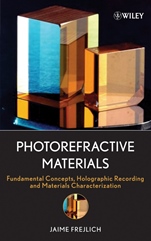
FIGURE ON THE COVER: Bi12GeO20 polished crystals grown by Dr. Jean Claude Launay at the Institut de Chimie de la Matière Condensée de Bordeaux, Bordeaux, France: The large thin plate on the bottom is a Cr–doped sample, the bigger crystal on the left–hand side is Fe–doped and the smaller on the right–hand side is undoped.
Spis treści:
LIST OF FIGURES.
LIST OF TABLES.
PREFACE.
ACKNOWLEDGMENTS.
I FUNDAMENTALS.
1. ELECTRO–OPTIC EFFECT.
1.1 Light propagation in crystals.
1.2 Tensorial Analysis.
1.3 Electro–optic effect.
1.4 Concluding Remarks.
2. PHOTOACTIVE CENTERS AND PHOTOCONDUCTIVITY.
2.1 Photoactive centers: Deep and shallow traps.
2.2 Photoconductivity.
2.3 Photochromic effect.
II HOLOGRAPHIC RECORDING.
3. RECORDING A SPACE–CHARGE ELECTRIC FIELD.
3.1 Index of refraction modulation.
3.2 General formulation.
3.3 First spatial harmonic approximation.
3.4 Steady–state nonstationary process.
3.5 Photovoltaic Materials.
4. VOLUME HOLOGRAM WITH WAVE MIXING.
4.1 Coupled wave theory: Fixed grating.
4.2 Dynamic coupled wave theory.
4.3 Phase modulation.
4.4 Four–wave mixing.
4.5 Final remarks.
5. ANISOTROPIC DIFFRACTION.
5.1 Coupled wave with anisotropic diffraction.
5.2 Anisotropic diffraction and optical activity.
6. STABILIZED HOLOGRAPHIC RECORDING.
6.1 Introduction.
6.2 Mathematical formulation.
6.3 Self–stabilized recording in actual materials.
III MATERIALS CHARACTERIZATION.
7. NONHOLOGRAPHIC OPTICAL METHODS.
7.1 Light–induced absorption.
7.2 Photoconductivity.
7.3 Electro–optic coefficient.
8. HOLOGRAPHIC TECHNIQUES.
8.1 Direct holographic techniques.
8.2 Phase modulation techniques.
9. SELF–STABILIZE
D HOLOGRAPHIC TECHNIQUES.
9.1 Holographic phase shift.
9.2 Fringe–locked running holograms.
9.3 Characterization of LiNbO3:Fe.
IV APPLICATIONS.
10. VIBRATIONS AND DEFORMATIONS.
10.1 Measurement of Vibration and Deformation.
10.2 Experimental Setup.
11. FIXED HOLOGRAMS.
11.1 Introduction.
11.2 Fixed holograms in LiNbO3.
11.3 Theory.
11.4 Experiment.
V APPENDICES.
A DETECTING A REVERSIBLE REAL–TIME HOLOGRAM.
A.1 Naked–eye detection.
A.1.1 Diffraction.
A.1.2 Interference.
A.2 Instrumental detection.
B DIFFRACTION EFFICIENCY MEASUREMENT: REVERSIBLE VOLUME HOLOGRAMS.
B.1 Angular Bragg selectivity.
B.1.1 In–Bragg recording beams.
B.1.2 Probe beam.
B.2 Reversible holograms.
B.3 High index of refraction material.
C EFFECTIVELY APPLIED ELECTRIC FIELD.
D PHYSICAL MEANING OF SOME FUNDAMENTAL PARAMETERS.
D.1 Debye screening length.
D.1.1 Temperature.
D.1.2 Debye screening length.
D.2 Diffusion and mobility.
E PHOTODIODES.
E.1 Photovoltaic regime.
E.2 Photoconductive regime.
E.3 Operational amplifier operated.
BIBLIOGRAPHY.
INDEX.
Nota biograficzna:
Jaime Frejlich graduated as a chemical engineer at the Universidad de la República, Uruguay (1973) and earned his PhD in physics/optics at Université Pierre et Marie Curie in Paris, France, in 1977. He has been a professor at Universidade Estadual de Campinas, Instituto de Física do Laboratório de Óptica in Brazil since 1978. Professor Frejlich has published more than eighty scientific papers in specialized journals. His present research interests are in photorefractive materials, effects, processes, and applications.
Okładka tylna:
The science needed to understand and undertake photorefractive materials research
Photorefractive Materials presents an overview of the basic features and properties of photorefractive
materials, covering a wide array of related topics. It provides a coherent approach suitable for introductory and advanced students seeking to learn or review the fundamentals, as well as senior researchers who need a reference while investigating more specialized areas.
Photorefractive Materials is divided into four parts:Fundamentals reviews the basic properties of the electro–optical effect, photoconduc tivity, and photochromism, all in relation to understanding how materials respond to light.Holographic Recording deals with the build–up of a space–charge electric field, the associated volume hologram, the diffraction of light by this hologram, and the mutual interaction between the recording beams and the hologram being recorded (wave–mixing). Special attention is paid to feedback–controlled holographic recording, which greatly increases control over the recording process.Materials Characterization describes optical techniques for characterizing photorefractives and measuring their parameters. Special attention is given to holographic phase modulation in two–wave mixing and self–stabilized holographic recording techniques. Mixed techniques like photoconductivity are also incuded.Applications covers two well–known applications: measurement of vibrations and deformations, and fabrication of diffractive fixed holographic optical components. These two applications are paradigmatic in terms of uses and materials in the field.
In addition to these sections, helpful appendices lay out topics of interest to those working with photorefractives in the laboratory. Throughout the book, experimental data and results are included, keeping theory and practical experience closely linked. Clearly organized for effective pedagogy, Photorefractive Materials is the definitive introduction to this exciting field of study.
FIGURE ON THE COVER: Bi12GeO20 polished crystals grown by
Dr. Jean Claude Launay at the Institut de Chimie de la Matière Condensée de Bordeaux, Bordeaux, France: The large thin plate on the bottom is a Cr–doped sample, the bigger crystal on the left–hand side is Fe–doped and the smaller on the right–hand side is undoped.
Koszyk
Książek w koszyku: 0 szt.
Wartość zakupów: 0,00 zł
Informacje


Kontakt
Gambit
Centrum Oprogramowania
i Szkoleń Sp. z o.o.
Al. Pokoju 29b/22-24
31-564 Kraków
Siedziba Księgarni
ul. Kordylewskiego 1
31-542 Kraków
+48 12 410 5991
+48 12 410 5987
+48 12 410 5989
Subskrypcje
Administratorem danych osobowych jest firma Gambit COiS Sp. z o.o. Na podany adres będzie wysyłany wyłącznie biuletyn informacyjny.
Autoryzacja płatności

Informacje na temat autoryzacji płatności poprzez PayU.

© Copyright 2012: GAMBIT COiS Sp. z o.o. Wszelkie prawa zastrzeżone.
Projekt i wykonanie: Alchemia Studio Reklamy