


Wydawcy
Katalog tematyczny
- Archeologia (109)
- Ekonomia, finanse, business (13704)
- Filozofia (1445)
- Historia (3040)
- Języki i językoznawstwo (2356)
- Lifestyle, hobby i rozrywka (475)
- Medycyna (9704)
- Nauki humanistyczne (4)
- Nauki o Ziemi i środowisku (2638)
- Nauki ścisłe (20412)
- Astronomia (294)
- Biologia (5119)
- Chemia (6540)
- Fizyka (3309)
- Elektryczność i magnetyzm (90)
- Fizyka atomowa i molekularna (110)
- Fizyka cząstek elementarnych (36)
- Fizyka jądra atomowego (36)
- Fizyka kwantowa (210)
- Fizyka matematyczna (121)
- Fizyka relatywistyczna (36)
- Fizyka statystyczna (51)
- Fizyka stosowana (498)
- Mechanika klasyczna (186)
- Optyka i światło (133)
- Stany materii (202)
- Matematyka (4574)
- Nauki ścisłe, ogólnie (503)
- Nauki społeczne (8486)
- Nauki techniczne (13450)
- Prawo (1696)
- Publikacje informacyjne i interdyscyplinarne (1288)
- Religia i wierzenia (917)
- Technika komputerowa (4067)
- Zdrowie, relacje międzyludzkie i rozwój osobisty (657)







Informacje szczegółowe o książce
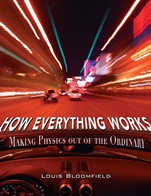
How Everything Works: Making Physics Out of the Ordinary
ISBN 9780471748175
Autor: Louis A. Bloomfield
Wydawca: Wiley
Dostępność: 3-6 tygodni
Cena: 351,75 zł
Przed złożeniem zamówienia prosimy o kontakt mailowy celem potwierdzenia ceny.
ISBN13: |
9780471748175 |
ISBN10: |
047174817X |
Autor: |
Louis A. Bloomfield |
Oprawa: |
Hardback |
Rok Wydania: |
2006-06-02 |
Ilość stron: |
736 |
Wymiary: |
287x222 |
Tematy: |
PH |
A user’s manual for our everyday world!
“Whether a curious layperson, a trained physicist, or a beginning physics student, most everyone will find this book an interesting and enlightening read and will go away comforted in that the world is not so strange and inexplicable after all.” ––From the Foreword by Carl Wieman, Nobel Laureate in Physics 2001, and CASE/Carnegie US University Professor of the Year 2004
If you didn’t know better, you might think the world was filled with magic––from the household appliances that make our lives easier to the CDs and DVDs that fill our world with sounds and images. Even a simple light bulb can seem mysterious when you stop to think about it.
Now in How Everything Works, Louis Bloomfield explains the physics behind the ordinary objects and natural phenomena all around us, and unravels the mysteries of how things work. Inside, you’ll find easy–to–understand answers to scores of fascinating questions, including:
How do microwave ovens cook food, and why does metal sometimes cause sparks in a microwave?How does an iPod use numbers to represent music?How do CDs and DVDs use light to convey information, and why are they so colorful?How can a CT or MRI image show a cross–sectional view of a person without actually entering the body?Why do golf balls have dimples?How does a pitcher make a curveball curve and knuckleball jitter about in an erratic manner?Why is the sun red at sunrise and sunset?How does a fluorescent lamp produce visible light?
You don’t need a science or engineering background to understand How Everything Works, all you need is an active curiosity about the extraordinary world all around you.
Spis treści:
Chapter 1. Things That Move.
Chapter 2. More Things That Move.
Chapter 3. Mechanical Things.
Chapter 4. More Mechanical Things
.
Chapter 5. Things Involving Fluids.
Chapter 6. Things That Move With Fluids.
Chapter 7. Thermal Things.
Chapter 8. Things That Work With Heat.
Chapter 9. Things with Resonances and Mechanical Waves.
Chapter 10. Electric Things.
Chapter 11. Magnetic and Electromagnetic Things.
Chapter 12. Electronic Things.
Chapter 13. Things That Use Electromagnetic Waves.
Chapter 14. Things That Involve Light.
Chapter 15. Optical Things.
Chapter 16. Things That Use Recent Physics.
Chapter 17. Things That Involve Materials.
Chapter 18. Things That Involve Chemical Physics.
Appendix A: Relevant Mathematics.
Appendix B: Units, Conversion of Uints.
Glossary.
Photo Credits.
Index.
Nota biograficzna:
Louis A. Bloomfield is Professor of Physics at the University of Virginia. He also works extensively with professional societies and the media to explain physics to the general public. Bloomfield received his Ph.D. from Stanford and was a postdoctoral fellow at AT&T Bell Laboratories. Widely recognized for his teaching of physics and science to non–science students at the University of Virginia, Bloomfield is the recipient of a 1998 State of Virginia Outstanding Faculty Award and the 2001 Pegram Medal of the Southeastern Section of the American Physical Society. He is the author of almost 100 publications in the fields of atomic clusters, autoionizing states, high–resolution laser spectroscopy, nonlinear optics, computer science, and general science literacy, and of the successful introductory textbook How Things Work: The Physics of Everyday Life, 3rd Edition (Wiley 2006). Bloomfield is the co–host of a new Discovery Channel television show called Some Assembly Required that will premiere in the fall of 2007.
Okładka tylna:
A user’s manual for our everyday world!
“Whether a curious layperson, a trained physicist, or a be
ginning physics student, most everyone will find this book an interesting and enlightening read and will go away comforted in that the world is not so strange and inexplicable after all.” ––From the Foreword by Carl Wieman, Nobel Laureate in Physics 2001, and CASE/Carnegie US University Professor of the Year 2004
If you didn’t know better, you might think the world was filled with magic––from the household appliances that make our lives easier to the CDs and DVDs that fill our world with sounds and images. Even a simple light bulb can seem mysterious when you stop to think about it.
Now in How Everything Works, Louis Bloomfield explains the physics behind the ordinary objects and natural phenomena all around us, and unravels the mysteries of how things work. Inside, you’ll find easy–to–understand answers to scores of fascinating questions, including:
How do microwave ovens cook food, and why does metal sometimes cause sparks in a microwave?How does an iPod use numbers to represent music?How do CDs and DVDs use light to convey information, and why are they so colorful?How can a CT or MRI image show a cross–sectional view of a person without actually entering the body?Why do golf balls have dimples?How does a pitcher make a curveball curve and knuckleball jitter about in an erratic manner?Why is the sun red at sunrise and sunset?How does a fluorescent lamp produce visible light?
You don’t need a science or engineering background to understand How Everything Works, all you need is an active curiosity about the extraordinary world all around you.
Koszyk
Książek w koszyku: 0 szt.
Wartość zakupów: 0,00 zł
Informacje


Kontakt
Gambit
Centrum Oprogramowania
i Szkoleń Sp. z o.o.
Al. Pokoju 29b/22-24
31-564 Kraków
Siedziba Księgarni
ul. Kordylewskiego 1
31-542 Kraków
+48 12 410 5991
+48 12 410 5987
+48 12 410 5989
Subskrypcje
Administratorem danych osobowych jest firma Gambit COiS Sp. z o.o. Na podany adres będzie wysyłany wyłącznie biuletyn informacyjny.
Autoryzacja płatności

Informacje na temat autoryzacji płatności poprzez PayU.

© Copyright 2012: GAMBIT COiS Sp. z o.o. Wszelkie prawa zastrzeżone.
Projekt i wykonanie: Alchemia Studio Reklamy