


Wydawcy
Katalog tematyczny
- Archeologia (109)
- Ekonomia, finanse, business (13704)
- Filozofia (1445)
- Historia (3040)
- Języki i językoznawstwo (2356)
- Lifestyle, hobby i rozrywka (475)
- Medycyna (9704)
- Nauki humanistyczne (4)
- Nauki o Ziemi i środowisku (2638)
- Nauki ścisłe (20412)
- Astronomia (294)
- Biologia (5119)
- Chemia (6540)
- Chemia analityczna (361)
- Chemia fizyczna (346)
- Chemia nieorganiczna (137)
- Chemia organiczna (535)
- Krystalografia (27)
- Minerologia (46)
- Fizyka (3309)
- Matematyka (4574)
- Nauki ścisłe, ogólnie (503)
- Nauki społeczne (8486)
- Nauki techniczne (13450)
- Prawo (1696)
- Publikacje informacyjne i interdyscyplinarne (1288)
- Religia i wierzenia (917)
- Technika komputerowa (4067)
- Zdrowie, relacje międzyludzkie i rozwój osobisty (657)





Informacje szczegółowe o książce
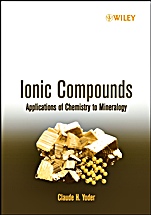
Ionic Compounds: Applications of Chemistry to Mineralogy
ISBN 9780471740469
Autor: Claude H. Yoder
Wydawca: Wiley
Dostępność: 3-6 tygodni
Cena: 464,10 zł
Przed złożeniem zamówienia prosimy o kontakt mailowy celem potwierdzenia ceny.
ISBN13: |
9780471740469 |
ISBN10: |
0471740462 |
Autor: |
Claude H. Yoder |
Oprawa: |
Paperback |
Rok Wydania: |
2006-10-31 |
Ilość stron: |
208 |
Wymiary: |
252x177 |
Tematy: |
PN |
An introduction to ionic compounds for both mineralogists and chemists
Mineralogy and chemistry find their paths intertwined in many ways. Minerals afford chemists interesting examples of simple and complex structures, as well as practical applications of bonding, symmetry, and thermodynamics. Concurrently, the relevant chemistry enriches the mineralogist′s view with a grasp of such aspects as structure, stability, and reactivity. This introduction to ionic compounds bridges the two disciplines by explaining the concepts that are used by the chemist and mineralogist in their attempts to unravel the mysteries of nature.
The lively style uses questions and answers throughout as a means to both engage the reader and enhance their understanding of the material. Ionic Compounds: Applications of Chemistry to Mineralogy conveys the fundamental principles of the structure and bonding in minerals and emphasizes the relationship of structure at the atomic level to the symmetry and properties of crystals. The book covers:Bonding and compositionStructure of ionic compounds, including close–packingThe symmetry of crystalsFactors that affect the symmetry of the unit cellMorphology and colorChemical properties
Requiring no knowledge of either chemistry or mineralogy beyond the typical secondary school level, Ionic Compounds is an accessible and highly useful reference for both professional scientist, student, and the serious mineral collector who can benefit from a deeper understanding of the chemical and crystallographic properties of minerals.
Spis treści:
Chapter 1. Bonding and Composition.
Types of Bonding.
Ionic Compounds.
Types of Ions.
Names of Ions.
Percent Composition and Empirical Formula.
The Mole.
Molar Mass (Formula Weight).
Calculation of Empirical Formula from Percent Composition.
Use of Oxide Data.
Formulas for Solid Solutions.
C
ovalent Character in Ionic Compounds.
Interactions Between Ions.
Some Laws of Electrostatics.
Potential Energy of Charged Particles.
Lattice Energy and Its Effect on Properties.
Chapter 2. Structure of Ionic Compounds: Close–packing.
Closest Packing of Ions.
The Holes Between the Layers.
Stacking Sequences.
Closest Packing for Ionic Compounds.
Relationship of Formula to Occupation of Voids.
Chapter 3. The Symmetry of Crystals.
Symmetry Elements.
Hermann–Mauguin Notation (Point Groups).
Crystal Systems.
Chapter 4. Structure of Some Simple Closest–packed Compounds.
Symmetry of the AB and ABC Closest–Packed Arrangements.
The Unit Cell.
The NaCl Structure.
The Sphalerite Structure.
Axial Relationships.
Wurtzite, a Polymorph of Sphalerite.
The Fluorite Structure.
The Rutile Structure, Polyhedral Coordination Models.
Chapter 5. Factors that Affect the Symmetry of the Unit Cell.
Effect of Cation.
The Chalcopyrite Structure and Solid Solution.
Effect of the Anion.
Some Oxy Anions.
The Pyrite Structure.
The Calcite Structure.
Aragonite, A Polymorph of Calcite.
Several Sulfates, Anhydrite and Barite.
Several Silicates, Zircon and Beryl.
Effect of Temperature and Pressure.
Chapter 6. Physical Properties: Morphology.
Morphology.
Miller indices.
Forms.
Habit.
Deviations in Crystal Growths.
Parallel Growth.
Twinning.
Epitaxis and Pseudomorphism.
Chapter 7. Physical Properties: Color.
Light and the Electromagnetic Spectrum.
The Nature of Electrons.
Electron Configurations.
The Crystal Field Model.
Colored Cations.
Ion Impurities.
Crystal Defects.
Chapter 8. Chemical Properties.
Solubility.
Energetics of Dissolution.
Solubility Rules.
Double Salts.
Reaction with Acids.
Types of Chemical Reactions.
Water as Both Acid and Base.
Strong and Weak Acids.
Conjugate Bases.
Use of Chemical Reactions for Identification.
Appendices.
1. The periodic chart.
2. The elements: Symbols, melting points, boiling points, densities, and electronegativities .
3. Metallic, covalent, and ionic radii.
4. Quartz.
5. Crystal system identification practice.
6. Crystal classes and point groups.
7. Additional reading and resources.
Nota biograficzna:
CLAUDE H. YODER is a chemistry professor at Franklin & Marshall College. He is the recipient of numerous national awards and research grants and is the author of over 100 publications.
Okładka tylna:
An introduction to ionic compounds for both mineralogists and chemists
Mineralogy and chemistry find their paths intertwined in many ways. Minerals afford chemists interesting examples of simple and complex structures, as well as practical applications of bonding, symmetry, and thermodynamics. Concurrently, the relevant chemistry enriches the mineralogist′s view with a grasp of such aspects as structure, stability, and reactivity. This introduction to ionic compounds bridges the two disciplines by explaining the concepts that are used by the chemist and mineralogist in their attempts to unravel the mysteries of nature.
The lively style uses questions and answers throughout as a means to both engage the reader and enhance their understanding of the material. Ionic Compounds: Applications of Chemistry to Mineralogy conveys the fundamental principles of the structure and bonding in minerals and emphasizes the relationship of structure at the atomic level to the symmetry and properties of crystals. The book covers:Bonding and compositionStructure of ionic compounds, including close–packingThe symmetry of crystalsFactors that affect the symmetry of the unit cellMorphology and colorChemical properties
Requiring no knowl
edge of either chemistry or mineralogy beyond the typical secondary school level, Ionic Compounds is an accessible and highly useful reference for both professional scientist, student, and the serious mineral collector who can benefit from a deeper understanding of the chemical and crystallographic properties of minerals.
Koszyk
Książek w koszyku: 0 szt.
Wartość zakupów: 0,00 zł
Informacje


Kontakt
Gambit
Centrum Oprogramowania
i Szkoleń Sp. z o.o.
Al. Pokoju 29b/22-24
31-564 Kraków
Siedziba Księgarni
ul. Kordylewskiego 1
31-542 Kraków
+48 12 410 5991
+48 12 410 5987
+48 12 410 5989
Subskrypcje
Administratorem danych osobowych jest firma Gambit COiS Sp. z o.o. Na podany adres będzie wysyłany wyłącznie biuletyn informacyjny.
Autoryzacja płatności

Informacje na temat autoryzacji płatności poprzez PayU.

© Copyright 2012: GAMBIT COiS Sp. z o.o. Wszelkie prawa zastrzeżone.
Projekt i wykonanie: Alchemia Studio Reklamy