


Wydawcy
Katalog tematyczny
- Archeologia (109)
- Ekonomia, finanse, business (13704)
- Filozofia (1445)
- Historia (3040)
- Języki i językoznawstwo (2356)
- Lifestyle, hobby i rozrywka (475)
- Medycyna (9704)
- Nauki humanistyczne (4)
- Nauki o Ziemi i środowisku (2638)
- Nauki ścisłe (20412)
- Nauki społeczne (8486)
- Nauki techniczne (13450)
- Prawo (1696)
- Publikacje informacyjne i interdyscyplinarne (1288)
- Religia i wierzenia (917)
- Technika komputerowa (4067)
- Zdrowie, relacje międzyludzkie i rozwój osobisty (657)





Informacje szczegółowe o książce
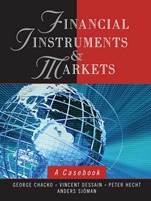
Financial Instruments and Markets: A Casebook
ISBN 9780471737674
Autor: George Chacko, Vincent Dessain, Peter Hecht, Anders Sjoman
Wydawca: Wiley
Dostępność: 3-6 tygodni
Cena: 925,05 zł
Przed złożeniem zamówienia prosimy o kontakt mailowy celem potwierdzenia ceny.
ISBN13: |
9780471737674 |
ISBN10: |
0471737674 |
Autor: |
George Chacko, Vincent Dessain, Peter Hecht, Anders Sjoman |
Oprawa: |
Hardback |
Rok Wydania: |
2006-02-10 |
Ilość stron: |
656 |
Wymiary: |
257x204 |
Tematy: |
KF |
Create value while you manage risk Today s increasingly volatile financial markets have caused an explosion of new financial instruments designed to transfer risk from collateralized mortgage–backed securities to swaptions that trade directly between financial actors. And now these complex financial instruments have become standard operating procedure at most large and mid–sized businesses. Managers overseeing any substantial business, financial or non–financial, must thoroughly understand these financial instruments and their value in hedging and diversifying to succeed.
With this unique casebook, you ll have the opportunity to gain the analytical, institutional, and functional knowledge you need to use these instruments to solve new problems. Featuring cases from the authors MBA and Executive Education level courses at Harvard Business School
, the book covers the basics of financial instruments, from terminology to pricing, and the markets in which these instruments trade. Throughout, the emphasis is on how these securities accomplish risk transfer from actors who do not want risk to those who are willing to take it on for a fee of course.
These cases include:
Deutsche Bank: Finding Relative Value Trades
Ticonderoga Capital: Inverse Floating Rate Bonds
100–Year Liabilities at Prudential Insurance
Swedish Lottery Bonds
The Enron Odyssey: The Special Purpose of SPEs
Building Hedge Funds at Prospero Capital
Dell Computer Corporation: Share Repurchase Program
First American Bank: Credit Default Swaps
Morgan Stanley and TRAC–X: The Battle for the CDS Indexes Market
and more
Acknowledgments.
About the Authors.
1. Introduction.
SECTION 1: FIXED–INCOME SECURITIES.
Module FI–1: Fixed–Income Securities: Concepts.
2. Reading Note Note on Bond Valuation &Returns.
3. Case Deutsche Bank: Finding Relative ValueTrades.
4. Reading Note Note on Duration and Convexity.
5. Case Ticonderoga Capital: Inverse Floating RateBonds.
6. Case 100–Year Liabilities at PrudentialInsurance.
Module FI–1: Fixed–Income Securities:Applications.
7. Case Deutsche Bank: Discussing the Equity RiskPremium.
8. Case Swedish LotteryBonds.
9. Case Bank Leu s Prima Cat Bond Fond.
10. Case Catastrophe Bonds at SwissRe.
11. Case Mortgage Backs atTiconderoga.
12. Case KAMCO and the Cross–Border Securitization ofKorean Non–Performing Loans.
13. Case Nexgen: Structuring Collateralized DebtObligations (CDOs).
14. Reading Notes Forward and SwapContracts.
15. Case The Enron Odyssey (A):The Special Purpose ofSPEs.
SECTION 2: DERIVATIVE SECURITIES (EQUITY AND INTEREST RATEOPTIONS).
Module DS–1: Equity Options: Concepts.
16. Reading Notes Note on Basic OptionProperties.
17. Dell Computer Corporation: Share RepurchaseProgram.
18. Reading Notes Note on Option Valuation.
19. Sally Jameson 1999.
Module DS–2: Equity Options: Applications.
20. Case Pine Street Capital.
21. Case Tribune Company: The PHONES Proposal.
22. Case Cox Communications, Inc., 1999.
23. Case DigaMem Inc.
24. Case ALZA and Bio–Electro Systems (A): Technologicaland Financial Innovation.
Module DS–3: Credit Derivatives.
25. Reading Notes Note on Credit Derviatives.
26. Case First American Bank: Credit DefaultSwaps.
27. Case Morgan Stanley and TRAC–X: The Battle forthe CDS Indexes Market.
Module DS–4: Interest Rate Derviatives.
28. Reading Note Introduction to Interest RateOptions.
29. Case Advising on Currency Risk at ICICIBank.
Module DS–5: Equity and Options Exchanges.
30. Case DeutscheBorse.
31. Case The Chicago Board OptionsExchange.
32. Case The International Securities Exchange: NewGround in Options Markets.
Module DS–6: Real Options.
33: Case RTY Telecom: Network Expansion.
Index.
George Chacko joined the Harvard Business SchoolFaculty in the Finance Area in 1997. He currently teaches asecond–year course on Capital Markets in the MBA Program, and heteaches a Ph.D. course on Asset Pricing that is jointly offered bythe Business School and the Harvard Economics Department. He hasalso taught Corporate Financial Engineering in both the MBA programand the Executive Education program at HBS, as well as a first–yearcourse on Corporate Finance in the MBA program.
Professor Chacko holds a Ph.D. in Business Economics fromHarvard University, and dual Master′s degrees in Business Economics(Harvard University) and Business Administration (University ofChicago). He holds a Bachelor′s degree in Electrical Engineeringfrom the Massachusetts Institute of Technology. Professor Chacko′sexperiences prior to HBS have included work at a major financialservices firm, and a large consulting firm. He currently consultswith with financial institutions ranging from commercial/investmentbanks and insurance companies to hedge funds.
Professor Chacko′s research has focused on three areas: (1) thestructure of fixed income markets and the design of instrumentsthat trade in those markets; (2) the study of portfolio choice byindividuals and institutions; and (3) the analysis and applicationof derivative securities.
Koszyk
Książek w koszyku: 0 szt.
Wartość zakupów: 0,00 zł
Informacje


Kontakt
Gambit
Centrum Oprogramowania
i Szkoleń Sp. z o.o.
Al. Pokoju 29b/22-24
31-564 Kraków
Siedziba Księgarni
ul. Kordylewskiego 1
31-542 Kraków
+48 12 410 5991
+48 12 410 5987
+48 12 410 5989
Subskrypcje
Administratorem danych osobowych jest firma Gambit COiS Sp. z o.o. Na podany adres będzie wysyłany wyłącznie biuletyn informacyjny.
Autoryzacja płatności

Informacje na temat autoryzacji płatności poprzez PayU.

© Copyright 2012: GAMBIT COiS Sp. z o.o. Wszelkie prawa zastrzeżone.
Projekt i wykonanie: Alchemia Studio Reklamy