


Wydawcy
Katalog tematyczny
- Archeologia (109)
- Ekonomia, finanse, business (13704)
- Filozofia (1445)
- Historia (3040)
- Języki i językoznawstwo (2356)
- Lifestyle, hobby i rozrywka (475)
- Medycyna (9704)
- Nauki humanistyczne (4)
- Nauki o Ziemi i środowisku (2638)
- Nauki ścisłe (20412)
- Nauki społeczne (8486)
- Nauki techniczne (13450)
- Budownictwo lądowe (1045)
- Chemia przemysłowa (2258)
- Elektronika i telekomunikacja (3287)
- Energetyka (1122)
- Inne nauki stosowane (363)
- Inżynieria biochemiczna (507)
- Inżynieria transportu (232)
- Mechanika i materiały (3316)
- Nauka o środowisku (321)
- Rolnictwo (507)
- Technika, ogólnie (475)
- Prawo (1696)
- Publikacje informacyjne i interdyscyplinarne (1288)
- Religia i wierzenia (917)
- Technika komputerowa (4067)
- Zdrowie, relacje międzyludzkie i rozwój osobisty (657)





Informacje szczegółowe o książce
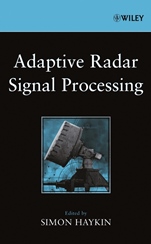
Adaptive Radar Signal Processing
ISBN 9780471735823
Autor: Simon Haykin
Wydawca: Wiley
Dostępność: 3-6 tygodni
Cena: 631,05 zł
Przed złożeniem zamówienia prosimy o kontakt mailowy celem potwierdzenia ceny.
ISBN13: |
9780471735823 |
ISBN10: |
0471735825 |
Autor: |
Simon Haykin |
Oprawa: |
Hardback |
Rok Wydania: |
2006-11-24 |
Ilość stron: |
248 |
Wymiary: |
243x168 |
Tematy: |
TJ |
An Exploration of Key Issues Integral to the Design of Adaptive Radar Systems
This collaborative work presents the results of over twenty years of pioneering research by Professor Simon Haykin and his colleagues, dealing with the use of adaptive radar signal processing to account for the nonstationary nature of the environment. These results, described by the researchers themselves, have profound implications for defense–related signal processing and remote sensing.
The book is divided into two parts:Part I discusses radar spectral analysis, with emphasis on spectrum estimation of the received signal. Following an introductory chapter, Chapter 2 addresses the low–angle tracking radar problem. Focusing on the target′s angle of arrival in the presence of multipath, the authors set forth a spectrum estimation procedure known as the multi–taper, or multiple–window, method. This method accounts for the specular as well as diffuse kinds of multipath, which are integral parts of a physical low–angle tracking radar environment. Chapter 3 builds on the multi–taper method by estimating the power spectrum of the received signal as a function of both time and frequency with emphasis on sea clutter.Part II examines dynamic models of radar returns produced in a marine environment. Chapters 4 and 5 study different approaches to modeling the underlying dynamics responsible for the generation of sea clutter. Chapter 6 completes the discussion by formulating a Bayesian framework for the detection–through–tracking of a target in the presence of sea clutter.
References are provided in each chapter guiding the reader to the original research on which this book is based. This is a must–read for all engineers involved with radar systems—even senior–level engineers will find much new and thought–provoking material.
Spis treści:
Preface.
Contri
butors List.
1. Introduction (Simon Haykin).
Experimental Radar Facilities.
Organization of the Book.
Part I Radar Spectral Analysis.
2. Angle–of–Arrival Estimation in the Presence of Multipath (Anastasios Drosopoulos and Simon Haykin).
2.1 Introduction.
2.2 The Low–Angle Tracking Radar Problem.
2.3 Spectrum Estimation Background.
2.3.1 The Fundamental Equation of Spectrum Estimation.
2.4 Thomson’s Multi–Taper Method.
2.4.1 Prolate Spheroidal Wavefunctions and Sequences.
2.5 Test Dataset and a Comparison of Some Popular Spectrum Estimation Procedures.
2.5.1 Classical Spectrum Estimation.
2.5.2 MUSIC and MFBLP.
2.6 Multi–taper Spectrum Estimation.
2.6.1 The Adaptive Spectrum.
2.6.2 The Composite Spectrum.
2.6.3 Computing the Crude, Adaptive, and Composite Spectra.
2.7 F–Test for the Line Components.
2.7.1 Brief Outline of the F–Test.
2.7.2 The Point Regression Single–Line F–Test.
2.7.3 The Integral Regression Single–Line F–Test.
2.7.4 The Point Regression Double–Line F–Test .
2.7.5 The Integral Regression Double–Line F–Test.
2.7.6 Line Component Extraction.
2.7.7 Prewhitening.
2.7.8 Multiple Snapshots.
2.7.9 Multiple Snapshot, Single–Line, Point–Regression F–Tests.
2.7.10 Multiple–Snapshot, Double–Line Point–Regression F–Tests.
2.8 Experimental Data Description for a Low–Angle Tracking Radar Study.
2.9 Angle–of–Arrival (AOA) Estimation.
2.10 Diffuse Multipath Spectrum Estimation.
2.11 Discussion.
References.
3. Time–Frequency Analysis of Sea Clutter (David J. Thomson and Simon Haykin).
3.1 Introduction.
3.2 An Overview of Nonstationary Behavior and Time–Frequency Analysis.
3.3 Theoretical Background on Nonstat
ionarity.
3.3.1 Multi–taper Estimates.
3.3.2 Spectrum Estimation as an Inverse Problem.
3.4 High–Resolution Multi–taper Spectrograms.
3.4.1 Nonstationary Quadratic–Inverse Theory.
3.4.2 Multi–taper Estimates of the Loève Spectrum.
3.5 Spectrum Analysis of Radar Signals.
3.6 Discussion.
3.6.1 Target Detection Rooted in Learning.
References.
Part II Dynamic Models.
4. Dynamics of Sea Clutter (Simon Haykin, Rembrandt Bakker, and Brian Currie).
4.1 Introduction.
4.2 Statistical Nature of Sea Clutter: Classical Approach.
4.2.1 Background.
4.2.2 Current Models.
4.3 Is There a Radar Clutter Attractor?
4.3.1 Nonlinear Dynamics.
4.3.2 Chaotic Invariants.
4.3.3 Inconclusive Experimental Results on the Chaotic Invariants of Sea Clutter.
4.3.4 Dynamic Reconstruction.
4.3.5 Chaos, a Self–Fulfi lling Prophecy?
4.4 Hybrid AM/FM Model of Sea Clutter.
4.4.1 Radar Return Plots.
4.4.2 Rayleigh Fading.
4.4.3 Time–Doppler Spectra.
4.4.4 Evidence for Amplitude Modulation, Frequency Modulation, and More.
4.4.5 Modeling Sea Clutter as a Nonstationary Complex Autoregressive Process.
4.5 Discussion.
4.5.1 Nonlinear Dynamics of Sea Clutter.
4.5.2 Autoregressive Modeling of Sea Clutter.
4.5.3 State–Space Theory.
4.5.4 Nonlinear Dynamical Approach Versus Classical Statistical Approach.
4.5.5 Stochastic Chaos.
References.
Appendix A Specifi cations of the Three Sea–Clutter Sets Used in This Chapter.
5. Sea–Clutter Nonstationarity: The Infl uence of Long Waves (Maria Greco and Fulvio Gini).
5.1 Introduction.
5.2 Radar and Data Description.
5.3 Statistical Data Analyses.
5.4 Modulation of Long Waves: Hybrid AM/FM Model.
5.5 Nonstationary AR Model.
5.6 Parametric Analysis of Texture Process.
5.7 Discussion.
5.7.1 Autoregressive Modeling of Sea Clutter.
5.7.2 Cyclostationarity of Se
a Clutter.
References.
6. Two New Strategies for Target Detection in Sea Clutter (Rembrandt Bakker, Brian Currie, and Simon Haykin).
6.1 Introduction.
6.2 Bayesian Direct Filtering Procedure.
6.2.1 Single–Target Scenario.
6.2.2 Conditioning on Past and Future Measurements.
6.3 Operational Details.
6.3.1 Experimental Data.
6.3.2 Statistics of Sea Clutter.
6.3.3 Statistics of Target Returns.
6.3.4 Motion Model of the Target.
6.4 Experimental Results on the Bayesian Direct Filter.
6.5 Additional Notes on the Bayesian Direct Filter.
6.6 Correlation Anomally Detection Strategy.
6.7 Experimental Comparison of the Bayesian Direct Filter and Correlation Anomaly Receiver.
6.7.1 Target–to–Interference Ratio.
6.7.2 Receiver Comparison.
6.8 Discussion.
6.8.1 Further Research.
References.
Index.
Nota biograficzna:
SIMON HAYKIN, PhD, is Distinguished University Professor in the Department of Electrical and Computer Engineering at McMaster University. He has pioneered signal–processing techniques and systems for radar and communication applications, and authored several acclaimed textbooks. Dr. Haykin has received numerous awards for his research including Honorary Doctor of Technical Sciences from ETH Zurich, Switzerland, and the first International Union of Radio Science Henry Booker Gold Medal.
Okładka tylna:
An Exploration of Key Issues Integral to the Design of Adaptive Radar Systems
This collaborative work presents the results of over twenty years of pioneering research by Professor Simon Haykin and his colleagues, dealing with the use of adaptive radar signal processing to account for the nonstationary nature of the environment. These results, described by the researchers themselves, have profound implications for defense–related signal processing and remote sensing.
The book is divided into two parts:Par
Koszyk
Książek w koszyku: 0 szt.
Wartość zakupów: 0,00 zł
Informacje


Kontakt
Gambit
Centrum Oprogramowania
i Szkoleń Sp. z o.o.
Al. Pokoju 29b/22-24
31-564 Kraków
Siedziba Księgarni
ul. Kordylewskiego 1
31-542 Kraków
+48 12 410 5991
+48 12 410 5987
+48 12 410 5989
Subskrypcje
Administratorem danych osobowych jest firma Gambit COiS Sp. z o.o. Na podany adres będzie wysyłany wyłącznie biuletyn informacyjny.
Autoryzacja płatności

Informacje na temat autoryzacji płatności poprzez PayU.

© Copyright 2012: GAMBIT COiS Sp. z o.o. Wszelkie prawa zastrzeżone.
Projekt i wykonanie: Alchemia Studio Reklamy