


Wydawcy
Katalog tematyczny
- Archeologia (109)
- Ekonomia, finanse, business (13704)
- Filozofia (1445)
- Historia (3040)
- Języki i językoznawstwo (2356)
- Lifestyle, hobby i rozrywka (475)
- Medycyna (9704)
- Nauki humanistyczne (4)
- Nauki o Ziemi i środowisku (2638)
- Nauki ścisłe (20412)
- Nauki społeczne (8486)
- Nauki techniczne (13450)
- Budownictwo lądowe (1045)
- Chemia przemysłowa (2258)
- Elektronika i telekomunikacja (3287)
- Energetyka (1122)
- Inne nauki stosowane (363)
- Inżynieria biochemiczna (507)
- Inżynieria transportu (232)
- Mechanika i materiały (3316)
- Nauka o środowisku (321)
- Rolnictwo (507)
- Technika, ogólnie (475)
- Prawo (1696)
- Publikacje informacyjne i interdyscyplinarne (1288)
- Religia i wierzenia (917)
- Technika komputerowa (4067)
- Zdrowie, relacje międzyludzkie i rozwój osobisty (657)





Informacje szczegółowe o książce
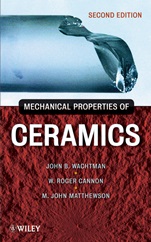
Mechanical Properties of Ceramics
ISBN 9780471735816
Autor: John B. Wachtman, W. Roger Cannon, M. John Matthewson
Wydawca: Wiley
Dostępność: 3-6 tygodni
Cena: 736,05 zł
Przed złożeniem zamówienia prosimy o kontakt mailowy celem potwierdzenia ceny.
ISBN13: |
9780471735816 |
ISBN10: |
0471735817 |
Autor: |
John B. Wachtman, W. Roger Cannon, M. John Matthewson |
Oprawa: |
Hardback |
Rok Wydania: |
2009-04-29 |
Numer Wydania: |
2nd Edition |
Ilość stron: |
496 |
Wymiary: |
234x165 |
Tematy: |
TG |
A Comprehensive and Self–Contained Treatment of the Theory and Practical Applications of Ceramic Materials
When failure occurs in ceramic materials, it is often catastrophic, instantaneous, and total. Now in its Second Edition, this important book arms readers with a thorough and accurate understanding of the causes of these failures and how to design ceramics for failure avoidance. It systematically covers:
Stress and strain
Types of mechanical behavior
Strength of defect–free solids
Linear elastic fracture mechanics
Measurements of elasticity, strength, and fracture toughness
Subcritical crack propagation
Toughening mechanisms in ceramics
Effects of microstructure on toughness and strength
Cyclic fatigue of ceramics
Thermal stress and thermal shock in ceramics
Fractography
Dislocation and plastic deformation in ceramics
Creep and superplasticity of ceramics
Creep rupture at high temperatures and safe life design
Hardness and wear
And more
While maintaining the first edition′s reputation for being an indispensable professional resource, this new edition has been updated with sketches, explanations, figures, tables, summaries, and problem sets to make it more student–friendly as a textbook in undergraduate and graduate courses on the mechanical properties of ceramics.
Spis treści:
Preface.
Acknowledgments.
1 Stress and Strain.
1.1 Introduction.
1.2 Tensor Notation for Stress.
1.3 Stress in Rotated Coordinate System.
1.4 Principal Stress.
1.4.1 Principal Stresses in Three Dimensions.
1.5 Stress Invariants.
1.6 Stress Deviator.
1.7 Strain.
1.8 True Stress and True Strain.
1.8.1 True Strain.
1.8.2 True Stress.
Problems.
2 Types of Mechanical Behavior.
2.1 Introduction.
2.2 Elasticity and Brittle Fracture.
2.3 Permanen
t Deformation.
3 Elasticity.
3.1 Introduction.
3.2 Elasticity of Isotropic Bodies.
3.3 Reduced Notation for Stresses, Strains, and Elastic Constants.
3.4 Effect of Symmetry on Elastic Constants.
3.5 Orientation Dependence of Elastic Moduli in Single Crystals and Composites.
3.6 Values of Polycrystalline Moduli in Terms of Single–Crystal Constants.
3.7 Variation of Elastic Constants with Lattice Parameter.
3.8 Variation of Elastic Constants with Temperature.
3.9 Elastic Properties of Porous Ceramics.
3.10 Stored Elastic Energy.
Problems.
4 Strength of Defect–Free Solids.
4.1 Introduction.
4.2 Theoretical Strength in Tension.
4.3 Theoretical Strength in Shear.
Problems.
5 Linear Elastic Fracture Mechanics.
5.1 Introduction.
5.2 Stress Concentrations.
5.3 Griffith Theory of Fracture of a Brittle Solid.
5.4 Stress at Crack Tip: An Estimate.
5.5 Crack Shape in Brittle Solids.
5.6 Irwin Formulation of Fracture Mechanics: Stress Intensity Factor.
5.7 Irwin Formulation of Fracture Mechanics: Energy Release Rate.
5.8 Some Useful Stress Intensity Factors.
5.9 The J Integral.
5.10 Cracks with Internal Loading.
5.11 Failure under Multiaxial Stress.
Problems.
6 Measurements of Elasticity, Strength, and Fracture Toughness.
6.1 Introduction.
6.2 Tensile Tests.
6.3 Flexure Tests.
6.4 Double–Cantilever–Beam Test.
6.5 Double–Torsion Test.
6.6 Indentation Test.
6.7 Biaxial Flexure Testing.
6.8 Elastic Constant Determination Using Vibrational and Ultrasonic Methods.
Problems.
7 Statistical Treatment of Strength.
7.1 Introduction.
7.2 Statistical Distributions.
7.3 Strength Distribution Functions.
7.4 Weakest Link Theory.
7.5 Determining Weibull Parameters.
7.6 Effect of Specimen Size.
7.7 Adaptation to Bend Testing.
7.8 Safety Factors.
7.9 Example of Safe Stress Calculation
.
7.10 Proof Testing.
7.11 Use of Pooled Fracture Data in Linear Regression Determination of Weibull Parameters.
7.12 Method of Maximum Likelihood in Weibull Parameter Estimation.
7.13 Statistics of Failure under Multiaxial Stress.
7.14 Effects of Slow Crack Propagation and R–Curve Behavior on Statistical Distributions of Strength.
7.15 Surface Flaw Distributions and Multiple Flaw Distributions.
Problems.
8 Subcritical Crack Propagation.
8.1 Introduction.
8.2 Observed Subcritical Crack Propagation.
8.3 Crack Velocity Theory and Molecular Mechanism.
8.4 Time to Failure under Constant Stress.
8.5 Failure under Constant Stress Rate.
8.6 Comparison of Times to Failure under Constant Stress and Constant Stress Rate.
8.7 Relation of Weibull Statistical Parameters with and without Subcritical Crack Growth.
8.8 Construction of Strength–Probability–Time Diagrams.
8.9 Proof Testing to Guarantee Minimum Life.
8.10 Subcritical Crack Growth and Failure from Flaws Originating from Residual Stress Concentrations.
8.11 Slow Crack Propagation at High Temperature.
Problems.
9 Stable Crack Propagation and R–Curve Behavior.
9.1 Introduction.
9.2 R–Curve (T–Curve) Concept.
9.3 R–Curve Effects of Strength Distributions.
9.4 Effect of R Curve on Subcritical Crack Growth.
Problems.
10 Overview of Toughening Mechanisms in Ceramics.
10.1 Introduction.
10.2 Toughening by Crack Deflection.
10.3 Toughening by Crack Bowing.
10.4 General Remarks on Crack Tip Shielding.
11 Effect of Microstructure on Toughness and Strength.
11.1 Introduction.
11.2 Fracture Modes in Polycrystalline Ceramics.
11.3 Crystalline Anisotropy in Polycrystalline Ceramics.
11.4 Effect of Grain Size on Toughness.
11.5 Natural Flaws in Polycrystalline Ceramics.
11.6 Effect of Grain Size on Fracture Strength.
11.7 Effect
of Second–Phase Particles on Fracture Strength.
11.8 Relationship between Strength and Toughness.
11.9 Effect of Porosity on Toughness and Strength.
11.10 Fracture of Traditional Ceramics.
Problems.
12 Toughening by Transformation.
12.1 Introduction.
12.2 Basic Facts of Transformation Toughening.
12.3 Theory of Transformation Toughening.
12.4 Shear–Dilatant Transformation Theory.
12.5 Grain–Size–Dependent Transformation Behavior.
12.6 Application of Theory to Ca–Stabilized Zirconia.
Problems.
13 Mechanical Properties of Continuous–Fiber–Reinforced Ceramic Matrix Composites.
13.1 Introduction.
13.2 Elastic Behavior of Composites.
13.3 Fracture Behavior of Composites with Continuous, Aligned Fibers.
13.4 Complete Matrix Cracking of Composites with Continuous, Aligned Fibers.
13.5 Propagation of Short, Fully Bridged Cracks.
13.6 Propagation of Partially Bridged Cracks.
13.7 Additional Treatment of Crack–Bridging Effects.
13.8 Additional Statistical Treatments.
13.9 Summary of Fiber–Toughening Mechanisms.
13.10 Other Failure Mechanisms in Continuous, Aligned–Fiber Composites.
13.11 Tensile Stress–Strain Curve of Continuous, Aligned–Fiber Composites.
13.12 Laminated Composites.
Problems.
14 Mechanical Properties of Whisker–, Ligament–, and Platelet–Reinforced Ceramic Matrix Composites.
14.1 Introduction.
14.2 Model for Whisker Toughening.
14.3 Combined Toughening Mechanisms in Whisker–Reinforced Composites.
14.4 Ligament–Reinforced Ceramic Matrix Composites.
14.5 Platelet–Reinforced Ceramic Matrix Composites.
Problems.
15 Cyclic Fatigue of Ceramics.
15.1 Introduction.
15.2 Cyclic Fatigue of Metals.
15.3 Cyclic Fatigue of Ceramics.
15.4 Mechanisms of Cyclic Fatigue of Ceramics.
15.5 Cyclic Fatigue by Degradation of Crack B
Koszyk
Książek w koszyku: 0 szt.
Wartość zakupów: 0,00 zł
Informacje


Kontakt
Gambit
Centrum Oprogramowania
i Szkoleń Sp. z o.o.
Al. Pokoju 29b/22-24
31-564 Kraków
Siedziba Księgarni
ul. Kordylewskiego 1
31-542 Kraków
+48 12 410 5991
+48 12 410 5987
+48 12 410 5989
Subskrypcje
Administratorem danych osobowych jest firma Gambit COiS Sp. z o.o. Na podany adres będzie wysyłany wyłącznie biuletyn informacyjny.
Autoryzacja płatności

Informacje na temat autoryzacji płatności poprzez PayU.

© Copyright 2012: GAMBIT COiS Sp. z o.o. Wszelkie prawa zastrzeżone.
Projekt i wykonanie: Alchemia Studio Reklamy