


Wydawcy
Katalog tematyczny
- Archeologia (109)
- Ekonomia, finanse, business (13704)
- Filozofia (1445)
- Historia (3040)
- Języki i językoznawstwo (2356)
- Lifestyle, hobby i rozrywka (475)
- Medycyna (9704)
- Nauki humanistyczne (4)
- Nauki o Ziemi i środowisku (2638)
- Nauki ścisłe (20412)
- Astronomia (294)
- Biologia (5119)
- Chemia (6540)
- Chemia analityczna (361)
- Chemia fizyczna (346)
- Chemia nieorganiczna (137)
- Chemia organiczna (535)
- Krystalografia (27)
- Minerologia (46)
- Fizyka (3309)
- Matematyka (4574)
- Nauki ścisłe, ogólnie (503)
- Nauki społeczne (8486)
- Nauki techniczne (13450)
- Prawo (1696)
- Publikacje informacyjne i interdyscyplinarne (1288)
- Religia i wierzenia (917)
- Technika komputerowa (4067)
- Zdrowie, relacje międzyludzkie i rozwój osobisty (657)





Informacje szczegółowe o książce
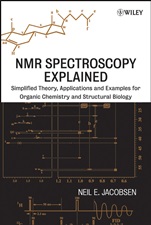
NMR Spectroscopy Explained: Simplified Theory, Applications and Examples for Organic Chemistry and Structural Biology
ISBN 9780471730965
Autor: Neil E. Jacobsen
Wydawca: Wiley
Dostępność: 3-6 tygodni
Cena: 861,00 zł
Przed złożeniem zamówienia prosimy o kontakt mailowy celem potwierdzenia ceny.
ISBN13: |
9780471730965 |
ISBN10: |
0471730963 |
Autor: |
Neil E. Jacobsen |
Oprawa: |
Hardback |
Rok Wydania: |
2007-09-18 |
Ilość stron: |
688 |
Wymiary: |
254x178 |
Tematy: |
PN |
A STEP–BY–STEP APPROACH TO UNDERSTANDING NMR SPECTROSCOPY
Used in concert with complementary analytical techniques such as light spectroscopy and mass spectrometry, Nuclear Magnetic Resonance (NMR) spectroscopy is the most powerful tool for the determination of organic structure. This book fosters a real–world understanding of NMR spectroscopy and how it works without burying the reader in technical details and physical and mathematical formalism. With an accessible, clear style and approach, NMR Spectroscopy Explained:
Introduces readers to modern NMR spectroscopy as it is applied to the analysis of organic compounds and biomolecules
Minimizes complicated theory and focuses on the practical aspects of NMR spectroscopy
Provides comprehensive coverage of how NMR spectroscopy experiments actually work and how to optimize them on the spectrometer
Provides examples of every experiment, with detailed interpretation of data
Presents essential descriptive theory in mainly nonmathematical terms
The guide starts with a basic model and expands it one step at a time, complete with experiments and examples, helping readers who are not experts in physics or physical chemistry to develop an empowering understanding of even the most complex biological NMR spectroscopy techniques. It is an ideal reference for professionals in industry and academia who use NMR spectroscopy technology, NMR facility managers, and upper–level undergraduates and graduate students in organic chemistry, biochemistry, pharmacology, biophysics, and engineering.
Spis treści:
Preface.
Acknowledgments.
1 Fundamentalsof NMR Spectroscopy in Liquids.
1.1 Introduction to NMR Spectroscopy.
1.2 Examples: NMR Spectroscopy of Oligosaccharides and Terpenoids.
1.3 Typical Values of Chemical Shifts and Coupling Constants.
1.4 Fundamental Concepts of NMR Spe
ctroscopy.
2 Interpretation of Proton (1H) NMR Spectra.
2.1 Assignment.
2.2 Effect of Bo Field Strength on the Spectrum.
2.3 First–Order Splitting Patterns.
2.4 The Use of 1H–1H Coupling Constants to Determine Stereochemistry and Conformation.
2.5 Symmetry and Chirality in NMR.
2.6 The Origin of the Chemical Shift.
2.7 J Coupling to Other NMR–Active Nuclei.
2.8 Non–First–Order Splitting Patterns: Strong Coupling.
2.9 Magnetic Equivalence.
3 NMR Hardware and Software.
3.1 Sample Preparation.
3.2 Sample Insertion.
3.3 The Deuterium Lock Feedback Loop.
3.4 The Shim System.
3.5 Tuning and Matching the Probe.
3.6 NMR Data Acquisition and Acquisition Parameters.
3.7 Noise and Dynamic Range.
3.8 Special Topic: Oversampling and Digital Filtering.
3.9 NMR Data Processing—Overview.
3.10 The Fourier Transform.
3.11 Data Manipulation Before the Fourier Transform.
3.12 Data Manipulation After the Fourier Transform.
4 Carbon–13 (13C) NMR Spectroscopy.
4.1 Sensitivity of 13C.
4.2 Splitting of 13C Signals.
4.3 Decoupling.
4.4 Heteronuclear Decoupling: 1H Decoupled 13C Spectra.
4.5 Decoupling Hardware.
4.6 Decoupling Software: Parameters.
4.7 The Nuclear Overhauser Effect (NOE).
4.8 Heteronuclear Decoupler Modes.
5 NMR Relaxation—Inversion–Recovery and the Nuclear Overhauser Effect (NOE).
5.1 The Vector Model.
5.2 One Spin in a Magnetic Field.
5.3 A Large Population of Identical Spins: Net Magnetization.
5.4 Coherence: Net Magnetization in the x–y Plane.
5.5 Relaxation.
5.6 Summary of the Vector Model.
5.7 Molecular Tumbling and NMR Relaxation.
5.8 Inversion–Recovery: Measurement of T1 Values.
5.9 Continuous–Wave Low–Power Irradiation of One Resonance.
5.1
0 Homonuclear Decoupling.
5.11 Presaturation of Solvent Resonance.
5.12 The Homonuclear Nuclear Overhauser Effect (NOE).
5.13 Summary of the Nuclear Overhauser Effect.
6 The Spin Echo and the Attached Proton Test (APT).
6.1 The Rotating Frame of Reference.
6.2 The Radio Frequency (RF) Pulse.
6.3 The Effect of RF Pulses.
6.4 Quadrature Detection, Phase Cycling, and the Receiver Phase.
6.5 Chemical Shift Evolution.
6.6 Scalar (J) Coupling Evolution.
6.7 Examples of J–coupling and Chemical Shift Evolution.
6.8 The Attached Proton Test (APT).
6.9 The Spin Echo.
6.10 The Heteronuclear Spin Echo: Controlling J–Coupling Evolution and Chemical Shift Evolution.
7 Coherence Transfer: INEPT and DEPT.
7.1 Net Magnetization.
7.2 Magnetization Transfer.
7.3 The Product Operator Formalism: Introduction.
7.4 Single Spin Product Operators: Chemical Shift Evolution.
7.5 Two–Spin Operators: J–coupling Evolution and Antiphase Coherence.
7.6 The Effect of RF Pulses on Product Operators.
7.7 INEPT and the Transfer of Magnetization from 1H to 13C.
7.8 Selective Population Transfer (SPT) as a Way of Understanding INEPT Coherence Transfer.
7.9 Phase Cycling in INEPT.
7.10 Intermediate States in Coherence Transfer.
7.11 Zero– and Double–Quantum Operators.
7.12 Summary of Two–Spin Operators.
7.13 Refocused INEPT: Adding Spectral Editing.
7.14 DEPT: Distortionless Enhancement by Polarization Transfer.
7.15 Product Operator Analysis of the DEPT Experiment.
8 Shaped Pulses, Pulsed Field Gradients, and Spin Locks: Selective 1D NOE and 1D TOCSY.
8.1 Introducing Three New Pulse Sequence Tools.
8.2 The Effect of Off–Resonance Pulses on Net Magnetization.
8.3 The Excitation Profile for Rectangular Pulses.
8.4 Selective Pulses and Shaped Pulses.
8.5 Pulsed Field Gradients.
8
.6 Combining Shaped Pulses and Pulsed Field Gradients: "Excitation Sculpting."
8.7 Coherence Order: Using Gradients to Select a Coherence Pathway.
8.8 Practical Aspects of Pulsed Field Gradients and Shaped Pulses.
8.9 1D Transient NOE using DPFGSE.
8.10 The Spin Lock.
8.11 Selective 1D ROESY and 1D TOCSY.
8.12 Selective 1D TOCSY using DPFGSE.
8.13 RF Power Levels for Shaped Pulses and Spin Locks.
9 Two–Dimensional NMR Spectroscopy: HETCOR, COSY, and TOCSY.
9.1 Introduction to Two–Dimensional NMR.
9.2 HETCOR: A 2D Experiment Created from the 1D INEPT Experiment.
9.3 A General Overview of 2D NMR Experiments.
9.4 2D Correlation Spectroscopy (COSY).
9.5 Understanding COSY with Product Operators.
9.6 2D TOCSY (Total Correlation Spectroscopy).
9.7 Data Sampling in t1 and the 2D Spectral Window.
10 Advanced NMR Theory: NOESY and DQF–COSY.
10.1 Spin Kinetics: Derivation of the Rate Equation for Cross–Relaxation.
10.2 Dynamic Processes and Chemical Exchange in NMR.
10.3 2D NOESY and 2D ROESY.
10.4 Expanding Our View of Coherence: Quantum Mechanics and Spherical Operators.
10.5 Double–Quantum Filtered COSY (DQF–COSY).
10.6 Coherence Pathway Selection in NMR Experiments.
10.7 The Density Matrix Representation of Spin States.
10.8 The Hamiltonian Matrix: Strong Coupling and Ideal Isotropic (TOCSY) Mixing.
11 Inverse Heteronuclear 2D Experiments: HSQC, HMQC, and HMBC.
11.1 Inverse Experiments: 1H Observe with 13C Decoupling.
11.2 General Appearance of Inverse 2D Spectra.
11.3 Examples of One–Bond Inverse Correlation (HMQC and HSQC) Without 13C Decoupling.
11.4 Examples of Edited, 13C–Decoupled HSQC Spectra.
11.5 Examples of HMBC Spectra.
11.6 Structure Determination Using HSQC and HMBC.
11.7 Understanding the HSQC Pulse Sequence.
11.8 Understanding the HMQC Pulse Sequence.
11.9 Understanding the Heteron
Koszyk
Książek w koszyku: 0 szt.
Wartość zakupów: 0,00 zł
Informacje


Kontakt
Gambit
Centrum Oprogramowania
i Szkoleń Sp. z o.o.
Al. Pokoju 29b/22-24
31-564 Kraków
Siedziba Księgarni
ul. Kordylewskiego 1
31-542 Kraków
+48 12 410 5991
+48 12 410 5987
+48 12 410 5989
Subskrypcje
Administratorem danych osobowych jest firma Gambit COiS Sp. z o.o. Na podany adres będzie wysyłany wyłącznie biuletyn informacyjny.
Autoryzacja płatności

Informacje na temat autoryzacji płatności poprzez PayU.

© Copyright 2012: GAMBIT COiS Sp. z o.o. Wszelkie prawa zastrzeżone.
Projekt i wykonanie: Alchemia Studio Reklamy