


Wydawcy
Katalog tematyczny
- Archeologia (109)
- Ekonomia, finanse, business (13704)
- Filozofia (1445)
- Historia (3040)
- Języki i językoznawstwo (2356)
- Lifestyle, hobby i rozrywka (475)
- Medycyna (9704)
- Nauki humanistyczne (4)
- Nauki o Ziemi i środowisku (2638)
- Nauki ścisłe (20412)
- Nauki społeczne (8486)
- Nauki techniczne (13450)
- Budownictwo lądowe (1045)
- Chemia przemysłowa (2258)
- Elektronika i telekomunikacja (3287)
- Energetyka (1122)
- Inne nauki stosowane (363)
- Inżynieria biochemiczna (507)
- Inżynieria transportu (232)
- Mechanika i materiały (3316)
- Nauka o środowisku (321)
- Rolnictwo (507)
- Technika, ogólnie (475)
- Prawo (1696)
- Publikacje informacyjne i interdyscyplinarne (1288)
- Religia i wierzenia (917)
- Technika komputerowa (4067)
- Zdrowie, relacje międzyludzkie i rozwój osobisty (657)





Informacje szczegółowe o książce
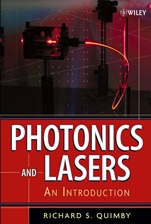
Photonics and Lasers: An Introduction
ISBN 9780471719748
Autor: Richard S. Quimby
Wydawca: Wiley
Dostępność: 3-6 tygodni
Cena: 730,80 zł
Przed złożeniem zamówienia prosimy o kontakt mailowy celem potwierdzenia ceny.
ISBN13: |
9780471719748 |
ISBN10: |
0471719749 |
Autor: |
Richard S. Quimby |
Oprawa: |
Hardback |
Rok Wydania: |
2006-05-30 |
Ilość stron: |
536 |
Wymiary: |
264x188 |
Tematy: |
TJ |
An introduction to photonics and lasers that does not rely on complex mathematics
This book evolved from a series of courses developed by the author and taught in the areas of lasers and photonics. This thoroughly classroom–tested work fills a unique need for students, instructors, and industry professionals in search of an introductory–level book that covers a wide range of topics in these areas. Comparable books tend to be aimed either too high or too low, or they cover only a portion of the topics that are needed for a comprehensive treatment.
Photonics and Lasers is divided into four parts:Propagation of LightGeneration and Detection of LightLaser LightLight–Based Communication
The author has ensured that complex mathematics does not become an obstacle to understanding key physical concepts. Physical arguments and explanations are clearly set forth while, at the same time, sufficient mathematical detail is provided for a quantitative understanding. As an additional aid to readers who are learning to think symbolically, some equations are expressed in words as well as symbols.
Problem sets are provided throughout the book for readers to test their knowledge and grasp of key concepts. A solutions manual is also available for instructors. Finally, the detailed bibliography leads readers to in–depth explorations of particular topics.
The book′s topics, lasers and photonics, are often treated separately in other texts; however, the author skillfully demonstrates their natural synergy. Because of the combined coverage, this text can be used for a two–semester course or a one–semester course emphasizing either lasers or photonics. This is a perfect introductory textbook for both undergraduate and graduate students, additionally serving as a practical reference for engineers in telecommunications, optics, and laser electronics.
Spis treści:
Pre
face.
PART I: PROPAGATION OF LIGHT.
1. Overview.
1–1 Photonics Defined.
1–2 Fiber Optic Communications.
1–3 Overview of Topics.
2. Review of Optics.
2–1 The Nature of Light.
2–2 Light at a Boundary.
2–3 Light Passing through.
2–4 Imaging Optics.
3. Planar Waveguides.
3–1 Waveguide Modes.
3–2 Mode Chart.
3–3 Dispersion.
4. Cylindrical Waveguides.
4–1 Acceptance Angle and Numerical Aperture.
4–2 Cylindrical Waveguide.
5. Losses in Optical Fibers.
5–1 Absorption Loss.
5–2 Scattering.
5–3 Bending Losses.
6. Dispersion in Optical Fibers.
6–1 Graded Index Fiber.
6–2 Intramodal Dispersion.
7. Fiber Connections and Diagnostics.
7–1 Fiber Connections.
7–2 Losses in Fiber Connections.
7–3 Fiber Loss Diagnostics.
8. Photonic Crystal Optics.
8–1 1–D Photonic Crystals.
8–2 2–D Photonic Crystals.
8–3 3–D Photonic Crystals.
9. Nonlinear Optics.
9–1 Fundamental Mechanisms.
9–2 Frequency Conversion.
9–3 Nonlinear Refractive Index.
9–4 Electro–optic Effects.
PART II: GENERATION AND DETECTTION OF LIGHT.
10. Review of Semiconductor Physics.
10–1 Uniform Semiconductors.
10–2 Layered Semiconductors.
11. Light Sources.
11–1 The LED.
11–2 The Laser Diode.
12. Light Source to Waveguide Coupling Efficiency.
12–1 Point Source.
12–2 Lambertian Source.
12–3 Laser Source.
13. Optical Detectors.
13–1 Thermal Detectors.
13–2 Photon Detectors.
13–3 Noise in Photon Detectors.
Part 2 Generation and Detection of Light.
14. Photodiode Detectors .
14–1 Biasing the Photodiode.
14–2
Output Saturation.
14–3 Response Time.
14–4 Types of Photodiodes.
14–5 Signal–to–Noise Ratio.
14–6 Detector Circuits.
PART 3: LASER LIGHT.
15. Lasers and Coherent Light.
15–1 Overview of Laser.
15–2 Optical Coherence.
16. Optical Resonators.
16–1 Mode Frequencies.
16–2 Mode Width.
16–3 Fabry–Perot Interferometer.
17. Gaussian Beam Optics.
17–1 Gaussian Beams in Free.
17–2 Gaussian Beams in a Laser.
17–3 Gaussian Beams Passing.
18. Stimulated Emission and Optical Gain.
18–1 Transition Rates.
18–2 Optical Gain.
19. Optical Amplifiers.
19–1 Gain Coefficient.
19–2 Total Gain of Amplifier.
20. Laser Oscillation.
20–1 Threshold Condition.
20–2 Above Lasing Threshold.
21. CW Laser Characteristics.
21–1 Mode Spectrum of Laser.
21–2 Controlling the Laser.
22. Pulsed Lasers.
22–1 Uncontrolled Pulsing.
22–2 Pulsed Pump.
22–3 Theory of Q–Switching.
22–4 Methods of Q–Switching.
22–5 Theory of Mode Locking.
22–6 Methods of Mode Locking.
23 Survey of Laser Types.
PART 4: LIGHT–BASED COMMUNICATIONS.
23–1 Optically Pumped Lasers.
23–2 Electrically Pumped Lasers.
24 Optical Communications.
24–1 Fiber Optic CommunicationsSystems.
24–2 Signal Multiplexing.
24–3 Power Budget in Fiber Optic.
24–4 Optical Amplifiers.
24–5 Free–Space Optics.
Bibliography.
Appendix A: Solid Angle and the Brightness Theorem.
Appendix B: Fourier Synthesis and the Uncertainty Relation.
List of Symbols.
Index.
Nota biograficzna:
Richard S. Quimby is an Associate Professor of physics at
Worcester Polytechnic Institute. He earned a BS in EE/Physics at Clarkson College of Technology in 1975 and a PhD in Physics at the University of Wisconsin, Madison, in 1979. He has been actively involved in research relating to photonics devices such as fiber lasers and fiber amplifiers since the 1980′s. His work has resulted in approximately 35 publications, as well as three invited conference presentations. He also is a contributor to the book FLUORIDE GLASS FIBER OPTICS (Academic Press 1991).
Okładka tylna:
An introduction to photonics and lasers that does not rely on complex mathematics
This book evolved from a series of courses developed by the author and taught in the areas of lasers and photonics. This thoroughly classroom–tested work fills a unique need for students, instructors, and industry professionals in search of an introductory–level book that covers a wide range of topics in these areas. Comparable books tend to be aimed either too high or too low, or they cover only a portion of the topics that are needed for a comprehensive treatment.
Photonics and Lasers is divided into four parts:Propagation of LightGeneration and Detection of LightLaser LightLight–Based Communication
The author has ensured that complex mathematics does not become an obstacle to understanding key physical concepts. Physical arguments and explanations are clearly set forth while, at the same time, sufficient mathematical detail is provided for a quantitative understanding. As an additional aid to readers who are learning to think symbolically, some equations are expressed in words as well as symbols.
Problem sets are provided throughout the book for readers to test their knowledge and grasp of key concepts. A solutions manual is also available for instructors. Finally, the detailed bibliography leads readers to in–depth explorations of particula
r topics.
The book′s topics, lasers and photonics, are often treated separately in other texts; however, the author skillfully demonstrates their natural synergy. Because of the combined coverage, this text can be used for a two–semester course or a one–semester course emphasizing either lasers or photonics. This is a perfect introductory textbook for both undergraduate and graduate students, additionally serving as a practical reference for engineers in telecommunications, optics, and laser electronics.
Koszyk
Książek w koszyku: 0 szt.
Wartość zakupów: 0,00 zł
Informacje


Kontakt
Gambit
Centrum Oprogramowania
i Szkoleń Sp. z o.o.
Al. Pokoju 29b/22-24
31-564 Kraków
Siedziba Księgarni
ul. Kordylewskiego 1
31-542 Kraków
+48 12 410 5991
+48 12 410 5987
+48 12 410 5989
Subskrypcje
Administratorem danych osobowych jest firma Gambit COiS Sp. z o.o. Na podany adres będzie wysyłany wyłącznie biuletyn informacyjny.
Autoryzacja płatności

Informacje na temat autoryzacji płatności poprzez PayU.

© Copyright 2012: GAMBIT COiS Sp. z o.o. Wszelkie prawa zastrzeżone.
Projekt i wykonanie: Alchemia Studio Reklamy