


Wydawcy
Katalog tematyczny
- Archeologia (109)
- Ekonomia, finanse, business (13704)
- Filozofia (1445)
- Historia (3040)
- Języki i językoznawstwo (2356)
- Lifestyle, hobby i rozrywka (475)
- Medycyna (9704)
- Nauki humanistyczne (4)
- Nauki o Ziemi i środowisku (2638)
- Nauki ścisłe (20412)
- Astronomia (294)
- Biologia (5119)
- Chemia (6540)
- Chemia analityczna (361)
- Chemia fizyczna (346)
- Chemia nieorganiczna (137)
- Chemia organiczna (535)
- Krystalografia (27)
- Minerologia (46)
- Fizyka (3309)
- Matematyka (4574)
- Nauki ścisłe, ogólnie (503)
- Nauki społeczne (8486)
- Nauki techniczne (13450)
- Prawo (1696)
- Publikacje informacyjne i interdyscyplinarne (1288)
- Religia i wierzenia (917)
- Technika komputerowa (4067)
- Zdrowie, relacje międzyludzkie i rozwój osobisty (657)





Informacje szczegółowe o książce
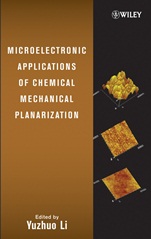
Microelectronic Applications of Chemical Mechanical Planarization
ISBN 9780471719199
Autor: Yuzhuo Li
Wydawca: Wiley
Dostępność: 3-6 tygodni
Cena: 909,30 zł
Przed złożeniem zamówienia prosimy o kontakt mailowy celem potwierdzenia ceny.
ISBN13: |
9780471719199 |
ISBN10: |
0471719196 |
Autor: |
Yuzhuo Li |
Oprawa: |
Hardback |
Rok Wydania: |
2007-11-13 |
Ilość stron: |
760 |
Wymiary: |
235x164 |
Tematy: |
PN |
An authoritative, systematic, and comprehensive description of current CMP technology
Chemical Mechanical Planarization (CMP) provides the greatest degree of planarization of any known technique. The current standard for integrated circuit (IC) planarization, CMP is playing an increasingly important role in other related applications such as microelectromechanical systems (MEMS) and computer hard drive manufacturing. This reference focuses on the chemical aspects of the technology and includes contributions from the foremost experts on specific applications. After a detailed overview of the fundamentals and basic science of CMP, Microelectronic Applications of Chemical Mechanical Planarization:
Provides in–depth coverage of a wide range of state–of–the–art technologies and applications
Presents information on new designs, capabilities, and emerging technologies, including topics like CMP with nanomaterials and 3D chips
Discusses different types of CMP tools, pads for IC CMP, modeling, and the applicability of tribometrology to various aspects of CMP
Covers nanotopography, CMP performance and defect profiles, CMP waste treatment, and the chemistry and colloidal properties of the slurries used in CMP
Provides a perspective on the opportunities and challenges of the next fifteen years
Complete with case studies, this is a valuable, hands–on resource for professionals, including process engineers, equipment engineers, formulation chemists, IC manufacturers, and others. With systematic organization and questions at the end of each chapter to facilitate learning, it is an ideal introduction to CMP and an excellent text for students in advanced graduate courses that cover CMP or related semiconductor manufacturing processes.
Spis treści:
Foreword.
Contributing Authors.
1 Why CMP?
1.1 Introduction.
1.2 Preparation of Planar Surfac
e.
1.3 Formation of Functional Microstructures.
1.4 CMP to Correct Defects.
1.5 Advantages and Disadvantages of CMP.
1.6 Conclusion.
2 Current and Future Challenges in CMP Materials.
2.1 Introduction.
2.2 Historic Prospective and Future Trends.
2.3 CMP Material Characterization.
2.4 Conclusions.
3 Processing Tools for Manufacturing.
3.1 CMP Operation and Characteristics.
3.2 Description of the CMP Process.
3.3 Overview of Polishers.
3.4 Carriers and Dressers.
3.5 In Situ and Ex Situ Metrologies.
3.6 Conclusions.
4 Tribometrology of CMP Process.
4.1 Introduction.
4.2 Tribometrology of CMP.
4.3 Factors Influencing the Tribology During CMP.
4.4 Optimizing Pad Conditioning Process.
4.5 Conditioner Design.
4.6 CMP Consumable Testing.
4.7 Defect Analysis.
4.8 Summary.
5 Pads for IC CMP.
5.1 Introduction.
5.2 Physical Properties of CMP Pads and Their Effects on Polishing Performance.
5.3 Chemical Properties of CMP Pads and Their Effects on Polishing Performances.
5.4 Pad Conditioning and Its Effect on CMP Performance.
5.5 Modeling of Pad Effects on Polishing Performance.
5.6 Novel Designs of CMP Pads.
6 Modeling.
6.1 Introduction.
6.2 A Two–Step Chemical Mechanical Material Removal Model.
6.3 Pad Surfaces and Pad Surface Contact Modeling.
6.4 Reaction Temperature.
6.5 A Polishing Example.
6.6 Topography Planarization.
7 Key Chemical Components in Metal CMP Slurries.
7.1 Introduction.
7.2 Oxidizers.
7.3 Chelating Agents.
7.4 Surfactants.
7.5 Abrasive Particles.
7.6 Particle Surface Modification.
7.7 Soft Particles.
7.8 Case Study: Organic Particles as Abrasives in Cu CMP.
7.9 Conclusions.
8 Corrosion Inhibitor for Cu CMP Slurry.
8.1 Thermodynamic Considerations of Copper Surface.
8.2 Types of Passivating Films on Copper Surface Under Oxdizing Conditions.
8.3 Effect of pH on BTA in Glycine–Hydrogen Peroxid
e Based Cu CMP Slurry.
8.4 Evaluation of Potential BTA Alternatives for Acidic Cu CMP Slurry.
8.5 Electrochemical Polarization Study of Corrosion Inhibitors in Cu CMP Slurry.
8.6 Hydrophobicity of the Surface Passivation Film.
8.7 Competitive Surface Adsorption Behavior of Corrosion Inhibitors.
8.8 Summary.
9 Tungsten CMP Applications.
9.1 Introduction.
9.2 Basic Tungsten Application, Requirements, and Process.
9.3 W CMP Defects.
9.4 Various W CMP Processing Options.
9.5 Overall Tungsten Process (Various Processing Design Options and Suggestions).
9.6 Conclusions.
10 Electrochemistry in ECMP.
10.1 Introduction.
10.2 Physical and Chemical Processes in Electrochemical Planarization.
10.3 Mechanisms and Limitation of Electrochemical Planarization.
10.4 In Situ Analysis of Anodic/Passivation Films.
10.5 Modified Electrochemical Polishing Approaches.
11 Planarization Technologies Involving Electrochemical Reactions.
11.1 Introduction.
11.2 CMP.
11.3 ECP.
11.4 ECMP.
11.5 Full Sequence Electrochemical–Mechanical Planarization.
11.6 Conclusions.
12 Shallow Trench Isolation Chemical Mechanical Planarization.
12.1 Introduction.
12.2 LOCOS to STI.
12.3 Shallow Trench Isolation.
12.4 The Planarization Step in Detail.
12.5 Optimization Techniques.
12.6 Outlook.
13 Consumables for Advanced Shallow Trench Isolation (STI).
13.1 Introduction.
13.2 Representative Testing Wafers for STI Process and Consumable Evaluations.
13.3 Effects of Abrasive Types on STI Slurry Performance.
13.4 Effects of Chemical Additives to Oxide: Nitride Selectivity.
13.5 Effect of Slurry pH.
13.6 Effect of Abrasive Particle Size on Removal Rate and Defectivity.
13.7 Conclusion.
14 Fabrication of Microdevices Using CMP.
14.1 Introduction.
14.2 Microfabrication Processes.
14.3 Microfabrication Products.
14.4 CMP Requirements in Comparison with IC Fabrication.
14.5 Ex
amples of CMP Applications for Microfabrication.
14.6 Outlook.
15 Three–Dimensional (3D) Integration.
15.1 Overview of 3D Technology.
15.2 Factors Motivating Research in 3D.
15.3 Approaches to 3D.
15.4 Wafer–Level 3D Unit Processes.
15.5 Planarity Issues in 3D Integration.
15.6 Conclusions.
16 Post–CMP Cleaning.
16.1 Introduction.
16.2 Types of Post–CMP Cleaning Processes.
16.3 Post–CMP Cleaning Chemistry.
16.4 Post–CMP Cleaning According to Applications.
16.5 Adhesion Force, Friction Force, and Defects During Cu CMP.
16.6 Case Study: Megasonic Post–CMP Cleaning of Thermal Oxide Wafers.
16.7 Summary.
17 Defects Observed on the Wafer After the CMP Process.
17.1 Introduction.
17.2 Defects After Oxide CMP.
17.3 Defects After Polysilicon CMP.
17.4 Defects After Tungsten CMP.
17.5 Defects After Copper CMP.
17.6 Defect Observation and Characterization Techniques.
17.7 Ensemble Defect Detection and Inspection Techniques.
17.8 Consideration for the Future.
18 CMP Slurry Metrology, Distribution, and Filtration.
18.1 Introduction.
18.2 CMP Slurry Metrology and Characterization.
18.3 CMP Slurry Blending and Distribution.
18.4 CMP Slurry Filtration.
18.5 Pump Handling Effects on CMP Slurry Filtration—Case Studies.
19 The Facilities Side of CMP.
19.1 Introduction.
19.2 Characterization of the CMP Waste Stream.
19.3 Materials of Compatibility.
19.4 Collection System Methodologies.
19.5 Treatment System Components.
19.6 Integration of Components—Putting It All Together.
19.7 Conclusions.
20 CMP—The Next Fifteen Years.
20.1 The Past 15 Years.
20.2 Challenges to Silicon IC Manufacturing.
20.3 New CMP Processes.
20.4 CMP Challenges.
20.5 Summary.
21 Utilitarian Information for CMP Scientists and Engineers.
21.1 Physical and Chemical Properties of Abrasive Particles.
21.2 Physical an
Koszyk
Książek w koszyku: 0 szt.
Wartość zakupów: 0,00 zł
Informacje


Kontakt
Gambit
Centrum Oprogramowania
i Szkoleń Sp. z o.o.
Al. Pokoju 29b/22-24
31-564 Kraków
Siedziba Księgarni
ul. Kordylewskiego 1
31-542 Kraków
+48 12 410 5991
+48 12 410 5987
+48 12 410 5989
Subskrypcje
Administratorem danych osobowych jest firma Gambit COiS Sp. z o.o. Na podany adres będzie wysyłany wyłącznie biuletyn informacyjny.
Autoryzacja płatności

Informacje na temat autoryzacji płatności poprzez PayU.

© Copyright 2012: GAMBIT COiS Sp. z o.o. Wszelkie prawa zastrzeżone.
Projekt i wykonanie: Alchemia Studio Reklamy