


Wydawcy
Katalog tematyczny
- Archeologia (109)
- Ekonomia, finanse, business (13704)
- Filozofia (1445)
- Historia (3040)
- Języki i językoznawstwo (2356)
- Lifestyle, hobby i rozrywka (475)
- Medycyna (9704)
- Nauki humanistyczne (4)
- Nauki o Ziemi i środowisku (2638)
- Nauki ścisłe (20412)
- Nauki społeczne (8486)
- Nauki techniczne (13450)
- Budownictwo lądowe (1045)
- Chemia przemysłowa (2258)
- Elektronika i telekomunikacja (3287)
- Energetyka (1122)
- Inne nauki stosowane (363)
- Inżynieria biochemiczna (507)
- Inżynieria transportu (232)
- Mechanika i materiały (3316)
- Nauka o środowisku (321)
- Rolnictwo (507)
- Technika, ogólnie (475)
- Prawo (1696)
- Publikacje informacyjne i interdyscyplinarne (1288)
- Religia i wierzenia (917)
- Technika komputerowa (4067)
- Zdrowie, relacje międzyludzkie i rozwój osobisty (657)





Informacje szczegółowe o książce
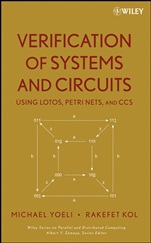
Verification of Systems and Circuits Using LOTOS, Petri Nets, and CCS
ISBN 9780471704492
Autor: Michael Yoeli, Rakefet Kol
Wydawca: Wiley
Dostępność: 3-6 tygodni
Cena: 662,55 zł
Przed złożeniem zamówienia prosimy o kontakt mailowy celem potwierdzenia ceny.
ISBN13: |
9780471704492 |
ISBN10: |
0471704490 |
Autor: |
Michael Yoeli, Rakefet Kol |
Oprawa: |
Hardback |
Rok Wydania: |
2008-04-15 |
Ilość stron: |
248 |
Wymiary: |
235x162 |
Tematy: |
TJ |
A Step–by–Step Guide to Verification of Digital Systems
This practical book provides a step–by–step, interactive introduction to formal verification of systems and circuits. The book offers theoretical background and introduces the application of three powerful verification toolsets: LOTOS–based CADP, Petri nets–based PETRIFY, and CCS–based CWB. The book covers verification of modular asynchronous circuits, alternating–bit protocols, arbiters, pipeline controllers, up–down counters, and phase converters, as well as many other verification examples.
Using the given detailed examples, exercises, and easy–to–follow tutorials, complete with the downloadable toolsets available via referenced Web sites, this book serves as an ideal text in advanced undergraduate and graduate courses in computer science and electrical engineering. It is also valuable as a desktop reference for practicing verification engineers who are interested in verifying that designed digital systems meet specifications and requirements.
Spis treści:
1. Introduction.
1.1 Event–Based Approach.
1.2 Event–Based Systems.
1.3 Types of Verification.
1.4 Toolsets Used.
1.5 Level–Based Approach.
1.6 Overview of the Book.
1.7 References.
2. Processes.
2.1 Introduction.
2.2 Examples of Processes and Basic Concepts.
2.3 About Prefixing.
2.4 Process Graphs.
2.5 Choice Operator.
2.6 Another Process Example.
2.7 Equivalence.
2.8 Labeled Transition System (LTSs).
2.9 Parallel Operators.
2.10 Sequential Composition.
2.11 Further Reading.
2.12 Selected Solutions.
2.13 References.
3. From Digital hardware to Processes.
3.1 The C–Element.
3.2 The XOR–Gate.
3.3 TOGGLES.
3.4 Modulo–N Transaction counters.
3.5 Modular Networks.
3.6 Propositional Logic: A Review of Known Concepts.
3.7 Se
lected Solutions.
3.8 References.
4. Introducing LOTOS.
4.1 From Blot to Basic LOTOS.
4.2 Some semantics.
4.3 From LTS to LOTOS.
4.4 Comparing Parallel Operators.
4.5 Sequential Composition.
4.6 Hiding.
4.7 Equivalences and Preorders.
4.8 About CADP.
4.9 Full LOTOS—An Introduction.
4.10 The Regular Mu–calculus (RMC).
4.11 Further Reading.
4.12 Selected Solutions.
4.13 References.
5. Introducing Petri Nets.
5.1 About Petri Nets.
5.2 About Languages.
5.3 About PETRIFY.
5.4 Illustrating Petri Nets.
5.5 Labeled Nets.
5.6 Bounded Nets.
5.7 Observation Equivalence of LPNs.
5.8 From Blot to Petri Nets.
5.9 Liveness and Persistence.
5.10 Simple Reduction Rules.
5.11 Marked Graphs.
5.12 A Simple Net Algebra.
5.13 Arc–Weighted Nets.
5.14 Readers—Writers System.
5.15 Inhibitor Nets.
5.16 True Concurrency.
5.17 Further Reading.
5.18 Selected Solutions.
5.19 References.
6. Introducing CCS.
6.1 About CCS.
6.2 Operators ‘Prefix’ and ‘Sum’.
6.3 Recursion.
6.4 Concurrency.
6.5 Equivalence.
6.6 Restriction.
6.7 CTL.
6.8 The Concurrency Workbench (CWB).
6.9 CCS and CWB Application Examples.
6.10 Further Reading.
6.11 Selected Solutions.
6.12 References.
7. Verification of Modular Asynchronous Circuits.
7.1 About Asynchronous Circuits.
7.2 XOR–Gates.
7.3 CEL–Circuit.
7.4 Other Modules.
7.5 Module Extensions.
7.6 Modular Networks.
7.7 Realizations.
7.8 Verification of Extended Modules.
7.9 Verification of Parallel Control Structures.
7.10 Further Reading.
7.11 Selected Solutions.
7.12 References.
8. Verification of Communication Protocols.
8.1 Introduction.
8.2 Two Simple Communication Protocols.
8.3 The Alternating Bit (AB) Protocol.
8.4 Further Reading.
8.5 Selected Solutions.
8.6 References.
<
b>9. Verification of Arbiters.
9.1 Introduction.
9.2 A random Arbiter (RGDA).
9.3 A Token–Ring Arbiter.
9.4 Further reading.
9.5 Selected Solutions.
9.6 References.
10. More Verification Case Studies.
10.1 Verification of Combinational Logic.
10.2 Verification of Asynchronous Pipeline Controllers.
10.3 Verification of Producer – Consumer Systems.
10.4 Verification Based on Design Approaches.
10.5 Verification of Toggles and Transition Counters.
10.6 Vending machines Verification—Revisited.
10.7 Pi–Realizations.
10.8 A Comparison of Equivalence Relations.
10.9 Selected Solutions.
10.10 References.
11. Guide to Further Studies.
11.1 Verification of Telecommunication Systems.
11.2 Verification Using Colored Petri Nets.
11.3 Verification of Traffic Signal Control Systems.
11.4 References.
Index.
Nota biograficzna:
Michael Yoeli, PhD, is Professor Emeritus in the Department of Computer Science, Technion, Israel. He is the author or editor of several books on digital networks and formal verification. His research interests include theory and applications of Petri nets, formal verification of hardware design, formal verification and synthesis of modular asynchronous networks, and computer–assisted analysis of parallel systems. He was awarded a Certificate of Acknowledgment by the Israel Section of the IEEE and the Israel Chapter of the IEEE Computer Society.
Rakefet Kol, PhD, is a member of the Electrical Engineering Department, Technion, Israel. Her research interests include computer architectures, asynchronous design, formal verification of hardware designs, and software engineering. She is a senior member of the IEEE and a professional member of the ACM.
Okładka tylna:
A Step–by–Step Guide to Verification of Digital Systems
This practical book provides a step–by–step, intera
ctive introduction to formal verification of systems and circuits. The book offers theoretical background and introduces the application of three powerful verification toolsets: LOTOS–based CADP, Petri nets–based PETRIFY, and CCS–based CWB. The book covers verification of modular asynchronous circuits, alternating–bit protocols, arbiters, pipeline controllers, up–down counters, and phase converters, as well as many other verification examples.
Using the given detailed examples, exercises, and easy–to–follow tutorials, complete with the downloadable toolsets available via referenced Web sites, this book serves as an ideal text in advanced undergraduate and graduate courses in computer science and electrical engineering. It is also valuable as a desktop reference for practicing verification engineers who are interested in verifying that designed digital systems meet specifications and requirements.
Koszyk
Książek w koszyku: 0 szt.
Wartość zakupów: 0,00 zł
Informacje


Kontakt
Gambit
Centrum Oprogramowania
i Szkoleń Sp. z o.o.
Al. Pokoju 29b/22-24
31-564 Kraków
Siedziba Księgarni
ul. Kordylewskiego 1
31-542 Kraków
+48 12 410 5991
+48 12 410 5987
+48 12 410 5989
Subskrypcje
Administratorem danych osobowych jest firma Gambit COiS Sp. z o.o. Na podany adres będzie wysyłany wyłącznie biuletyn informacyjny.
Autoryzacja płatności

Informacje na temat autoryzacji płatności poprzez PayU.

© Copyright 2012: GAMBIT COiS Sp. z o.o. Wszelkie prawa zastrzeżone.
Projekt i wykonanie: Alchemia Studio Reklamy