


Wydawcy
Katalog tematyczny
- Archeologia (1)
- Ekonomia, finanse, business (698)
- Filozofia (20)
- Historia (57)
- Języki i językoznawstwo (4)
- Lifestyle, hobby i rozrywka (32)
- Medycyna (1025)
- Nauki humanistyczne (2)
- Nauki o Ziemi i środowisku (430)
- Nauki ścisłe (1680)
- Nauki społeczne (1297)
- Nauki techniczne (530)
- Prawo (1437)
- Publikacje informacyjne i interdyscyplinarne (32)
- Religia i wierzenia (15)
- Technika komputerowa (237)
- Zdrowie, relacje międzyludzkie i rozwój osobisty (4)





Informacje szczegółowe o książce
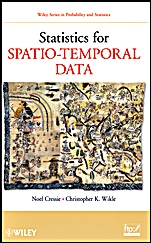
Statistics for Spatio–Temporal Data
ISBN 9780471692744
Autor: Noel Cressie, Christopher K. Wikle
Wydawca: Wiley
Dostępność: 3-6 tygodni
Cena: 427,35 zł
Przed złożeniem zamówienia prosimy o kontakt mailowy celem potwierdzenia ceny.
ISBN13: |
9780471692744 |
ISBN10: |
0471692743 |
Autor: |
Noel Cressie, Christopher K. Wikle |
Oprawa: |
Hardback |
Rok Wydania: |
2011-04-19 |
Ilość stron: |
624 |
Wymiary: |
234x156 |
Tematy: |
AT |
A state–of–the–art presentation of spatio–temporal processes, bridging classic ideas with modern hierarchical statistical modeling concepts and the latest computational methods From understanding environmental processes and climate trends to developing new technologies for mapping public–health data and the spread of invasive species, there is a high demand for statistical analyses of data that take spatial, temporal, and spatio–temporal information into account. Statistics for Spatio–Temporal Data presents a systematic approach to key quantitative techniques that incorporate the latest advances in statistical computing as well as hierarchical, particularly Bayesian, statistical modeling, with an emphasis on dynamical spatio–temporal models. The authors supply a unique presentation that incorporates ideas from the areas of time series and spatial statistics as well as stochastic processes. Beginning with separate treatments of temporal data and spatial data, the book combines these concepts to discuss spatio–temporal statistical methods for understanding complex processes. Topics of coverage include: Exploratory methods for spatio–temporal data, including visualization, spectral analysis, empirical orthogonal function analysis, and LISAs Spatio–temporal covariance functions, spatio–temporal kriging, and time series of spatial processes Development of hierarchical dynamical spatio–temporal models (DSTMs), with discussion of linear and nonlinear DSTMs and computational algorithms for their implementation Quantifying and exploiting spatio–temporal variability in scientific applications, including case studies based on real–world environmental data Throughout the book, interesting applications demonstrate the relevance of the presented concepts. Vivid, full–color graphics emphasize the visual nature of the topic, and a related FTP site contains supplementary material. Statistics for Spatio–Temporal Data is an excellent book for a graduate–level course on spatio–temporal statistics. It is also a valuable reference for researchers and practitioners in the fields of applied mathematics, engineering, and the environmental and health sciences.
Preface xv Acknowledgments xix 1 Space–Time: The Next Frontier 1 2 Statistical Preliminaries 17 2.1 Conditional Probabilities and Hierarchical Modeling (HM), 20 2.2 Inference and Diagnostics, 33 2.3 Computation of the Posterior Distribution, 42 2.4 Graphical Representations of Statistical Dependencies, 48 2.5 Data/Model/Computing Compromises, 53 3 Fundamentals of Temporal Processes 55 3.1 Characterization of Temporal Processes, 56 3.2 Introduction to Deterministic Dynamical Systems, 59 3.3 Time Series Preliminaries, 80 3.4 Basic Time Series Models, 84 3.5 Spectral Representation of Temporal Processes, 100 3.6 Hierarchical Modeling of Time Series, 112 3.7 Bibliographic Notes, 116 4 Fundamentals of Spatial Random Processes 119 4.1 Geostatistical Processes, 124 4.2 Lattice Processes, 167 4.3 Spatial Point Processes, 204 4.4 Random Sets, 224 4.5 Bibliographic Notes, 231 5 Exploratory Methods for Spatio–Temporal Data 243 5.1 Visualization, 244 5.2 Spectral Analysis, 259 5.3 Empirical Orthogonal Function (EOF) Analysis, 266 5.4 Extensions of EOF Analysis, 271 5.5 Principal Oscillation Patterns (POPs), 279 5.6 Spatio–Temporal Canonical Correlation Analysis (CCA), 284 5.7 Spatio–Temporal Field Comparisons, 291 5.8 Bibliographic Notes, 292 6 Spatio–Temporal Statistical Models 297 6.1 Spatio–Temporal Covariance Functions, 304 6.2 Spatio–Temporal Kriging, 321 6.3 Stochastic Differential and Difference Equations, 327 6.4 Time Series of Spatial Processes, 336 6.5 Spatio–Temporal Point Processes, 347 6.6 Spatio–Temporal Components–of–Variation Models, 351 6.7 Bibliographic Notes, 356 7 Hierarchical Dynamical Spatio–Temporal Models 361 7.1 Data Models for the DSTM, 363 7.2 Process Models for the DSTM: Linear Models, 382 7.3 Process Models for the DSTM: Nonlinear Models, 403 7.4 Process Models for the DSTM: Multivariate Models, 418 7.5 DSTM Parameter Models, 425 7.6 Dynamical Design of Monitoring Networks, 430 7.7 Switching the Emphasis of Time and Space, 432 7.8 Bibliographic Notes, 433 8 Hierarchical DSTMs: Implementation and Inference 441 8.1 DSTM Process: General Implementation and Inference, 441 8.2 Inference for the DSTM Process: Linear/Gaussian Models, 444 8.3 Inference for the DSTM Parameters: Linear/Gaussian Models, 450 8.4 Inference for the Hierarchical DSTM: Nonlinear/Non–Gaussian Models, 460 8.5 Bibliographic Notes, 472 9 Hierarchical DSTMs: Examples 475 9.1 Long–Lead Forecasting of Tropical Pacific Sea Surface Temperatures, 476 9.2 Remotely Sensed Aerosol Optical Depth, 488 9.3 Modeling and Forecasting the Eurasian Collared Dove Invasion, 499 9.4 Mediterranean Surface Vector Winds, 507 Epilogue 519 References 523 Index 571
Noel Cressie, PhD , is Professor of Statistics and Director of the Program in Spatial Statistics and Environmental Statistics at The Ohio State University. A Fellow of the American Statistical Association and the Institute of Mathematical Statistics, he has published extensively in the areas of statistical modeling, analysis of spatial and spatio–temporal data, and empirical–Bayesian and Bayesian methods. He is a recipient of the R.A. Fisher Lectureship, awarded by COPSS to recognize the importance of statistical methods for scientific investigations. Dr. Cressie is an advisor for the Wiley Series in Probability and Statistics and the author of Statistics for Spatial Data, Revised Edition . Chirstopher K. Wikle, PhD , is Professor of Statistics at the University of Missouri. Dr. Wikle is a Fellow of the American Statistical Association and the author of more than 100 articles on the topics of spatio–temporal methodology, spatial statistics, hierarchical models, Bayesian methods, and computational methods for large data sets. His work is motivated by problems in climatology, ecology, fisheries and wildlife, meteorology, and oceanography.
“It is a wonderful place to begin studying spatio–temporal processes.” ( Mathematical Reviews Clippings , 1 January 2013) “Overall, I believe this academic monograph would be an excellent reference book for researchers and graduate students who are interested in a systematic and indepth understanding of statistical approaches to spatio–temporal data analysis and modeling.” (Journal of the American Statistical Association, 15 March 2013) "Better than any other reference now available, Cressie and Wikle bridge the gap between applied science and modern inference. This book is a must for any environmental scientist or engineer engaged in modeling and computation." – James S. Clark, H.L. Blomquist Professor of Environment, Duke University "The future lies at the intersection of a question in science or engineering, a process–based model intended to elucidate the question, and the statistical analysis of data to give us an idea of whether or not the model has done the job. This is what I call ′modeling the process, not just the data.′ Cressie and Wikle have provided a guidebook that will broadly appeal to the scientific community – from statistical neophytes to experts – and which will stand the test of time." – Marc Mangel, Distinguished Professor of Applied Mathematics and Statistics, University of California Santa Cruz "This book, written by two of the world′s leading experts on modeling environmental spatio–temporal processes, is a worthy successor to Cressie′s earlier classic on spatial statistics. Particularly noteable is its extensive coverage not found in any other book in statistical science, of hierarchical dynamic process modeling, a new frontier at the interface between the physical and statistical sciences. It takes us there with a most–justified excursion into the world of methods such as the extended Kalman filter, sequential importance sampling, and INLA, that address the computational issues confronted at that frontier. This comprehensive, very readable treatment of hot areas of modern research and applications, is written with great clarity and insight. That and its coverage of a broad range of applications, will make it an essential and long–lived reference for statistical as well as non–statistical scientists alike." – Jim Zidek, Professor Emeritus and Fellow of the Royal Society of Canada, University of British Columbia "This book is by far the most comprehensive treatment available on the statistics of spatio–temporal processes and will surely become a standard reference in the field. After extensive surveys of time series analysis and traditional spatial statistics, the authors develop spatio–temporal analysis through a series of chapters covering empirical and exploratory methods, followed by probability models for spatio–temporal processes, and then three chapters on the hierarchical dynamical approach which has been at the core of their own contributions since the late 1990s. Throughout the book, they develop the methods through detailed descriptions of computational algorithms, leading up to a final chapter that discusses in–depth applications to predicting sea–surface temperatures and wind speeds, remote–sensing measures of atmospheric particles, and bird migration. Every researcher involved in the analysis of large–scale environmental datasets should own a copy of this book." – Richard L. Smith, Distinguished Professor of Statistics, University of North Carolina at Chapel Hill, and Director, Statistical and Applied Mathematical Sciences Institute (SAMSI)
Koszyk
Książek w koszyku: 0 szt.
Wartość zakupów: 0,00 zł
Informacje


Kontakt
Gambit
Centrum Oprogramowania
i Szkoleń Sp. z o.o.
Al. Pokoju 29b/22-24
31-564 Kraków
Siedziba Księgarni
ul. Kordylewskiego 1
31-542 Kraków
+48 12 410 5991
+48 12 410 5987
+48 12 410 5989
Subskrypcje
Administratorem danych osobowych jest firma Gambit COiS Sp. z o.o. Na podany adres będzie wysyłany wyłącznie biuletyn informacyjny.
Autoryzacja płatności

Informacje na temat autoryzacji płatności poprzez PayU.

© Copyright 2012: GAMBIT COiS Sp. z o.o. Wszelkie prawa zastrzeżone.
Projekt i wykonanie: Alchemia Studio Reklamy