


Wydawcy
Katalog tematyczny
- Archeologia (109)
- Ekonomia, finanse, business (13704)
- Filozofia (1445)
- Historia (3040)
- Języki i językoznawstwo (2356)
- Lifestyle, hobby i rozrywka (475)
- Medycyna (9704)
- Nauki humanistyczne (4)
- Nauki o Ziemi i środowisku (2638)
- Nauki ścisłe (20412)
- Nauki społeczne (8486)
- Nauki techniczne (13450)
- Budownictwo lądowe (1045)
- Chemia przemysłowa (2258)
- Elektronika i telekomunikacja (3287)
- Energetyka (1122)
- Inne nauki stosowane (363)
- Inżynieria biochemiczna (507)
- Inżynieria transportu (232)
- Mechanika i materiały (3316)
- Nauka o środowisku (321)
- Rolnictwo (507)
- Technika, ogólnie (475)
- Prawo (1696)
- Publikacje informacyjne i interdyscyplinarne (1288)
- Religia i wierzenia (917)
- Technika komputerowa (4067)
- Zdrowie, relacje międzyludzkie i rozwój osobisty (657)





Informacje szczegółowe o książce
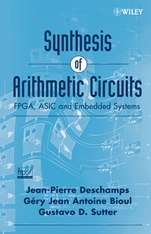
Synthesis of Arithmetic Circuits: FPGA, ASIC and Embedded Systems
ISBN 9780471687832
Autor: Jean–Pierre Deschamps, Gery J.A. Bioul, Gustavo D. Sutter
Wydawca: Wiley
Dostępność: 3-6 tygodni
Cena: 849,45 zł
Przed złożeniem zamówienia prosimy o kontakt mailowy celem potwierdzenia ceny.
ISBN13: |
9780471687832 |
ISBN10: |
0471687839 |
Autor: |
Jean–Pierre Deschamps, Gery J.A. Bioul, Gustavo D. Sutter |
Oprawa: |
Hardback |
Rok Wydania: |
2006-03-31 |
Ilość stron: |
576 |
Wymiary: |
241x163 |
Tematy: |
TJ |
A new approach to the study of arithmetic circuits
In Synthesis of Arithmetic Circuits: FPGA, ASIC and Embedded Systems, the authors take a novel approach of presenting methods and examples for the synthesis of arithmetic circuits that better reflects the needs of today′s computer system designers and engineers. Unlike other publications that limit discussion to arithmetic units for general–purpose computers, this text features a practical focus on embedded systems.
Following an introductory chapter, the publication is divided into two parts. The first part, Mathematical Aspects and Algorithms, includes mathematical background, number representation, addition and subtraction, multiplication, division, other arithmetic operations, and operations in finite fields. The second part, Synthesis of Arithmetic Circuits, includes hardware platforms, general principles of synthesis, adders and subtractors, multipliers, dividers, and other arithmetic primitives. In addition, the publication distinguishes itself with:A separate treatment of algorithms and circuits—a more useful presentation for both software and hardware implementationsComplete executable and synthesizable VHDL models available on the book′s companion Web site, allowing readers to generate synthesizable descriptionsProposed FPGA implementation examples, namely synthesizable low–level VHDL models for the Spartan II and Virtex familiesTwo chapters dedicated to finite field operations
This publication is a must–have resource for students in computer science and embedded system designers, engineers, and researchers in the field of hardware and software computer system design and development.
Spis treści:
Preface.
About the Authors.
1. Introduction.
1.1 Number Representation.
1.2 Algorithms.
1.3 Hardware Platforms.
1.4 Hardware–Software Partitioning.
1.5 Software Generation.
1.6 Synthesis.
1.7 A First Example.
1.7.1 Specification.
1.7.2 Number Representation.
1.7.3 Algorithms.
1.7.4 Hardware Platform.
1.7.5 Hardware–Software Partitioning.
1.7.6 Program Generation.
1.7.7 Synthesis.
1.7.8 Prototype.
1.8 Bibliography.
2. Mathematical Background.
2.1 Number Theory.
2.1.1 Basic Definitions.
2.1.2 Euclidean Algorithms.
2.1.3 Congruences.
2.2 Algebra.
2.2.1 Groups.
2.2.2 Rings.
2.2.3 Fields.
2.2.4 Polynomial Rings.
2.2.5 Congruences of Polynomial.
2.3 Function Approximation.
2.4 Bibliography.
3. Number Representation.
3.1 Natural Numbers.
3.1.1 Weighted Systems.
3.1.2 Residue Number System.
3.2 Integers.
3.2.1 Sign–Magnitude Representation.
3.2.2 Excess–E Representation.
3.2.3 B’s Complement Representation.
3.2.4 Booth’s Encoding.
3.3 Real Numbers.
3.4 Bibliography.
4. Arithmetic Operations: Addition and Subtraction.
4.1 Addition of Natural Numbers.
4.1.1 Basic Algorithm.
4.1.2 Faster Algorithms.
4.1.3 Long–Operand Addition.
4.1.4 Multioperand Addition.
4.1.5 Long–Multioperand Addition.
4.2 Subtraction of Natural Numbers.
4.3 Integers.
4.3.1 B’s Complement Addition.
4.3.2 B’s Complement Sign Change.
4.3.3 B’s Complement Subtraction.
4.3.4 B’s Complement Overflow Detection.
4.3.5 Excess–E Addition and Subtraction.
4.3.6 Sign–Magnitude Addition and Subtraction.
4.4 Bibliography.
5. Arithmetic Operations: Multiplication.
5.1 Natural Numbers Multiplication.
5.1.1 Introduction.
5.1.2 Shift and Add Algorithms.
5.1.2.1 Shift and Add 1.
5.1.2.2 Shift and Add 2.
5.1.2.3 Extended Shift and Add Algorithm: XY þ C þ D.
5.1.2.4 Cellular Shift and Add.
5.1.3 Long–Operand Algorithm.
5.2 Integers.
5.2.1 B’s Complement Multiplication.
5.2.1.1 Mod Bn&#
254;m B’s Complement Multiplication.
5.2.1.2 Signed Shift and Add.
5.2.1.3 Postcorrection B’s Complement Multiplication.
5.2.2 Postcorrection 2’s Complement Multiplication.
5.2.3 Booth Multiplication for Binary Numbers.
5.2.3.1 Booth–r Algorithms.
5.2.3.2 Per Gelosia Signed–Digit Algorithm.
5.2.4 Booth Multiplication for Base–B Numbers (Booth–r Algorithm in Base B).
5.3 Squaring.
5.3.1 Base–B Squaring.
5.3.1.1 Cellular Carry–Save Squaring Algorithm.
5.3.2 Base–2 Squaring.
5.4 Bibliography.
6 Arithmetic Operations: Division.
6.1 Natural Numbers.
6.2 Integers.
6.2.1 General Algorithm.
6.2.2 Restoring Division Algorithm.
6.2.3 Base–2 Nonrestoring Division Algorithm.
6.2.4 SRT Radix–2 Division.
6.2.5 SRT Radix–2 Division with Stored–Carry Encoding.
6.2.6 P–D Diagram.
6.2.7 SRT–4 Division.
6.2.8 Base–B Nonrestoring Division Algorithm.
6.3 Convergence (Functional Iteration) Algorithms.
6.3.1 Introduction.
6.3.2 Newton–Raphson Iteration Technique.
6.3.3 MacLaurin Expansion—Goldschmidt’s Algorithm.
6.4 Bibliography.
7. Other Arithmetic Operations.
7.1 Base Conversion.
7.2 Residue Number System Conversion.
7.2.1 Introduction.
7.2.2 Base–B to RNS Conversion.
7.2.3 RNS to Base–B Conversion.
7.3 Logarithmic, Exponential, and Trigonometric Functions.
7.3.1 Taylor–MacLaurin Series.
7.3.2 Polynomial Approximation.
7.3.3 Logarithm and Exponential Functions Approximation by Convergence Methods.
7.3.3.1 Logarithm Function Approximation by Multiplicative Normalization.
7.3.3.2 Exponential Function Approximation by Additive Normalization.
7.3.4 Trigonometric Functions—CORDIC Algorithms.
7.4 Square Rooting.
7.4.1 Digit Recurrence Algorithm—Base–B Integers.
7.4.2 Restoring Binary Shift̵
1;and–Subtract Square Rooting Algorithm.
7.4.3 Nonrestoring Binary Add–and–Subtract Square Rooting Algorithm.
7.4.4 Convergence Method—Newton–Raphson.
7.5 Bibliography.
8. Finite Field Operations.
8.1 Operations in Zm.
8.1.1 Addition.
8.1.2 Subtraction.
8.1.3 Multiplication.
8.1.3.1 Multiply and Reduce.
8.1.3.2 Modified Shift–and–Add Algorithm.
8.1.3.3 Montgomery Multiplication.
8.1.3.4 Specific Ring.
8.1.4 Exponentiation.
8.2 Operations in GF(p).
8.3 Operations in Zp[x]/f (x).
8.3.1 Addition and Subtraction.
8.3.2 Multiplication.
8.4 Operations in GF(pn).
8.5 Bibliography.
Appendix 8.1 Computation of fki.
9 Hardware Platforms.
9.1 Design Methods for Electronic Systems.
9.1.1 Basic Blocks of Integrated Systems.
9.1.2 Recurring Topics in Electronic Design.
9.1.2.1 Design Challenge: Optimizing Design Metrics.
9.1.2.2 Cost in Integrated Circuits.
9.1.2.3 Moore’s Law.
9.1.2.4 Time–to–Market.
9.1.2.5 Performance Metric.
9.1.2.6 The Power Dimension.
9.2 Instruction Set Processors.
9.2.1 Microprocessors.
9.2.2 Microcontrollers.
9.2.3 Embedded Processors Everywhere.
9.2.4 Digital Signal Processors.
9.2.5 Application–Specific Instruction Set Processors.
9.2.6 Programming Instruction Set Processors.
9.3 ASIC Designs.
9.3.1 Full–Custom ASIC.
9.3.2 Semicustom ASIC.
9.3.2.1 Gate–Array ASIC.
9.3.2.2 Standard–Cell–Based ASIC.
9.3.3 Design Flow in ASIC.
9.4 Programmable Logic.
9.4.1 Programmable Logic Devices (PLDs).
9.4.2 Field Programmable Gate Array (FPGA).
9.4.2.1 Why FPGA? A Short Historical Survey.
9.4.2.2 Basic FPGA Concepts.
9.4.3 XilinxTM Specifics.
9.4.3.1 Configurable Logic Blocks (CLBs).
9.4.3.2 Input/Output Blocks (IOBs).
9.4.3.3 RAM Blocks.
9.4.3.4 Programmable Routing.
9.4.3.5 Arithmetic Resources in Xili
Koszyk
Książek w koszyku: 0 szt.
Wartość zakupów: 0,00 zł
Informacje


Kontakt
Gambit
Centrum Oprogramowania
i Szkoleń Sp. z o.o.
Al. Pokoju 29b/22-24
31-564 Kraków
Siedziba Księgarni
ul. Kordylewskiego 1
31-542 Kraków
+48 12 410 5991
+48 12 410 5987
+48 12 410 5989
Subskrypcje
Administratorem danych osobowych jest firma Gambit COiS Sp. z o.o. Na podany adres będzie wysyłany wyłącznie biuletyn informacyjny.
Autoryzacja płatności

Informacje na temat autoryzacji płatności poprzez PayU.

© Copyright 2012: GAMBIT COiS Sp. z o.o. Wszelkie prawa zastrzeżone.
Projekt i wykonanie: Alchemia Studio Reklamy