


Wydawcy
Katalog tematyczny
- Archeologia (109)
- Ekonomia, finanse, business (13704)
- Filozofia (1445)
- Historia (3040)
- Języki i językoznawstwo (2356)
- Lifestyle, hobby i rozrywka (475)
- Medycyna (9704)
- Nauki humanistyczne (4)
- Nauki o Ziemi i środowisku (2638)
- Nauki ścisłe (20412)
- Astronomia (294)
- Biologia (5119)
- Chemia (6540)
- Chemia analityczna (361)
- Chemia fizyczna (346)
- Chemia nieorganiczna (137)
- Chemia organiczna (535)
- Krystalografia (27)
- Minerologia (46)
- Fizyka (3309)
- Matematyka (4574)
- Nauki ścisłe, ogólnie (503)
- Nauki społeczne (8486)
- Nauki techniczne (13450)
- Prawo (1696)
- Publikacje informacyjne i interdyscyplinarne (1288)
- Religia i wierzenia (917)
- Technika komputerowa (4067)
- Zdrowie, relacje międzyludzkie i rozwój osobisty (657)





Informacje szczegółowe o książce
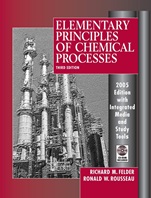
Elementary Principles of Chemical Processes
ISBN 9780471687573
Autor: Richard M. Felder, Ronald W. Rousseau
Wydawca: Wiley
Dostępność: 3-6 tygodni
Cena: 1 041,60 zł
Przed złożeniem zamówienia prosimy o kontakt mailowy celem potwierdzenia ceny.
ISBN13: |
9780471687573 |
ISBN10: |
047168757X |
Autor: |
Richard M. Felder, Ronald W. Rousseau |
Oprawa: |
Hardback |
Rok Wydania: |
2004-12-09 |
Numer Wydania: |
3rd Update Edition |
Ilość stron: |
702 |
Wymiary: |
257x209 |
Tematy: |
PN |
GAIN A BETTER UNDERSTANDING OF CHEMICAL PROCESSES.
Materials that′s presented in a very clear and accessible way... frequent use of examples... case studies based on commercial processes... a CD–ROM with instructional tutorials, a powerful equation solver, and a visual encyclopedia of chemical process equipment... These are just a few of the features of this text that help provide a realistic, informative introduction to chemical processes.
Key Features of the Third EditionNearly every section in the third edition has been revised to provide increased clarity.Hundreds of new and revised problems and new case studies cover a broader spectrum of chemical engineering applications.Some problems require spread sheeting, and others call for using equation–solving software.The INTERACTIVE CHEMICAL PROCESS PRINCIPLES (ICPP) CD–ROM Provides an active learning environment. With this software, students respond to questions and receive immediate feedback, explore variations in process parameters and see the effect of their changes on process operations, and more.2005 Edition Icons in the text margin let you know when it′s most helpful to use the ICPP CD–ROM and the Student Workbook.
Spis treści:
Preface to the Third Edition.
Notes to Instructors.
Interactive Chemical Process Principles.
Nomenclature.
Glossary.
PART 1: ENGINEERING PROBLEM ANALYSIS.
Chapter 1. What Some Chemical Engineers Do for a Living.
Chapter 2. Introduction to Engineering Calculations.
2.0 Instructional Objectives.
2.1 Units and Dimensions.
2.2 Conversion of Units.
2.3 Systems of Units.
2.4 Force and Weight.
2.5 Numerical Calculation and Estimation.
2.6 Dimensional Homogeneity and Dimensionless Quantities.
2.7 Process Data Representation and Analysis.
2.8 Summary.
Problem
s.
Chapter 3. Processes and Process Variables.
3.0 Instructional Objectives.
3.1 Mass and Volume.
3.2 Flow Rate.
3.3 Chemical Composition.
3.4 Pressure.
3.5 Temperature.
3.6 Summary.
Problems.
PART 2: MATERIAL BALANCES.
Chapter 4. Fundamentals of Material Balances.
4.0 Instructional Objectives.
4.1 Process Classification.
4.2 Balances.
4.3 Material Balance Calculations.
4.4 Balances on Multiple–Unit Processes.
4.5 Recycle and Bypass.
4.6 Chemical Reaction Stoichiometry.
4.7 Balances on Reactive Processes.
4.8 Combustion Reactions.
4.9 Some Additional Considerations about Chemical Processes.
4.10 Summary.
Problems.
Chapter 5. Single–Phase Systems.
5.0 Instructional Objectives.
5.1 Liquid and Solid Densities.
5.2 Ideal Gases.
5.3 Equations of State for Nonideal Gases.
5.4 The Compressibility Factor Equation of State.
5.5 Summary.
Problems.
Chapter 6. Multiphase Systems.
6.0 Instructional Objectives.
6.1 Single–Component Phase Equilibrium.
6.2 The Gibbs Phase Rule.
6.3 Gas–Liquid Systems: One Condensable Component.
6.4 Multicomponent Gas–Liquid Systems.
6.5 Solutions of Solids in Liquids.
6.6 Equilibrium Between Two Liquid Phases.
6.7 Adsorption on Solid Surfaces.
6.8 Summary.
Problems.
PART 3: ENERGY BALANCES.
Chapter 7. Energy and Energy Balances.
7.0 Instructional Objectives.
7.1 Forms of Energy: The First Law of Thermodynamics.
7.2 Kinetic and Potential Energy.
7.3 Energy Balances on Closed Systems.
7.4 Energy Balances on Open Systems at Steady State.
7.5 Tables of Thermodynamic Data.
7.6 Energy Balance Procedures.
7.7 Mechanical Energy Balances.
7.8 Summary.
Problems.
Chapter 8. Balances on Nonreactive Processes.
8.0 Instructional
Objectives.
8.1 Elements of Energy Balance Calculations.
8.2 Changes in Pressure at Constant Temperature.
8.3 Changes in Temperature.
8.4 Phase Change Operations.
8.5 Mixing and Solution.
8.6 Summary.
Problems.
Chapter 9. Balances on Reactive Processes.
9.0 Instructional Objectives.
9.1 Heats of Reaction.
9.2 Measurement and Calculation of Heats of Reaction: Hess’s Law.
9.3 Formation Reactions and Heats of Formation.
9.4 Heats of Combustion.
9.5 Energy Balances on Reactive Processes.
9.6 Fuels and Combustion.
9.7 Summary.
Problems.
Chapter 10. Computer–Aided Balance Calculations.
10.0 Instructional Objectives.
10.1 Degree–of–Freedom Analysis Revisited.
10.2 Sequential Modular Simulation.
10.3 Equation–Based Simulation.
10.4 Commercial Process Simulation Packages.
10.5 Final Considerations.
Problems.
Chapter 11. Balances on Transient Processes.
11.0 Instructional Objectives.
11.1 The General Balance Equation . . . Again.
11.2 Material Balances.
11.3 Energy Balances on Single–Phase Nonreactive Processes.
11.4 Simultaneous Transient Balances.
11.5 Summary.
Problems.
PART 4: CASE STUDIES.
Chapter 12. Production of Chlorinated Polyvinyl Chloride.
PVC Chlorination Reaction Chemistry.
Process Description.
Problems.
Chapter 13. Steam Reforming of Natural Gas and Subsequent Synthesis of Methanol.
Process Description.
Problems.
Chapter 14. Scrubbing of Sulfur Dioxide from Power Plant Stack Gases.
Process Description.
Problems.
Appendix A: Computational Techniques.
A.1 The Method of Least Squares.
A.2 Iterative Solution of Nonlinear Algebraic Equations.
A.3 Numerical Integration.
Appendix B: Physical Property Tables.
B.1 Selected Physical Property Da
ta.
B.2 Heat Capacities.
B.3 Vapor Pressure of Water.
B.4 Antoine Equation Constants.
B.5 Properties of Saturated Steam: Temperature Table.
B.6 Properties of Saturated Steam: Pressure Table.
B.7 Properties of Superheated Steam.
B.8 Specific Enthalpies of Selected Gases: SI Units.
B.9 Specific Enthalpies of Selected Gases: American Engineering Units.
B.10 Atomic Heat Capacities for Kopp’s Rule.
B.11 Integral Heats of Solution and Mixing at 25 C.
Answers to Test Yourselves.
Answers to Selected Problems.
Index.
Nota biograficzna:
Richard M. Felder is Hoechst Celanses Professor Emeritus of Chemical Engineering at North Carolina State University. He has authored or coauthored over 200 papers on chemical process engineering and engineering education and presented hundreds of seminars, workshops, and short courses in both categories to industrial and research institutions and universities throughout the United States and abroad. Since 1991 he has co–directed the National Effective Teaching Institute Under the auspices of the Ameican Society for Engineering Education. He is a Fellow of the American Society for Engineering Education. Many of his publications can be found at www.ncsu.edu/effective—teaching
Ronald W. Rousseau Hoechst the Cecil J. "Pete" Silas Endowed chair and also chairs the School of Chemical & Biomolecular Engineering at the Georgia Institute of Technology. In addition to his Commitment to undergraduate education, he has been an active researcher in the field of separation science and technology, focusing his attention on crystallization science and technology among other topics. He is a Fellow of both AIChE and the American Association for the Advancement of Science and has served as chair of the Council for Chemical Research, Member of the Board of Directors of AIChE, and chair of t
Koszyk
Książek w koszyku: 0 szt.
Wartość zakupów: 0,00 zł
Informacje


Kontakt
Gambit
Centrum Oprogramowania
i Szkoleń Sp. z o.o.
Al. Pokoju 29b/22-24
31-564 Kraków
Siedziba Księgarni
ul. Kordylewskiego 1
31-542 Kraków
+48 12 410 5991
+48 12 410 5987
+48 12 410 5989
Subskrypcje
Administratorem danych osobowych jest firma Gambit COiS Sp. z o.o. Na podany adres będzie wysyłany wyłącznie biuletyn informacyjny.
Autoryzacja płatności

Informacje na temat autoryzacji płatności poprzez PayU.

© Copyright 2012: GAMBIT COiS Sp. z o.o. Wszelkie prawa zastrzeżone.
Projekt i wykonanie: Alchemia Studio Reklamy