


Wydawcy
Katalog tematyczny
- Archeologia (109)
- Ekonomia, finanse, business (13704)
- Filozofia (1445)
- Historia (3040)
- Języki i językoznawstwo (2356)
- Lifestyle, hobby i rozrywka (475)
- Medycyna (9704)
- Nauki humanistyczne (4)
- Nauki o Ziemi i środowisku (2638)
- Nauki ścisłe (20412)
- Nauki społeczne (8486)
- Nauki techniczne (13450)
- Budownictwo lądowe (1045)
- Chemia przemysłowa (2258)
- Elektronika i telekomunikacja (3287)
- Energetyka (1122)
- Inne nauki stosowane (363)
- Inżynieria biochemiczna (507)
- Inżynieria transportu (232)
- Mechanika i materiały (3316)
- Nauka o środowisku (321)
- Rolnictwo (507)
- Technika, ogólnie (475)
- Prawo (1696)
- Publikacje informacyjne i interdyscyplinarne (1288)
- Religia i wierzenia (917)
- Technika komputerowa (4067)
- Zdrowie, relacje międzyludzkie i rozwój osobisty (657)





Informacje szczegółowe o książce
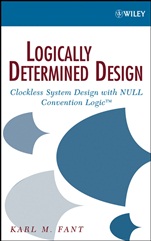
Logically Determined Design: Clockless System Design with NULL Convention Logic
ISBN 9780471684787
Autor: Karl M. Fant
Wydawca: Wiley
Dostępność: 3-6 tygodni
Cena: 740,25 zł
Przed złożeniem zamówienia prosimy o kontakt mailowy celem potwierdzenia ceny.
ISBN13: |
9780471684787 |
ISBN10: |
0471684783 |
Autor: |
Karl M. Fant |
Oprawa: |
Hardback |
Rok Wydania: |
2005-02-22 |
Ilość stron: |
310 |
Wymiary: |
243x168 |
Tematy: |
TJ |
A Revolutionary New Digital System Design Methodology
Logically determined electronic system design is a viable solution to manage the growing complexity of digital design in today′s industry. The author shows how this new clockless design methodology is essential for securing the future economic growth of the digital design industry by removing a costly design factor and opening the door to more reliable and less expensive products. Key features include:An explanation of why Boolean logic is an inadequate conceptual foundation for digital design; how it is compromising the growth of the digital design industry; and why logically determined design is the necessary solutionA conceptual derivation of NULL Convention LogicTM and the basic principles of logically determined designA complete introduction to the basic structures of logically determined design and the methods of composing these structures into a logically determined systemPerformance analysis techniques of a logically determined system and the methodology of optimal system design
Following the author′s logical progression of topics and attention to detail, learn how to design a digital system solely in terms of logical relationships, transcending issues of critical timing and simplifying the design and manufacture of robust and reliable large–scale digital systems.
Not afraid to be controversial, this book successfully challenges the current theoretical foundations of digital system design. This is essential reading for all researchers, practitioners, engineers, and students in the fields of computer system design and electrical engineering.
Spis treści:
Preface.
Acknowledgments.
1. Trusting Logic.
1.1 Mathematicianless Enlivenment of Logic Expression.
1.2 Emulating the Mathematician.
1.3 Supplementing the Expressivity of Boolean Logic.
1.4 Defining a Sufficiently Expressive Logic.
1.5 Th
e Logically Determined System.
1.6 Trusting the Logic: A Methodology of Logical Confidence.
1.7 Summary.
1.8 Exercises.
2. A Sufficiently Expressive Logic.
2.1 Searching for a New Logic.
2.2 Deriving a 3 Value Logic.
2.3 Deriving a 2 Value Logic.
2.4 Compromising Logical Completeness.
2.5 Summary.
3. The Structure of Logically Determined Systems.
3.1 The Cycle.
3.2 Basic Pipeline Structures.
3.3 Control Variables and Wavefront Steering.
3.4 The Logically Determined System.
3.5 Initialization.
3.6 Testing.
3.7 Summary.
3.8 Exercises.
4. 2NCL Combinational Expression.
4.1 Function Classification.
4.2 The Library of 2NCL Operators.
4.3 2NCL Combinational Expression.
4.4 Example 1: Binary Plus Trinary to Quaternary Adder.
4.5 Example 2: Logic Unit.
4.6 Example 3: Minterm Construction.
4.7 Example 4: A Binary Clipper.
4.8 Example 5: A Code Detector.
4.9 Completeness Sufficiency.
4.10 Greater Combinational Composition.
4.11 Directly Mapping Boolean Combinational Expressions.
4.12 Summary.
4.13 Exercises.
5. Cycle Granularity.
5.1 Partitioning Combinational Expressions.
5.2 Partitioning the Data Path.
5.3 Two–dimensional Pipelining: Orthogonal Pipelining Across a Data Path.
5.4 2D Wavefront Behavior.
5.5 2D Pipelined Operations.
5.6 Summary.
5.7 Exercises.
6. Memory Elements.
6.1 The Ring Register.
6.2 Complex Function Registers.
6.3 The Consume/Produce Register Structure.
6.4 The Register File.
6.5 Delay Pipeline Memory.
6.6 Delay Tower.
6.7 FIFO Tower.
6.8 Stack Tower.
6.9 Wrapper for Standard Memory Modules.
6.10 Exercises.
7. State Machines.
7.1 Basic State Machine Structure.
7.2 Exercises.
8. Busses and Networks.
8.1 The Bus.
8.2 A Fan–out Steering Tree.
8.3 Fan–in Steering Trees Do Not Work.
8.4 Arbitrated Steering Structures.
8.5 Concurrent Crossbar Network.
8.
6 Exercises.
9. Multi–value Numeric Design.
9.1 Numeric Representation.
9.2 A Quaternary ALU.
9.3 A Binary ALU.
9.4 Comparison.
9.5 Summary.
9.6 Exercises.
10. The Shadow Model of Pipeline Behavior.
10.1 Pipeline Structure.
10.2 The Pipeline Simulation Model.
10.3 Delays Affecting Throughput.
10.4 The Shadow Model.
10.5 The Value of the Shadow Model.
10.6 Exercises.
11. Pipeline Buffering.
11.1 Enhancing Throughput.
11.2 Buffering for Constant Rate Throughput.
11.3 Summary of Buffering.
11.4 Exercises.
12. Ring Behavior.
12.1 The Pipeline Ring.
12.2 Wavefront–limited Ring Behavior.
12.3 The Cycle–to–Wavefront Ratio.
12.4 Ring Signal Behavior.
13. Interacting Pipeline Structures.
13.1 Preliminaries.
13.2 Example 1: The Basics of a Two–pipeline Structure.
13.3 Example 2: A Wavefront Delay Structure.
13.4 Example 3: Reducing the Period of the Slowest Cycle.
13.5 Exercises.
14. Complex Pipeline Structures.
14.1 Linear Feedback Shift Register Example.
14.2 Grafting Pipelines.
14.3 The LFSR with a Slow Cycle.
14.4 Summary.
14.5 Exercises.
Appendix A: Logically Determined Wavefront Flow.
A.1 Synchronization.
A.2 Wavefronts and Bubbles.
A.3 Wavefront Propagation.
A.4 Extended Simulation of Wavefront Flow.
A.5 Wavefront and Bubble Behavior in a System.
Appendix B: Playing with 2NCL.
B.1 The SR Flip–flop Implementations.
B.2 Initialization.
B.3 Auto–produce and Auto–consume.
Appendix C: Pipeline Simulation.
References.
Index.
Nota biograficzna:
KARL M. FANT is President of Theseus Research, Inc. After serving as a Research Fellow at Honeywell, he co–founded Theseus Research and then Theseus Logic, which is now commercializing NULL Convention LogicTM. He holds twenty–nine patents and has published numerous papers.
Okładka tylna:
A Revolutionary New Digital System Design Methodology
Logically determined electronic system design is a viable solution to manage the growing complexity of digital design in today′s industry. The author shows how this new clockless design methodology is essential for securing the future economic growth of the digital design industry by removing a costly design factor and opening the door to more reliable and less expensive products. Key features include:An explanation of why Boolean logic is an inadequate conceptual foundation for digital design; how it is compromising the growth of the digital design industry; and why logically determined design is the necessary solutionA conceptual derivation of NULL Convention LogicTM and the basic principles of logically determined designA complete introduction to the basic structures of logically determined design and the methods of composing these structures into a logically determined systemPerformance analysis techniques of a logically determined system and the methodology of optimal system design
Following the author′s logical progression of topics and attention to detail, learn how to design a digital system solely in terms of logical relationships, transcending issues of critical timing and simplifying the design and manufacture of robust and reliable large–scale digital systems.
Not afraid to be controversial, this book successfully challenges the current theoretical foundations of digital system design. This is essential reading for all researchers, practitioners, engineers, and students in the fields of computer system design and electrical engineering.
Koszyk
Książek w koszyku: 0 szt.
Wartość zakupów: 0,00 zł
Informacje


Kontakt
Gambit
Centrum Oprogramowania
i Szkoleń Sp. z o.o.
Al. Pokoju 29b/22-24
31-564 Kraków
Siedziba Księgarni
ul. Kordylewskiego 1
31-542 Kraków
+48 12 410 5991
+48 12 410 5987
+48 12 410 5989
Subskrypcje
Administratorem danych osobowych jest firma Gambit COiS Sp. z o.o. Na podany adres będzie wysyłany wyłącznie biuletyn informacyjny.
Autoryzacja płatności

Informacje na temat autoryzacji płatności poprzez PayU.

© Copyright 2012: GAMBIT COiS Sp. z o.o. Wszelkie prawa zastrzeżone.
Projekt i wykonanie: Alchemia Studio Reklamy