


Wydawcy
Katalog tematyczny
- Archeologia (109)
- Ekonomia, finanse, business (13704)
- Filozofia (1445)
- Historia (3040)
- Języki i językoznawstwo (2356)
- Lifestyle, hobby i rozrywka (475)
- Medycyna (9704)
- Nauki humanistyczne (4)
- Nauki o Ziemi i środowisku (2638)
- Nauki ścisłe (20412)
- Astronomia (294)
- Biologia (5119)
- Chemia (6540)
- Chemia analityczna (361)
- Chemia fizyczna (346)
- Chemia nieorganiczna (137)
- Chemia organiczna (535)
- Krystalografia (27)
- Minerologia (46)
- Fizyka (3309)
- Matematyka (4574)
- Nauki ścisłe, ogólnie (503)
- Nauki społeczne (8486)
- Nauki techniczne (13450)
- Prawo (1696)
- Publikacje informacyjne i interdyscyplinarne (1288)
- Religia i wierzenia (917)
- Technika komputerowa (4067)
- Zdrowie, relacje międzyludzkie i rozwój osobisty (657)





Informacje szczegółowe o książce
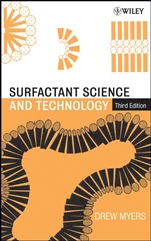
Surfactant Science and Technology
ISBN 9780471680246
Autor: Drew Myers
Wydawca: Wiley
Dostępność: 3-6 tygodni
Cena: 861,00 zł
Przed złożeniem zamówienia prosimy o kontakt mailowy celem potwierdzenia ceny.
ISBN13: |
9780471680246 |
ISBN10: |
0471680249 |
Autor: |
Drew Myers |
Oprawa: |
Hardback |
Rok Wydania: |
2005-11-11 |
Numer Wydania: |
3rd Edition |
Ilość stron: |
400 |
Wymiary: |
244x166 |
Tematy: |
PN |
A general introduction to surfactants, surface activity, and surfactant applications
Important advances in the tools available for studying the activity of surfactants has significantly increased scientific understanding of interfaces at the molecular level. However, there is still much to be learned. In this Third Edition of the successful classic, author and expert Drew Myers combines the latest information available in the field of surfactants with his original, accessible text on the subject.
Now fully updated to reflect recent developments in working with surfactants in both model and practical systems, the Third Edition of Surfactant Science and Technology provides a solid introduction to the field of surfactant science. Written especially for beginners and nonspecialists who would like a practical but not necessarily comprehensive knowledge of the field, this clear, cogent text conveys the most fundamental and useful concepts of surfactant action and application. New chapters bring readers up to date on current biological and medical applications of surfactants, as well as applications in food science, cosmetics, and other areas.
In addition to new chapters, Surfactant Science and Technology includes illustrative problems at the end of each chapter. These problems explain concepts discussed and stimulate imaginative solutions on the part of the reader. A helpful bibliography of supplementary resources for readers who desire more detail has also been included.
Surfactant Science and Technology, Third Edition is an invaluable resource for surface and polymer chemists, chemical and industrial engineers, and a wide range of chemistry students.
Spis treści:
Preface to the Third Edition.
Chapter 1. An Overview of Surfactant Science and Technology.
1.1. A Brief History of Surfactant Science and Technology.
1.2. The Economic Importance of Surfactants.
1.3. Some Traditional and Non–Traditional Applications
of Surfactants.
1.3.1. Detergents and Cleaners.
1.3.2. Cosmetics and Personal Care Products.
1.3.3. Textiles and fibers.
1.3.4. Leather and furs.
1.3.5. Paints, Lacquers and Other Coating Products.
1.3.6. Paper and Cellulose Products.
1.3.7. Mining and Ore Flotation.
1.3.8. Metal Processing Industries.
1.3.9. Plant Protection and Pest Control.
1.3.10. Foods and Food Packaging.
1.3.11. The Chemical Industry.
1.3.12. Oilfields Chemicals and Petroleum Production.
1.3.13. Plastics and Composite Materials.
1.3.14. Pharmaceuticals.
1.3.15. Medicine and Biochemical Research.
1.3.16. Other "Hi–Tech" Areas.
1.4. Surfactant Consumption.
1.5. The Economic and Technological Future.
1.6. Surfactants In the Environment.
1.7. Petrochemical vs. "Renewable" Oleochemical–based Surfactants.
1.8. A Surfactant Glossary.
Chapter 2. The Organic Chemistry of Surfactants.
2.1. Basic Surfactant Building Blocks.
2.1.1. Basic Surfactant Classifications.
2.1.2. Making A Choice.
2.2. The Generic Anatomy of Surfactants.
2.2.1. The Many Faces of Dodecane.
2.2.2. Surfactant Solubilizing Groups.
2.2.3. Common Surfactant Hydrophobic Groups.
2.2.3.1. The Natural Fatty Acids.
2.2.3.2. Saturated Hydrocarbons or Paraffins.
2.2.3.3. Olefins.
2.2.3.4. Alkyl benzenes.
2.2.3.5. Alcohols.
2.2.3.6. Alkyl phenols.
2.2.3.7. Polyoxypropylenes.
2.2.3.8. Fluorocarbons.
2.2.3.9. Silicone Surfactants.
2.2.3.10. Miscellaneous Biological Structures.
2.3. The Systematic Classification of Surfactants.
2.4. Anionic Surfactants.
2.4.1. Sulfate Esters.
2.4.1.1. Fatty Alcohol Sulfates.
2.4.1.2. Sulfated Fatty Acid Condensation Products.
2.4.1.3. Sulfated Ethers.
2.4.1.4. Sulfated Fats and Oils.
2.4.2. Sulfonic Acid Salts.
2.4.2.1. Aliphatic Sulfonates.
2.4.2.2. Alkylaryl Sulfonates.
2.4.2.3. a–Sulfocarboxylic Acids and Their Derivatives.
2.4.2.4. M
iscellaneous Sulfo–Ester and Amide Surfactants.
2.4.2.5. Alkyl Glyceryl Ether Sulfonates.
2.4.2.6. Lignin sulfonates.
2.4.3. Carboxylate Soaps and Detergents.
2.4.4. Phosphoric Acid Esters and Related Surfactants.
2.5. Cationic Surfactants.
2.6. Nonionic Surfactants.
2.6.1. Polyoxyethylene–Based Surfactants.
2.6.2. Derivatives of Polyglycerols and Other Polyols.
2.6.3. Block Copolymer Nonionic Surfactants.
2.6.4. Miscellaneous Nonionic Surfactants.
2.7. Amphoteric Surfactants.
2.7.1. Imidazoline Derivatives.
2.7.2. Surface Active Betaines and Sulfobetaines.
2.7.3. Phosphatides and Related Amphoteric Surfactants.
Problems.
Chapter 3. Fluid Surfaces and Interfaces.
3.1. Molecules At Interfaces.
3.2. Interfaces and Adsorption Phenomena.
3.2.1. A Thermodynamic Picture of Adsorption.
3.2.2. Surface and Interfacial Tensions.
3.2.3. The Effect of Surface Curvature.
3.3. The Surface Tension of Solutions.
3.3.1. Surfactants and the Reduction of Surface Tension.
3.3.2. Efficiency, Effectiveness, and Surfactant Structure.
Problems.
Chapter 4. Surfactants in Solution: Monolayers and Micelles.
4.1. Surfactant Solubility.
4.2. The Phase Spectrum of Surfactants In Solution.
4.3. The History and Development of Micellar Theory.
4.3.1. Manifestations of Micelle Formations.
4.3.2. Thermodynamics of Dilute Surfactant Solutions.
4.3.3. Classical Theories of Micelle Formation.
4.3.4. Free Energy of Micellization.
4.4. Molecular Geometry and the Formation of Association Colloids.
4.5. Experimental Observations of Micellar Systems.
4.5.1. Micellar Aggregation Numbers.
4.5.2. The Critical Micelle Concentration.
4.5.3. The Hydrophobic Group.
4.5.4. The Hydrophilic Group.
4.5.5. Counter–ion Effects on Micellization.
4.5.6. The Effects of Additives On the Micellization Process.
4.5.6.1. Electrolyte Effects on Micelle Formation.
4.5.6.
2. The Effect of pH.
4.5.6.3. The Effects of Added Organic Materials.
4.5.7. The Effect of Temperature On Micellization.
4.6. Micelle Formation In Mixed Surfactant Systems.
4.7. Micelle Formation In Nonaqueous Media.
4.7.1. Aggregation in Polar Organic Solvents.
4.7.2. Micelles in Nonpolar Solvents.
Problems.
Chapter 5. Higher Level Surfactant Aggregate Structures: Liquid Crystals, Continuous Bi–phases, and Microemulsions.
5.1. The Importance of Surfactant Phase Information.
5.2. Amphiphilic Fluids.
5.2.1. Liquid Crystalline, Bicontinuous, and Microemulsion Structures.
5.2.2. "Classical" Liquid Crystals.
5.2.3. Liquid Crystalline Phases in Simple Binary Systems.
5.3. Temperature and Additive Effects on Phase Behavior.
5.4. Some Current Theoretical Analyses of Novel Mesophases.
5.5. Vesicles and Bilayer Membranes.
5.5.1. Vesicles.
5.5.2. Polymerized Vesicles.
5.6. Biological Membranes.
5.6.1. Some Biological Implications of Mesophases.
5.6.2. Membrane Surfactants and Lipids.
5.7. Microemulsions.
5.7.1. Surfactants, Co–surfactants, and Microemulsion Formation.
5.7.1.1. Ionic Surfactant Systems.
5.7.1.2. Nonionic Surfactant Systems.
5.7.2. Applications.
Problems.
Chapter 6. Solubilization and Micellar and Phase Transfer Catalysis.
6.1. Solubilization In Surfactants Micelles.
6.1.1. The "Geography" of Solubilization in Micelles.
6.1.2. Surfactant Structure and the Solubilization Process.
6.1.3. Solubilization and the Nature of the Additive.
6.1.4. The Effect of Temperature on Solubilization Phenomena.
6.1.5. The Effects of Non–electrolyte Solutes.
6.1.6. The Effects of Added Electrolyte.
6.1.7. Miscellaneous Factors Affecting Solubilization.
6.2. Micellar Catalysis.
6.2.1. Micellar Catalysis in Aqueous Solution.
6.2.2. Micellar Catalysis in Nonaqueous Solvents.
6.3. Phase Transfer Catalysis.
6.3.1. Cross–p
Koszyk
Książek w koszyku: 0 szt.
Wartość zakupów: 0,00 zł
Informacje


Kontakt
Gambit
Centrum Oprogramowania
i Szkoleń Sp. z o.o.
Al. Pokoju 29b/22-24
31-564 Kraków
Siedziba Księgarni
ul. Kordylewskiego 1
31-542 Kraków
+48 12 410 5991
+48 12 410 5987
+48 12 410 5989
Subskrypcje
Administratorem danych osobowych jest firma Gambit COiS Sp. z o.o. Na podany adres będzie wysyłany wyłącznie biuletyn informacyjny.
Autoryzacja płatności

Informacje na temat autoryzacji płatności poprzez PayU.

© Copyright 2012: GAMBIT COiS Sp. z o.o. Wszelkie prawa zastrzeżone.
Projekt i wykonanie: Alchemia Studio Reklamy