


Wydawcy
Katalog tematyczny
- Archeologia (109)
- Ekonomia, finanse, business (13704)
- Filozofia (1445)
- Historia (3040)
- Języki i językoznawstwo (2356)
- Lifestyle, hobby i rozrywka (475)
- Medycyna (9704)
- Nauki humanistyczne (4)
- Nauki o Ziemi i środowisku (2638)
- Nauki ścisłe (20412)
- Nauki społeczne (8486)
- Nauki techniczne (13450)
- Budownictwo lądowe (1045)
- Chemia przemysłowa (2258)
- Elektronika i telekomunikacja (3287)
- Energetyka (1122)
- Inne nauki stosowane (363)
- Inżynieria biochemiczna (507)
- Inżynieria transportu (232)
- Mechanika i materiały (3316)
- Nauka o środowisku (321)
- Rolnictwo (507)
- Technika, ogólnie (475)
- Prawo (1696)
- Publikacje informacyjne i interdyscyplinarne (1288)
- Religia i wierzenia (917)
- Technika komputerowa (4067)
- Zdrowie, relacje międzyludzkie i rozwój osobisty (657)





Informacje szczegółowe o książce
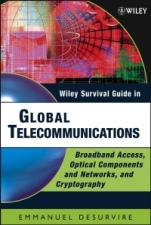
Wiley Survival Guide in Global Telecommunications: Broadband Access, Optical Components and Networks, and Cryptography
ISBN 9780471675204
Autor: Emmanuel Desurvire
Wydawca: Wiley
Dostępność: 3-6 tygodni
Cena: 660,45 zł
Przed złożeniem zamówienia prosimy o kontakt mailowy celem potwierdzenia ceny.
ISBN13: |
9780471675204 |
ISBN10: |
0471675202 |
Autor: |
Emmanuel Desurvire |
Oprawa: |
Hardback |
Rok Wydania: |
2004-10-12 |
Ilość stron: |
560 |
Wymiary: |
240x153 |
Tematy: |
TJ |
A survival guide to global telecommunication technologies
As our world grows ever more complex, no one can expect to be knowledgeable in, let alone master every technology. But as telecommunications technologies permeate nearly every aspect of our lives, gaining a working understanding of their principles and applications has become essential for both professional and personal success. For the undergraduate student preparing for his or her future vocation, as well as the accomplished professional on track for a rapid career move, this book is the "survival guide" to telecommunications–a quick introduction to the most important telecom technologies. Written with accuracy and rigor, this guide avoids any unnecessary background or academic style in order to introduce you directly to the core knowledge and understanding.
Wiley Survival Guide in Global Telecommunications: Broadband Access, Optical Components and Networks, and Cryptography provides in–depth discussions of key areas in telecommunications, including: Broadband wireline access (xDSL flavors, VoDSL, FTTx, xPON, HFC, home networking)Optical communications, from planar/fiber waveguides to passive/active photonic components, including fiber gratings, erbium/Raman fiber amplifiers, E/O switches, semiconductor lasers, SOA–based devices, photoreceivers, and optical cross–connects WDM transport and standards, network integration, protection, evolution, and convergenceCryptography, from ancestral algorithms to modern RSA, DES, and AES, and quantum key distributionCommunications security over the Internet and current/futuristic applications
Designed to be accessible to a wide range of readers, the book steers you directly into the relevant issues, while elucidating the science and engineering involved without heavy–duty mathematics, allowing you to produce results using your pocket calculator. You can read each chapt
er in sequence or, if you prefer, jump to topics of interest as you wish. A wealth of easy and practical exercises illustrate the concepts, chapter–end summaries of main keywords and acronyms clarify the technical language, and a selected reference list including Web sites leads you to other helpful sources for further investigation.
Arm yourself with the knowledge you need to survive in the telecom world by reading this book!
Spis treści:
Foreword.
Preface.
Acronyms.
Introduction: The Network Cloud.
CHAPTER 1 Broadband Wireline Access.
1.1 From Telephone and Cable–TV Networks to the Internet.
1.2 Digital Subscriber Line (DSL).
1.2.1 xDSL Flavors.
1.2.2 DSL Modulation and Coding Schemes.
1.2.3 DSL–signal Physical Impairments.
1.2.4 DSL Transfer Modes and Framing.
1.2.5 xDSL Services.
1.2.6 Voice Over DSL (VoDSL).
1.2.7 Incumbent and Competitive Local–Exchange Carriers (ILEC/CLEC).
1.3 Fiber in the Loop (FITL).
1.3.1 Passive Optical Networks (PON), TDM vs. WDM.
1.3.2 ATM and Ethernet Framing (APON/EPON) and Gigabit–PON (GPON).
1.3.3 Optical Access.
1.3.4 Hybrid Fiber–Coaxial (HFC) Systems.
1.4 Home Networking.
1.4.1 The Evolution of Intelligent Home Appliances.
1.4.2 An Internet Intrusion.
1.4.3 Wiring the House Network.
1.4.4 House–Network Control.
My Vocabulary.
CHAPTER 2. Optical Fiber Communications, Components and Networks.
2.1 Optical Communications: from Wireless to Wireline.
2.1.1 The Early Times of Wireless Optical Communications.
2.1.2 The Conceptual Grounds of Wireline Optical Communications.
2.2 Basic Physics of Light–Wave Signals.
2.2.1 Light’s Electromagnetic Nature.
2.2.2 The Speed of Light.
2.2.3 Light Reflection, Refraction and Polarization.
2.2.4 Classical and Quantum Natures of Light.
2.2.5 Optical Amplification.
2.2.6 Light and Photo–Current Generation in
Semiconductors.
2.2.7 Lasers and Coherent Light Generation.
2.3 Optical Waveguides.
2.3.1 Ray Propagation in Index Layers and Waveguiding.
2.3.2 Mirror Waveguide.
2.3.3 Dielectric Waveguide.
2.3.4 Glass Fiber Waveguides.
2.3.5 Fiber Loss and Dispersion.
2.3.6 Single–Mode Transmission–Fiber Types and Dispersion Compensation.
2.3.7 Polarization–Mode Dispersion (PMD).
2.3.8 Fiber Nonlinearities.
2.4 Passive Optical Components.
2.4.1 Connectors, Couplers, Splitters/Combiners, Multiplexers/Demultiplexers, and Polarization–Based Devices.
2.4.2 Optical Filters.
2.4.3 Compensation and Power Equalization.
2.4.4 Optical Fiber Amplifiers.
2.5 Active Optical Components.
2.5.1 Laser Sources and Transmitters.
2.5.2 Photodetectors and Receivers.
2.5.3 Photonic Switching and Optical Cross–Connects.
2.5.4 All–Optical Signal Regeneration.
2.6 WDM Networks.
2.6.1 Wavelength Standards and Digital Hierarchy.
2.6.2 Point–to–Point WDM Transport.
2.6.3 WDM Network Topology and Wavelength Connectivity.
2.6.4 Network Protection and Virtual–Topology Design.
2.6.5 Network Evolution and Convergence.
Exercises.
My Vocabulary.
CHAPTER 3. Cryptography and Communications Security.
3.1 Message Encryption, Decryption and Cryptanalysis.
3.1.1 Mono– and Multi–Alphabetic Encryption.
3.1.2 Frequency Analysis.
3.1.3 Other Classical Ciphers.
3.2 Modern Cryptography Algorithms.
3.2.1 Encryption With Binary Numbers.
3.2.2 Double–Key Encryption.
3.2.3 Modular–Algebra Basics.
3.2.4 Cryptography Without Key Exchange.
3.2.5 Public–Key Cryptography and RSA.
3.3 Communications Security and Applications.
3.3.1 Data Encryption Standard (DES).
3.3.2 Advanced Encryption Standard (AES).
3.3.3 Other Encryption Algorithms and Standards.
3.3.4 Digital Signature and Authentication.
3.3.5 Network and
Internet Security.
3.3.6 Current and Futuristic Applications of Cryptography.
3.4 Quantum Cryptography.
3.4.1 Photons, Polarization States and Measurements.
3.4.2 Quantum Key Distribution (QKD).
My Vocabulary.
Solutions to Exercises.
Bibliography.
Index.
Nota biograficzna:
EMMANUEL DESURVIRE has been involved in optical telecommunications for nearly twenty years, starting with his PhD work on Raman fiber amplifiers at Thomson–CSF in 1983, followed by post–doctoral research at Stanford University. He then joined AT&T Bell Laboratories for five years, where he led the early investigation and development of erbium–doped fiber amplifiers (EDFA). For his pioneering contributions to EDFAs, he received several national and international awards including the 1994 Prize from the International Commission for Optics and the 1998 Benjamin Franklin Medal in engineering. After a two–year professorship at Columbia University, he joined Alcatel where he conducted research on long–haul soliton transmission and all–optical regeneration, then 40Gbit/s systems development. He also created and directed a corporate program to foster synergies between experts and promote innovation. An IEEE Fellow, he has authored or coauthored more than 200 technical publications, four books, and over thirty patents.
Okładka tylna:
A survival guide to global telecommunication technologies
As our world grows ever more complex, no one can expect to be knowledgeable in, let alone master every technology. But as telecommunications technologies permeate nearly every aspect of our lives, gaining a working understanding of their principles and applications has become essential for both professional and personal success. For the undergraduate student preparing for his or her future vocation, as well as the accomplished professional on track for a rapid career move, this book is the "survival
Koszyk
Książek w koszyku: 0 szt.
Wartość zakupów: 0,00 zł
Informacje


Kontakt
Gambit
Centrum Oprogramowania
i Szkoleń Sp. z o.o.
Al. Pokoju 29b/22-24
31-564 Kraków
Siedziba Księgarni
ul. Kordylewskiego 1
31-542 Kraków
+48 12 410 5991
+48 12 410 5987
+48 12 410 5989
Subskrypcje
Administratorem danych osobowych jest firma Gambit COiS Sp. z o.o. Na podany adres będzie wysyłany wyłącznie biuletyn informacyjny.
Autoryzacja płatności

Informacje na temat autoryzacji płatności poprzez PayU.

© Copyright 2012: GAMBIT COiS Sp. z o.o. Wszelkie prawa zastrzeżone.
Projekt i wykonanie: Alchemia Studio Reklamy