


Wydawcy
Katalog tematyczny
- Archeologia (109)
- Ekonomia, finanse, business (13704)
- Filozofia (1445)
- Historia (3040)
- Języki i językoznawstwo (2356)
- Lifestyle, hobby i rozrywka (475)
- Medycyna (9704)
- Nauki humanistyczne (4)
- Nauki o Ziemi i środowisku (2638)
- Nauki ścisłe (20412)
- Nauki społeczne (8486)
- Nauki techniczne (13450)
- Budownictwo lądowe (1045)
- Chemia przemysłowa (2258)
- Elektronika i telekomunikacja (3287)
- Energetyka (1122)
- Inne nauki stosowane (363)
- Inżynieria biochemiczna (507)
- Inżynieria transportu (232)
- Mechanika i materiały (3316)
- Nauka o środowisku (321)
- Rolnictwo (507)
- Technika, ogólnie (475)
- Prawo (1696)
- Publikacje informacyjne i interdyscyplinarne (1288)
- Religia i wierzenia (917)
- Technika komputerowa (4067)
- Zdrowie, relacje międzyludzkie i rozwój osobisty (657)





Informacje szczegółowe o książce
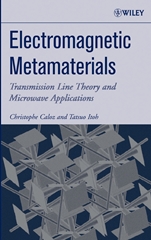
Electromagnetic Metamaterials: Transmission Line Theory and Microwave Applications
ISBN 9780471669852
Autor: Christophe Caloz, Tatsuo Itoh
Wydawca: Wiley
Dostępność: 3-6 tygodni
Cena: 730,80 zł
Przed złożeniem zamówienia prosimy o kontakt mailowy celem potwierdzenia ceny.
ISBN13: |
9780471669852 |
ISBN10: |
0471669857 |
Autor: |
Christophe Caloz, Tatsuo Itoh |
Oprawa: |
Hardback |
Rok Wydania: |
2005-12-16 |
Ilość stron: |
376 |
Wymiary: |
236x165 |
Tematy: |
TJ |
Electromagnetic metamaterials from fundamental physics to advanced engineering applications
This book presents an original generalized transmission line approach associated with non–resonant structures that exhibit larger bandwidths, lower loss, and higher design flexibility. It is based on the novel concept of composite right/left–handed (CRLH) transmission line metamaterials (MMs), which has led to the development of novel guided–wave, radiated–wave, and refracted–wave devices and structures.
The authors introduced this powerful new concept and are therefore able to offer readers deep insight into the fundamental physics needed to fully grasp the technology. Moreover, they provide a host of practical engineering applications.
The book begins with an introductory chapter that places resonant type and transmission line metamaterials in historical perspective. The next six chapters give readers a solid foundation in the fundamentals and practical applications:
Fundamentals of LH MMs describes the fundamental physics and exotic properties of left–handed metamaterials TL Theory of MMs establishes the foundations of CRLH structures in three progressive steps: ideal transmission line, LC network, and real distributed structure Two–Dimensional MMs develops both a transmission matrix method and a transmission line method to address the problem of finite–size 2D metamaterials excited by arbitrary sources Guided–Wave Applications and Radiated–Wave Applications present a number of groundbreaking applications developed by the authors The Future of MMs sets forth an expert view on future challenges and prospectsThis engineering approach to metamaterials paves the way for a new generation of microwave and photonic devices and structures. It is recommended for electrical engineers, as well as physicists and optical engineers, with an interest in practical negative refractive index structures and materials.
Preface.
Acknowledgments.
Acronyms.
1 Introduction.
1.1 Definition of Metamaterials (MTMs) and Left–Handed (LH) MTMs.
1.2 Theoretical Speculation by Viktor Veselago.
1.3 Experimental Demonstration of Left–Handedness.
1.4 Further Numerical and Experimental Confirmations.
1.5 Conventional Backward Waves and Novelty of LH MTMs.
1.6 Terminology.
1.7 Transmission Line (TL) Approach.
1.8 Composite Right/Left–Handed (CRLH) MTMs.
1.9 MTMs and Photonic Band–Gap (PBG) Structures.
1.10 Historical Germs of MTMs.
References.
2 Fundamentals of LH MTMs.
2.1 Left–Handedness from Maxwell s Equations.
2.2 Entropy Conditions in Dispersive Media.
2.3 Boundary Conditions.
2.4 Reversal of Doppler Effect.
2.5 Reversal of Vavilov– Cerenkov Radiation.
2.6 Reversal of Snell s Law: Negative Refraction.
2.7 Focusing by a Flat LH Lens .
2.8 Fresnel Coefficients.
2.9 Reversal of Goos–H¨anchen Effect.
2.10 Reversal of Convergence and Divergence in Convex and Concave Lenses.
2.11 Subwavelength Diffraction.
References.
3 TLTheoryofMTMs.
3.1 Ideal Homogeneous CRLH TLs.
3.1.1 Fundamental TL Characteristics.
3.1.2 Equivalent MTM Constitutive Parameters.
3.1.3 Balanced and Unbalanced Resonances.
3.1.4 Lossy Case.
3.2 LC Network Implementation.
3.2.1 Principle.
3.2.2 Difference with Conventional Filters.
3.2.3 Transmission Matrix Analysis.
3.2.4 Input Impedance.
3.2.5 Cutoff Frequencies.
3.2.6 Analytical Dispersion Relation.
3.2.7 Bloch Impedance.
3.2.8 Effect of Finite Size in the Presence of Imperfect Matching.
3.3 Real Distributed 1D CRLH Structures.
3.3.1 General Design Guidelines.
3.3.2 Microstrip Implementation.
3.3.3 Parameters Extraction.
3.4 Experimental Transmission Characteristics.
3.5 Conversion from Transmission Line to Constitutive Parameters.
References.
4 Two–Dimensional MTMs.
4.1 Eigenvalue Problem.
4.1.1 General Matrix System.
4.1.2 CRLH Particularization.
4.1.3 Lattice Choice, Symmetry Points, Brillouin Zone, and 2D Dispersion Representations.
4.2 Driven Problem by the Transmission Matrix Method (TMM).
4.2.1 Principle of the TMM.
4.2.2 Scattering Parameters.
4.2.3 Voltage and Current Distributions.
4.2.4 Interest and Limitations of the TMM.
4.3 Transmission Line Matrix (TLM) Modeling Method.
4.3.1 TLM Modeling of the Unloaded TL Host Network.
4.3.2 TLM Modeling of the Loaded TL Host Network (CRLH).
4.3.3 Relationship between Material Properties and the TLM Model Parameters.
4.3.4 Suitability of the TLM Approach for MTMs.
4.4 Negative Refractive Index (NRI) Effects.
4.4.1 Negative Phase Velocity.
4.4.2 Negative Refraction.
4.4.3 Negative Focusing.
4.4.4 RH–LH Interface Surface Plasmons.
4.4.5 Reflectors with Unusual Properties.
4.5 Distributed 2D Structures.
4.5.1 Description of Possible Structures.
4.5.2 Dispersion and Propagation Characteristics.
4.5.3 Parameter Extraction.
4.5.4 Distributed Implementation of the NRI Slab.
References.
5 Guided–Wave Applications.
5.1 Dual–Band Components.
5.1.1 Dual–Band Property of CRLH TLs.
5.1.2 Quarter–Wavelength TL and Stubs.
5.1.3 Passive Component Examples: Quadrature Hybrid and Wilkinson Power Divider.
5.1.3.1 Quadrature Hybrid.
5.1.3.2 Wilkinson Power Divider.
5.1.4 Nonlinear Component Example: Quadrature Subharmonically Pumped Mixer.
5.2 Enhanced–Bandwidth Components.
5.2.1 Principle of Bandwidth Enhancement.
5.2.2 Rat–Race Coupler Example.
5.3 Super–compact Multilayer Vertical TL.
5.3.1 Vertical TL Architecture.
5.3.2 TL Performances.
5.3.3 Diplexer Example.
5.4 Tight Edge–Coupled Coupled–Line Couplers (CLCs).
5.4.1 Generalities on Coupled–Line Couplers.
5.4.1.1 TEM and Quasi–TEM Symmetric Coupled–Line Structures with Small Interspacing: Impedance Coupling (IC).
5.4.1.2 Non–TEM Symmetric Coupled–Line Structures with Relatively Large Spacing: Phase Coupling (PC).
5.4.1.3 Summary on Symmetric Coupled–Line Structures.
5.4.1.4 Asymmetric Coupled–Line Structures.
5.4.1.5 Advantages of MTM Couplers.
5.4.2 Symmetric Impedance Coupler.
5.4.3 Asymmetric Phase Coupler.
5.5 Negative and Zeroth–Order Resonator.
5.5.1 Principle.
5.5.2 LC Network Implementation.
5.5.3 Zeroth–Order Resonator Characteristics.
5.5.4 Circuit Theory Verification.
5.5.5 Microstrip Realization.
References.
6 Radiated–Wave Applications.
6.1 Fundamental Aspects of Leaky–Wave Structures.
6.1.1 Principle of Leakage Radiation.
6.1.2 Uniform and Periodic Leaky–Wave Structures.
6.1.2.1 Uniform LW Structures.
6.1.2.2 Periodic LW Structures.
6.1.3 Metamaterial Leaky–Wave Structures.
6.2 Backfire–to–Endfire (BE) Leaky–Wave (LW) Antenna.
6.3 Electronically Scanned BE LW Antenna.
6.3.1 Electronic Scanning Principle.
6.3.2 Electronic Beamwidth Control Principle.
6.3.3 Analysis of the Structure and Results.
6.4 Reflecto–Directive Systems.
6.4.1 Passive Retro–Directive Reflector.
6.4.2 Arbitrary–Angle Frequency Tuned Reflector.
6.4.3 Arbitrary–Angle Electronically Tuned Reflector.
6.5 Two–Dimensional Structures.
6.5.1 Two–Dimensional LW Radiation.
6.5.2 Conical–Beam Antenna.
6.5.3 Full–Space Scanning Antenna.
6.6 Zeroth Order Resonating Antenna.
6.7 Dual–Band CRLH–TL Resonating Ring Antenna.
6.8 Focusing Radiative Meta–Interfaces .
6.8.1 Heterodyne Phased Array.
6.8.2 Nonuniform Leaky–Wave Radiator.
References.
7 The Future of MTMs.
7.1 Real–Artificial Materials: the Challenge of Homogenization.
7.2 Quasi–Optical NRI Lenses and Devices.
7.3 Three–Dimensional Isotropic LH MTMs.
7.4 Optical MTMs.
7.5 Magnetless Magnetic MTMs.
7.6 Terahertz Magnetic MTMs.
7.7 Surface Plasmonic MTMs.
7.8 Antenna Radomes and Frequency Selective Surfaces.
7.9 Nonlinear MTMs.
7.10 Active MTMs.
7.11 Other Topics of Interest.
References.
Index.
CHRISTOPHE CALOZ, PhD, is a Professor at the École Polytechnique de Montréal and a member of the university′s Poly–Grames Research Center. Dr. Caloz has authored or coauthored more than one hundred technical conference and journal papers, and three book chapters. He is also the holder of several patents as well as the Canada Research Chair.
TATSUO ITOH, PhD, is Professor in the Electrical Engineering Department of the University of California, Los Angeles. He has authored hundreds of book chapters and journal articles. He is also the author of a number of prominent publications, including RF Technologies for Low Power Wireless Communications.
Koszyk
Książek w koszyku: 0 szt.
Wartość zakupów: 0,00 zł
Informacje


Kontakt
Gambit
Centrum Oprogramowania
i Szkoleń Sp. z o.o.
Al. Pokoju 29b/22-24
31-564 Kraków
Siedziba Księgarni
ul. Kordylewskiego 1
31-542 Kraków
+48 12 410 5991
+48 12 410 5987
+48 12 410 5989
Subskrypcje
Administratorem danych osobowych jest firma Gambit COiS Sp. z o.o. Na podany adres będzie wysyłany wyłącznie biuletyn informacyjny.
Autoryzacja płatności

Informacje na temat autoryzacji płatności poprzez PayU.

© Copyright 2012: GAMBIT COiS Sp. z o.o. Wszelkie prawa zastrzeżone.
Projekt i wykonanie: Alchemia Studio Reklamy