


Wydawcy
Katalog tematyczny
- Archeologia (109)
- Ekonomia, finanse, business (13704)
- Filozofia (1445)
- Historia (3040)
- Języki i językoznawstwo (2356)
- Lifestyle, hobby i rozrywka (475)
- Medycyna (9704)
- Nauki humanistyczne (4)
- Nauki o Ziemi i środowisku (2638)
- Nauki ścisłe (20412)
- Nauki społeczne (8486)
- Nauki techniczne (13450)
- Budownictwo lądowe (1045)
- Chemia przemysłowa (2258)
- Elektronika i telekomunikacja (3287)
- Energetyka (1122)
- Inne nauki stosowane (363)
- Inżynieria biochemiczna (507)
- Inżynieria transportu (232)
- Mechanika i materiały (3316)
- Nauka o środowisku (321)
- Rolnictwo (507)
- Technika, ogólnie (475)
- Prawo (1696)
- Publikacje informacyjne i interdyscyplinarne (1288)
- Religia i wierzenia (917)
- Technika komputerowa (4067)
- Zdrowie, relacje międzyludzkie i rozwój osobisty (657)





Informacje szczegółowe o książce
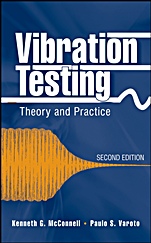
Vibration Testing: Theory and Practice
ISBN 9780471666516
Autor: Kenneth G. McConnell, Paulo S. Varoto
Wydawca: Wiley
Dostępność: 3-6 tygodni
Cena: 962,85 zł
Przed złożeniem zamówienia prosimy o kontakt mailowy celem potwierdzenia ceny.
ISBN13: |
9780471666516 |
ISBN10: |
0471666513 |
Autor: |
Kenneth G. McConnell, Paulo S. Varoto |
Oprawa: |
Hardback |
Rok Wydania: |
2008-10-24 |
Numer Wydania: |
2nd Edition |
Ilość stron: |
672 |
Wymiary: |
241x164 |
Tematy: |
TG |
Vibration Testing: Theory and Practice, Second Edition is a step–by–step guide that shows how to obtain meaningful experimental results via the proper use of modern instrumentation, vibration exciters, and signal–processing equipment, with particular emphasis on how different types of signals are processed with a frequency analyzer. Thoroughly updated, this new edition covers all basic concepts and principles underlying dynamic testing, explains how current instruments and methods operate within the dynamic environment, and describes their behavior in a number of commonly encountered field and laboratory test situations.
Spis treści:
Chapter One: an Overview Of Vibration Testing.
1.1 Introduction.
1.2 Preliminary Considerations.
1.3 General Input/Output Relationships in the Frequency Domain.
1.4 Overview of Equipment Employed.
1.5 Summary.
Chapter Two: Dynamic Signal Analysis.
2.1 Introduction.
2.1.1 Signal Classification.
2.1.2 Temporal Mean Value.
2.1.3 Temporal Mean Square and Temporal Root Mean Square.
2.1.4 The Frequency Spectrum.
2.1.5 Analysis of a Single Sinusoid.
2.2 Phasor Representation of Periodic Functions.
2.2.1 The Phasor.
2.2.2 The Phasor and Real–Valued Sinusoids.
2.3 Periodic Time Histories.
2.3.1 Periodic Fourier Series.
2.3.2 The Mean, Mean Square, and Parseval’s Formula.
2.3.3 Analysis of a Square Wave.
2.4 Transient Signal Analysis.
2.4.1 Difference Between Periodic and Transient Frequency Analysis.
2.4.2 The Transient Fourier Transform.
2.4.3 Transient Mean, Mean Square, And Parseval′s Formula.
2.5 Correlation Concepts – A Statistical Point of View.
2.6 Correlation Concepts – Periodic Time–Histories.
2.6.1 Cross–Correlation.
2.6.2 Auto–Correlation.
2.7 Correlation Concepts – Transient Time–Histories.
2.7.1 Cross–Correlation.
2.7.2 Auto&
#8211;Correlation.
2.8 Correlation Concepts – Random Time Histories.
2.8.1 Auto–Correlation and Auto–Spectral Density.
2.8.3 Correlation and Spectral Densities of Multiple Random Processes.
2.8.4 Statistical Distributions.
2.9 Summary.
2.10 General References on Signal Analysis.
References.
Chapter Three: Vibration Concepts.
3.1 Introduction.
3.2 The Single DOF Model.
3.2.1 Equation of Motion.
3.2.2 Free Undamped Vibration.
3.2.3 Free Damped Vibration.
3.2.4 Structure Orientation and Natural Frequency.
3.3 Single Degree of Freedom Forced Response.
3.3.1 The Viscous Damping Case.
3.3.2 Common Frfs.
3.3.3 Damping Models in Forced Response.
3.3.4 The Structural Damping Response.
3.3.5 The Bode Diagram.
3.3.6 Real & Imaginary Plots and Nyquist Diagrams.
3.4 General Input–Output Model for Linear Systems.
3.4.1 The Frequency–Domain (Fourier Transform) Approach.
3.4.2 The Time–Domain Impulse Response Approach.
3.4.3 Receptance Frf Vs Impulse Response Function.
3.4.4 Random Input–Output Relationships.
3.4.5 Shock Response Spectra.
3.5 The Two Degree of Freedom Vibration Model.
3.5.1 Equations of Motion.
3.5.2 Undamped Natural Frequencies and Mode Shapes.
3.5.3 Steady State Forced Vibration Response (Direct Method).
3.5.4 Steady State Forced Response (Modal Method).
3.5.5 Comparison of Direct and Modal Response FRFs.
3.6 The Second Order Continuous Vibration Model.
3.6.1 The Fundamental Equation of Motion.
3.6.2 Separation of Space and Time Variables.
3.6.3 Orthogonality Conditions.
3.6.4 The Modal Model and Forced Vibrations.
3.6.5 The Generalized Excitation Force for Distributed Loads.
3.6.6 Continuous Model FRFs.
3.7 Fourth Order Continuous Vibration System – The Beam.
3.7.1 The Fundamental Equation of Motion.
3.7.2 Natural Frequencies and Mode Shapes.
3.7.3 Natural Frequencies a
nd Boundary Conditions.
3.7.4 The Modal Model.
3.7.5 The Beam Under Tension.
3.8 Non–Linear Behavior.
3.8.1 The Phase Plane.
3.8.2 The Simple Pendulum.
3.8.3 The Duffing Equation of Forced Vibration.
3.8.4 The Van Der Pol Equation and Limit Cycles.
3.8.5 The Mathieu Equation.
3.8.6 Chaotic Vibration.
3.9 Summary.
References.
Chapter Four: Transducer Measurement Considerations.
4.1 Introduction.
4.2 Fixed Reference Transducers.
4.2.1 The Linear Variable Differential Transformer (LVDT).
4.2.2 The Laser Doppler Vibrometer (LDV).
4.3 Mechanical Model of Seismic Transducers – The Accelerometer.
4.3.1 The Basic Mechanical Model.
4.3.2 Gravity Forces And Acceleration Measurements.
4.4 Piezoelectric Sensor Characteristics.
4.4.1 Basic Circuits and Operational Amplifiers.
4.4.2 Charge Sensitivity Model.
4.4.3 The Charge Amplifier.
4.4.4 Built–In Voltage Followers.
4.4.5 The Overall Accelerometer FRF.
4.5 Combined Linear and Angular Accelerometers.
4.5.1 Using Multiple Accelerometers To Measure Combined.
4.5.2 The Combined Linear And Angular Accelerometer Transducer Response to Transient Inputs.
4.6 Transducer Response to Transient Inputs.
4.6.1 Mechanical Response.
4.6.2 Piezoelectric Circuit Response To Transient Signals.
4.6.3 Field Experience With Shock Loading.
4.7 Accelerometer Cross–Axis Sensitivity.
4.7.1 The Single Accelerometer Cross–Axis Sensitivity Model.
4.7.2 The Tri–Axial Accelerometer Cross–Axis Sensitivity Model.
4.7.3 Correcting Tri–Axial Acceleration Voltage Readings.
4.7.4 FRF Contamination and Its Removal.
4.7.5 Cross Axis Resonance.
4.8 The Force Transducer General Model.
4.8.1 General Electromechanical Model.
4.8.2 Force Transducer Attached to a Fixed Foundation.
4.8.3 The Force Transducer Attached to an Impulse Hammer.
4.8.4 The Force Transducer Used with Vibration Excit
er and Structure.
4.8.5 The Impedance Head.
4.9 Correcting Frf Data For Force Transducer Mass Loading.
4.9.1 A Consistent Force Transducer Model.
4.9.2 Correcting Driving Point Accelerance FRF in Frequency Domain.
4.9.3 Correcting Transfer Accelerance FRFs in Frequency Domain.
4.9.4 Electronic Compensation Using Seismic Acceleration.
4.9.5 Errors Due To Hipp(Ω) Being Nonunity.
4.10 Calibration.
4.10.1 Accelerometer Calibration – Sinusoidal Excitation.
4.10.2 Accelerometer Calibration – Transient Excitation.
4.10.3 Force Transducer – Sinusoidal Excitation.
4.10.4 Force Transducer – Transient Excitation.
4.10.5 Effects of Bending Moments on Measured Forces.
4.11 Environmental Factors.
4.11.1 Base Strain.
4.11.2 Cable Noise.
4.11.3 Humidity and Dirt.
4.11.4 Mounting the Transducer.
4.11.5 Nuclear Radiation.
4.11.6 Temperature.
4.11.7 Transducer Mass.
4.11.8 Transverse Sensitivity.
4.12 Summary.
References.
Chapter Five: The Digital Frequency Analyzer.
5.1 Introduction.
5.2 Basic Processes of A Digital Frequency Analyzer.
5.2.1 The Time Sampling Process.
5.2.2 Time–Domain Multiplication and Frequency–Domain Convolution.
5.2.3 Sample Function Multiplication Gives Aliasing.
5.2.4 The Window Function Creates the Digital Filter Characteristics.
5.2.5 Filter Leakage.
5.3 Digital Analyzer Operating Principles.
5.3.1 Operating Block Diagram.
5.3.2 Internal Calculation Relationships.
5.3.3 Display Scaling.
5.4 Factors In The Application of a Single Channel Analyzer.
5.4.1 Filter Performance Characteristics.
5.4.2 Four Commonly Employed Window Functions.
5.4.3 Window Comparison for Use with Sinusoidal Signals.
5.4.4 Spectral Line Uncertainty.
5.4.5 Recommended Window Usage.
5.5 The Dual Channel Analyzer.
5.5.1 Ideal Input – Output Relationships.
5.5.2 Actual Input–Output Estima
Koszyk
Książek w koszyku: 0 szt.
Wartość zakupów: 0,00 zł
Informacje


Kontakt
Gambit
Centrum Oprogramowania
i Szkoleń Sp. z o.o.
Al. Pokoju 29b/22-24
31-564 Kraków
Siedziba Księgarni
ul. Kordylewskiego 1
31-542 Kraków
+48 12 410 5991
+48 12 410 5987
+48 12 410 5989
Subskrypcje
Administratorem danych osobowych jest firma Gambit COiS Sp. z o.o. Na podany adres będzie wysyłany wyłącznie biuletyn informacyjny.
Autoryzacja płatności

Informacje na temat autoryzacji płatności poprzez PayU.

© Copyright 2012: GAMBIT COiS Sp. z o.o. Wszelkie prawa zastrzeżone.
Projekt i wykonanie: Alchemia Studio Reklamy