


Wydawcy
Katalog tematyczny
- Archeologia (109)
- Ekonomia, finanse, business (13704)
- Filozofia (1445)
- Historia (3040)
- Języki i językoznawstwo (2356)
- Lifestyle, hobby i rozrywka (475)
- Medycyna (9704)
- Nauki humanistyczne (4)
- Nauki o Ziemi i środowisku (2638)
- Nauki ścisłe (20412)
- Nauki społeczne (8486)
- Nauki techniczne (13450)
- Budownictwo lądowe (1045)
- Chemia przemysłowa (2258)
- Elektronika i telekomunikacja (3287)
- Energetyka (1122)
- Inne nauki stosowane (363)
- Inżynieria biochemiczna (507)
- Inżynieria transportu (232)
- Mechanika i materiały (3316)
- Nauka o środowisku (321)
- Rolnictwo (507)
- Technika, ogólnie (475)
- Prawo (1696)
- Publikacje informacyjne i interdyscyplinarne (1288)
- Religia i wierzenia (917)
- Technika komputerowa (4067)
- Zdrowie, relacje międzyludzkie i rozwój osobisty (657)





Informacje szczegółowe o książce
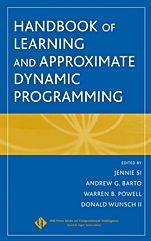
Handbook of Learning and Approximate Dynamic Programming
ISBN 9780471660545
Autor: Jennie Si, Andrew G. Barto, Warren B. Powell, Don Wunsch
Wydawca: Wiley
Dostępność: 3-6 tygodni
Cena: 822,15 zł
Przed złożeniem zamówienia prosimy o kontakt mailowy celem potwierdzenia ceny.
ISBN13: |
9780471660545 |
ISBN10: |
047166054X |
Autor: |
Jennie Si, Andrew G. Barto, Warren B. Powell, Don Wunsch |
Oprawa: |
Hardback |
Rok Wydania: |
2004-08-10 |
Ilość stron: |
672 |
Wymiary: |
247x157 |
Tematy: |
TJ |
Approximate dynamic programming solves decision and control problems
While advances in science and engineering have enabled us to design and build complex systems, how to control and optimize them remains a challenge. This was made clear, for example, by the major power outage across dozens of cities in the Eastern United States and Canada in August of 2003. Learning and approximate dynamic programming (ADP) is emerging as one of the most promising mathematical and computational approaches to solve nonlinear, large–scale, dynamic control problems under uncertainty. It draws heavily both on rigorous mathematics and on biological inspiration and parallels, and helps unify new developments across many disciplines.
The foundations of learning and approximate dynamic programming have evolved from several fields–optimal control, artificial intelligence (reinforcement learning), operations research (dynamic programming), and stochastic approximation methods (neural networks). Applications of these methods span engineering, economics, business, and computer science. In this volume, leading experts in the field summarize the latest research in areas including:Reinforcement learning and its relationship to supervised learningModel–based adaptive critic designsDirect neural dynamic programmingHierarchical decision–makingMultistage stochastic linear programming for resource allocation problemsConcurrency, multiagency, and partial observabilityBackpropagation through time and derivative adaptive criticsApplications of approximate dynamic programming and reinforcement learning in control–constrained agile missiles; power systems; heating, ventilation, and air conditioning; helicopter flight control; transportation and more.
Spis treści:
Foreword.
1. ADP: goals, opportunities and principles.
Part I: Overview.
2. Reinforcement l
earning and its relationship to supervised learning.
3. Model–based adaptive critic designs.
4. Guidance in the use of adaptive critics for control.
5. Direct neural dynamic programming.
6. The linear programming approach to approximate dynamic programming.
7. Reinforcement learning in large, high–dimensional state spaces.
8. Hierarchical decision making.
Part II: Technical advances.
9. Improved temporal difference methods with linear function approximation.
10. Approximate dynamic programming for high–dimensional resource allocation problems.
11. Hierarchical approaches to concurrency, multiagency, and partial observability.
12. Learning and optimization – from a system theoretic perspective.
13. Robust reinforcement learning using integral–quadratic constraints.
14. Supervised actor–critic reinforcement learning.
15. BPTT and DAC – a common framework for comparison.
Part III: Applications.
16. Near–optimal control via reinforcement learning.
17. Multiobjective control problems by reinforcement learning.
18. Adaptive critic based neural network for control–constrained agile missile.
19. Applications of approximate dynamic programming in power systems control.
20. Robust reinforcement learning for heating, ventilation, and air conditioning control of buildings.
21. Helicopter flight control using direct neural dynamic programming.
22. Toward dynamic stochastic optimal power flow.
23. Control, optimization, security, and self–healing of benchmark power systems.
Nota biograficzna:
JENNIE SI is Professor of Electrical Engineering, Arizona State University, Tempe, AZ. She is director of Intelligent Systems Laboratory, which focuses on analysis and design of learning and adaptive systems. In addition to her own publications, she is the Associate Editor for IEEE Transactions on Neural Networks, and past Associate
Editor for IEEE Transactions on Automatic Control and IEEE Transactions on Semiconductor Manufacturing. She was the co–chair for the 2002 NSF Workshop on Learning and Approximate Dynamic Programming.
ANDREW G. BARTO is Professor of Computer Science, University of Massachusetts, Amherst. He is co–director of the Autonomous Learning Laboratory, which carries out interdisciplinary research on machine learning and modeling of biological learning. He is a core faculty member of the Neuroscience and Behavior Program of the University of Massachusetts and was the co–chair for the 2002 NSF Workshop on Learning and Approximate Dynamic Programming. He currently serves as an associate editor of Neural Computation.
WARREN B. POWELL is Professor of Operations Research and Financial Engineering at Princeton University. He is director of CASTLE Laboratory, which focuses on real–time optimization of complex dynamic systems arising in transportation and logistics.
DONALD C. WUNSCH is the Mary K. Finley Missouri Distinguished Professor in the Electrical and Computer Engineering Department at the University of Missouri, Rolla. He heads the Applied Computational Intelligence Laboratory and also has a joint appointment in Computer Science, and is President–Elect of the International Neural Networks Society.
Okładka tylna:
Approximate dynamic programming solves decision and control problems
While advances in science and engineering have enabled us to design and build complex systems, how to control and optimize them remains a challenge. This was made clear, for example, by the major power outage across dozens of cities in the Eastern United States and Canada in August of 2003. Learning and approximate dynamic programming (ADP) is emerging as one of the most promising mathematical and computational approaches to solve nonlinear, large–scale, dynamic control problems under uncertainty. It draws heavily both on rigorous
mathematics and on biological inspiration and parallels, and helps unify new developments across many disciplines.
The foundations of learning and approximate dynamic programming have evolved from several fields–optimal control, artificial intelligence (reinforcement learning), operations research (dynamic programming), and stochastic approximation methods (neural networks). Applications of these methods span engineering, economics, business, and computer science. In this volume, leading experts in the field summarize the latest research in areas including:Reinforcement learning and its relationship to supervised learningModel–based adaptive critic designsDirect neural dynamic programmingHierarchical decision–makingMultistage stochastic linear programming for resource allocation problemsConcurrency, multiagency, and partial observabilityBackpropagation through time and derivative adaptive criticsApplications of approximate dynamic programming and reinforcement learning in control–constrained agile missiles; power systems; heating, ventilation, and air conditioning; helicopter flight control; transportation and more.
Koszyk
Książek w koszyku: 0 szt.
Wartość zakupów: 0,00 zł
Informacje


Kontakt
Gambit
Centrum Oprogramowania
i Szkoleń Sp. z o.o.
Al. Pokoju 29b/22-24
31-564 Kraków
Siedziba Księgarni
ul. Kordylewskiego 1
31-542 Kraków
+48 12 410 5991
+48 12 410 5987
+48 12 410 5989
Subskrypcje
Administratorem danych osobowych jest firma Gambit COiS Sp. z o.o. Na podany adres będzie wysyłany wyłącznie biuletyn informacyjny.
Autoryzacja płatności

Informacje na temat autoryzacji płatności poprzez PayU.

© Copyright 2012: GAMBIT COiS Sp. z o.o. Wszelkie prawa zastrzeżone.
Projekt i wykonanie: Alchemia Studio Reklamy